- Type
- Lesson plan
- Subject
- History & Social Studies
- Ages
- Ages 6-10
- Includes
- Quiz: 5 questions
How do mathematical patterns and teamwork help us construct an authentic Ancient Egyptian pyramid?
Overview
In this Ancient Egypt history and geography lesson, students explore the monumental architecture of pharaohs by examining how pyramids were constructed. Learners analyze geometric patterns behind layered structures, identifying how odd square numbers dictate the block count for each descending tier.
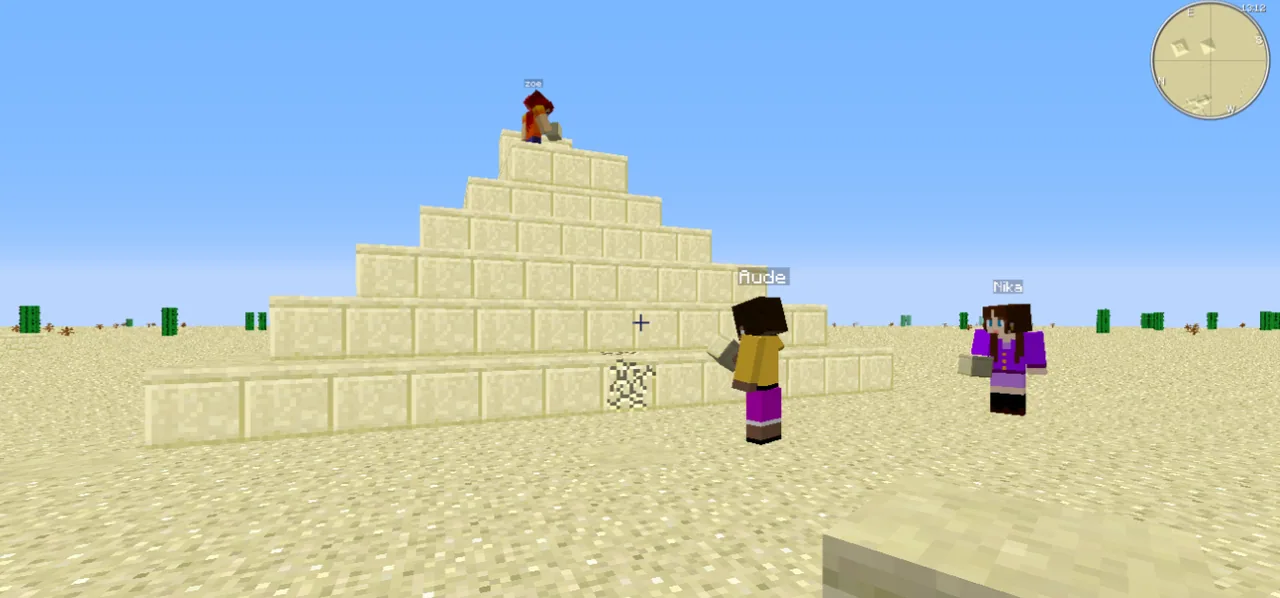
Working together in a shared blank Minecraft world, student teams select historically fitting materials like sandstone and coordinate their construction. They practice communication and project management while applying mathematical reasoning to build an even, hollow or solid stepped pyramid.
Learning objectives
By the end of this lesson students will be able to:
- Identify authentic building materials used for Ancient Egyptian pyramids, such as sandstone.
- Calculate block requirements for pyramid tiers using odd square number patterns.
- Build a mathematically even 3D pyramid with a square base alongside team members.
- Communicate and allocate tasks effectively to manage group building time.
Blocks and items used in this lesson


Key vocabulary
- Square Number
- The product of a number multiplied by itself, such as one, nine, and twenty-five.
- Sandstone
- A sedimentary rock made of sand grains, widely used to construct ancient monuments.
- Perimeter
- The total distance around the outside edge of a flat shape.
- Tier
- One of several levels or layers arranged on top of another.
Before class
Lesson sequence
- The Pharaoh's Challenge
Introduce the building challenge by explaining that student teams will construct a grand monument fit for an Egyptian pharaoh. Explain that teams showing high precision, steady pace, and strong collaboration will earn special pharaonic tokens.
- Pattern Exploration
Guide students through the math of a stepped pyramid using physical cubes where possible. Show that level one needs 1 cube, level two needs 9 cubes, and level three needs 25 cubes, helping them spot the sequence of odd square numbers. Ask groups to determine the block count for lower levels of a five- or six-tier design.
- Material and Architectural Planning
Review in-game blocks and evaluate their visual look and strength compared to historical structures, agreeing that sandstone is ideal. Remind groups to decide their base perimeter and clarify that leaving the interior hollow saves time and resources. Instruct teams not to dig interior tomb chambers during this stage.
- Collaborative Pyramid Build
Have teams load into a blank world, claim their construction zones, and begin laying down the square foundation. Monitor how students divide labor, verify layer dimensions, and communicate to ensure each tier steps inward evenly.
- Review and Extensions
Gather students to assess finished structures against mathematical accuracy and material choices. Teams that finish early can add exterior decorations or hire themselves out as contract builders to assist other groups.
Assessment: success criteria
- The pyramid is built from a suitable material, specifically sandstone.
- The pyramid features a square base and symmetrical, mathematically consistent steps at each level.
- Team members communicate clearly, distribute building roles, and manage time effectively.
- Students can explain the number pattern governing each layer of their structure.
Differentiation
Use physical building cubes to help learners model and count the 1, 9, and 25 block patterns before placing blocks in the game.
Challenge advanced builders to design and construct a Sphinx using reference pictures and paper sketches to map 3D limbs and colored headdress blocks.
Knowledge check
5 questions to check understanding after the lesson. Tap an answer to see if it is right; the score appears at the end.
1Which block is highlighted as the most historically fitting choice for building the pyramid?
Answer: B. The lesson discusses pros and cons of materials and identifies sandstone as the best choice.
2How many blocks make up the top two levels of the pyramid combined?
Answer: C. The top level uses 1 block and the second level uses 9 blocks, totaling 10 blocks.
3What number pattern governs the block count of the pyramid levels?
Answer: C. The layers follow odd squares: 1 squared is 1, 3 squared is 9, and 5 squared is 25.
4What construction tip is suggested to help teams complete their build faster?
Answer: A. The source notes that groups do not need to fill in the interior of the pyramid.
5Which secondary building task is offered for advanced Minecraft builders?
Answer: C. Stronger builders are given the enrichment challenge of planning and constructing a Sphinx.
Frequently Asked Questions
Should students build burial chambers or tombs inside the pyramids during this lesson?
No. The instructions specifically state that groups must not dig into their pyramids to create tombs yet, as this forms part of a later lesson in the sequence.
Do I need to download a custom Minecraft world template for this activity?
No. The lesson is designed to run in a standard blank or flat world where teams simply find an open area and start building.
How can teams that finish early stay engaged?
Early finishers can decorate the ground surrounding their pyramid or act as hired contract builders to assist teams needing extra support.
Adapted from Pyramid Building 1 by Steve Bambury on Minecraft Education, last updated Nov 20, 2016. This classroom version, the timings and the quiz were written by 9Minecraft Education.