- Type
- Lesson plan
- Ages
- Ages 8-13
- Duration
- about 1.7 hours (suggested)
- Includes
- Quiz: 5 questionsMinecraft world
How does population growth impact local land use and natural resources over time?
Overview
Human population growth places significant demands on natural spaces and community resources. In this lesson, students explore the connection between population numbers and their local environment, considering factors like agriculture, water supply, wildlife, and waste management from 1950 to the modern day.
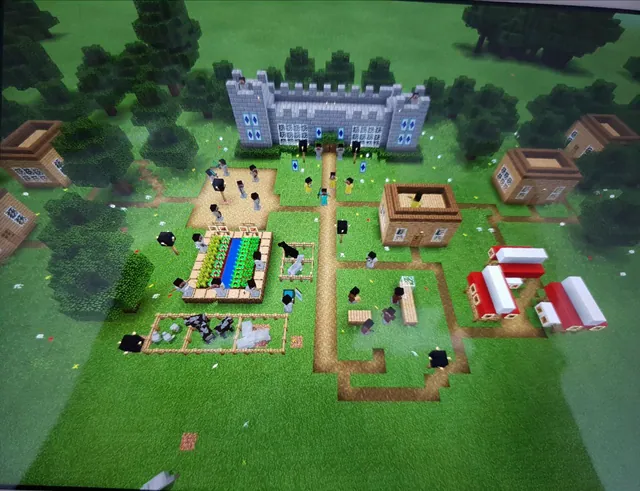
Using Minecraft, learners construct a model of their local community representing either 1950 or the present era. Through their builds, students illustrate how expansion affects surrounding ecosystems and discover the importance of using land efficiently.
Learning objectives
By the end of this lesson students will be able to:
- Identify how overpopulation influences atmosphere, agriculture, water systems, waste, ecosystems, and animals.
- Model a local community in Minecraft reflecting land use conditions from either 1950 or the present day.
- Compare historical and modern land design to understand changes in land efficiency.
- Document and explain world features using screenshots or screencast recordings.
Blocks and items used in this lesson


Key vocabulary
- Overpopulation
- A situation where the number of people exceeds the capacity of the environment to provide necessary resources.
- Ecosystem
- A community of living organisms interacting with their physical, non-living environment.
- Agriculture
- The practice of cultivating land, growing crops, and raising livestock for human consumption.
- Water Systems
- Natural or human-made networks that supply, route, and store water, such as rivers, lakes, and drainage channels.
Before class
Lesson sequence
Suggested timing: about 100 minutes in total.
- Whole-Class Introduction15 min
Introduce the topic of global population growth, noting that the world population in 1950 was roughly 2.55 billion. Guide a discussion using images of your local community from 1950 compared to current numbers, prompting students to consider how population shifts affect the atmosphere, farming, water, waste, and wildlife.
- Paper Arrow Circle Activity15 min
Have students stand shoulder-to-shoulder in a circle with a central sign labeled overpopulation. Distribute paper arrows labeled with specific impact terms. Students take turns explaining how their term relates to overpopulation, connecting their arrows on the floor to form a linked circle around the center.
- Community Land Research15 min
Direct students to look up historical or modern population figures for their chosen local area. Allow them to use Population City to examine future population projections and contextualize land use changes.
- Minecraft Build Phase40 min
Students work individually or in collaborative groups to construct an area of their local community under one of two options:
- Option 1: Recreate the community as it appeared in 1950.
- Option 2: Recreate the community in present day.
Each design must visibly show the effects of human population on at least one key area: atmosphere, agriculture, water systems, waste, ecosystems, or animals.
- Documentation and Reflection15 min
Students capture screencasts or screenshots of their Minecraft builds. They present their builds to peers or write descriptions detailing the features included and explaining how population pressure shaped their chosen region.
Assessment: success criteria
- Student articulates how their assigned arrow term connects to overpopulation during the circle activity.
- Minecraft build clearly demonstrates land design from either 1950 or the modern era.
- Build displays the specific impact of population on at least one chosen area (atmosphere, agriculture, water, waste, ecosystems, or animals).
- Student submits screenshots or a screencast describing their community model and its environmental changes.
Differentiation
Allow students to work in pairs focusing on a single, concrete category like waste or agriculture using pre-selected historical photos.
Have students calculate the mathematical change in community land density since 1950 or record a public service announcement video suggesting solutions to overpopulation challenges.
Knowledge check
5 questions to check understanding after the lesson. Tap an answer to see if it is right; the score appears at the end.
1What is described in the lesson as the primary environmental challenge facing the planet today?
Answer: B. The lesson introduction states that human overpopulation across the globe is the number one issue facing the environment.
2What was the approximate global human population in 1950 according to the lesson?
Answer: D. The source identifies the 1950 world population as 2,555,982,611.
3Where do students place the label for overpopulation during the arrow activity?
Answer: A. Students stand in a circle and place the paper labeled overpopulation in the middle on the floor.
4What two historical timeframes can students choose between for their Minecraft build?
Answer: C. The activity gives students the choice to model their local community in 1950 or in present day.
5Which of the following is one of the six specific areas students can illustrate in their builds?
Answer: B. Water systems is explicitly listed as one of the six areas affected by overpopulation.
Resources
Frequently Asked Questions
Can students work in groups during the Minecraft building task?
Yes. The lesson provides the option for students to complete their community design either independently or within a cooperative group.
What evidence should students submit to show what they built?
Students capture screenshots or record a screencast of their Minecraft build, accompanied by an explanation of the specific land features and how population impacted them.
Adapted from Preventing Urban Spread by Minecraft Education on Minecraft Education, last updated Sep 15, 2023. This classroom version, the timings and the quiz were written by 9Minecraft Education.