- Type
- Lesson plan
- Subject
- Science
- Topics
- Science
- Grade
- Primary (Grades 3-5)
- Ages
- Ages 8-10
- Duration
- about 60 min (suggested)
How can we design systems to reduce the impact of a volcanic eruption while protecting the local ecosystem?
Overview
Volcanic eruptions represent catastrophic natural hazards that dramatically alter human settlements and natural habitats. In this lesson, students engage with the science and engineering cycle to investigate how technological solutions can mitigate the destructive forces of an eruption. Rather than focusing solely on defense, learners evaluate how protective systems can keep communities safe without causing unintended negative side effects to the surrounding environment.
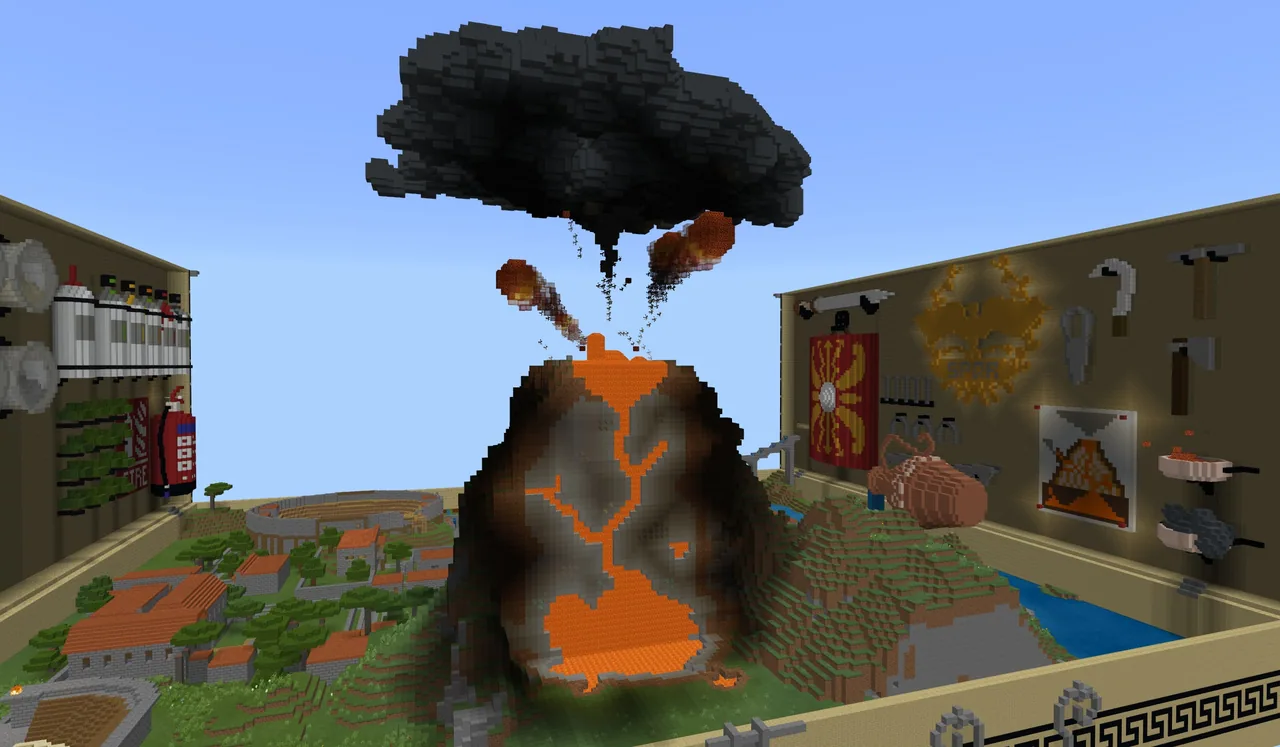
Using Minecraft: Education Edition, students load an intact, pre-eruption model of Pompeii from the Pompeii Toybox world. After planning their designs, students construct their mitigation systems within the settlement and trigger a simulated eruption using in-game code. By observing how their builds withstand the event and identifying performance flaws, students iteratively refine their structures based on direct evidence.
Learning objectives
By the end of this lesson students will be able to:
- Design a mitigation system in Minecraft to protect modern Pompeii from volcanic hazards.
- Test and refine protective builds by running the eruption simulation code and gathering observational evidence.
- Identify technical limitations and unintended consequences of proposed designs on local ecosystems.
- Present recommended solutions and evidence-based improvements to peers.
Blocks and items used in this lesson


Key vocabulary
- Mitigation
- Actions taken to reduce the severity, damage, or negative impact of natural hazards.
- Ecosystem
- A community of living organisms interacting together with their physical environment.
- Science Cycle
- A continuous process of asking questions, testing ideas, observing evidence, and refining models.
- Limitation
- A weakness, constraint, or boundary that prevents a system from working perfectly.
Before class
Lesson sequence
Suggested timing: about 60 minutes in total.
- Introduction and Review10 min
Review student observations from previous lessons regarding Mount Vesuvius and the effects of volcanic activity on ecosystems. Introduce the guiding questions: How can people reduce the impact of a volcanic eruption? and What additional impact does your proposed solution have on the ecosystem?
- In-Game Construction20 min
Direct students to launch Minecraft: Education Edition and load a fresh version of the Pompeii Toybox world. Students work individually or in teams to construct their planned mitigation structures around the pre-eruption landscape.
- Simulation and Evidence Gathering15 min
Have students trigger the eruption simulation by running the established code. Students observe the interaction between the volcanic hazards and their protective build, recording evidence of success and identifying structural failure points.
- Refine, Iterate, and Share15 min
Students analyze the limitations of their builds, solicit peer feedback, and reset the world as needed to rebuild and test refined solutions. Close the session by having teams summarize their refinements and ecological considerations.
Assessment: success criteria
- Constructs a functional mitigation build inside the pre-eruption Minecraft Pompeii world.
- Executes the eruption simulation code to test structural durability and community safety.
- Identifies concrete limitations and ecological impacts of the proposed system.
- Demonstrates iterative refinement of the design using observational evidence.
Differentiation
Allow students to work in pairs or small teams to share building responsibilities and discuss peer feedback during testing.
Challenge students to build physical volcano models from plaster to experiment with hands-on simulated eruptions.
Knowledge check
5 questions to check understanding after the lesson. Tap an answer to see if it is right; the score appears at the end.
1Why is it important to start the build phase with a fresh copy of the Pompeii Toybox world?
Answer: B. Starting with a fresh world resets Pompeii to its pre-eruption condition so students can test their designs from baseline.
2How do students test their protective structures inside the Minecraft world?
Answer: C. The lesson specifies testing designs against the eruption by executing the same simulation code introduced in Lesson 1.
3Besides human safety, what critical factor must students consider when designing their mitigation systems?
Answer: A. Students are tasked with designing solutions that protect people without negatively affecting the local ecosystem.
4What should students do when they discover weaknesses or limitations in their design during the eruption?
Answer: B. The science cycle requires students to analyze limitations and rebuild or refine their solutions based on evidence.
5How does peer observation support the engineering and design process in this lesson?
Answer: A. Receiving peer feedback allows builders to gather insights from outside observers to refine their work.
Resources
- Lesson package (.zip)Everything the author attached to this lesson in one download.
- Pompeii Toybox RubricResource
Frequently Asked Questions
Is there a formal graded assessment included in this lesson?
No formal grading takes place during Lesson 4. The teacher monitors student testing, data collection, and redesign efforts, while final grading occurs in Lesson 5 using the Pompeii Toybox Rubric.
What should students do if an eruption completely destroys their build?
Students simply import a fresh copy of the Pompeii Toybox world to reset the map, apply lessons learned from the failure, and rebuild an improved version before re-running the test.
Adapted from Pompeii Toybox Lesson 4 of 5 by Phygital Labs on Minecraft Education, last updated Jul 14, 2022. This classroom version, the timings and the quiz were written by 9Minecraft Education.