- Type
- Lesson plan
- Subject
- Science
- Topics
- Science
- Grade
- Primary (Grades 3-5)
- Ages
- Ages 8-10
- Duration
- about 60 min (suggested)
How do volcanic eruptions disrupt an ecosystem?
Overview
In this second lesson of the Pompeii Toybox series, students explore how natural volcanic hazards alter both living and non-living parts of an ecosystem. By gathering empirical evidence across multiple historical events, learners examine environmental disruptions and consider what goals should guide intervention efforts.
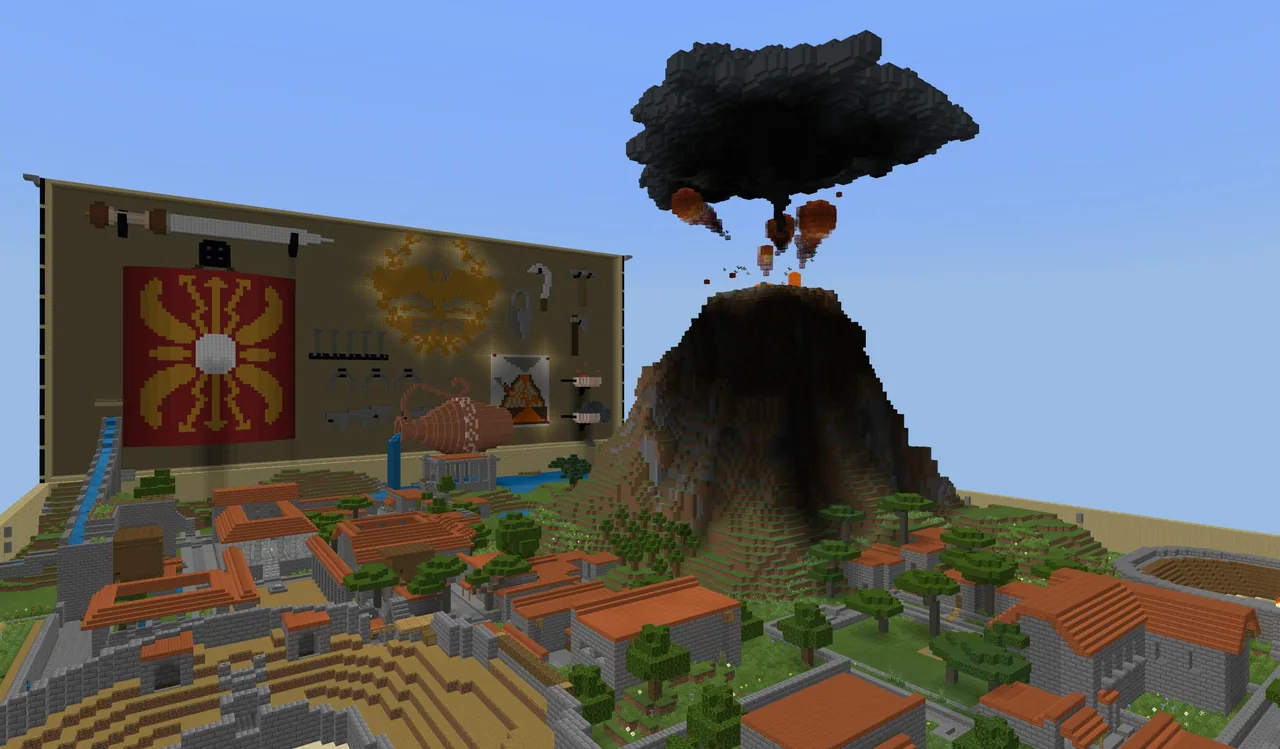
Students return to the simulation world to locate Pliny the Younger on an aqueduct ledge. Through links provided by this character, students research four real-world volcanoes—Mount Vesuvius, Mount St. Helens, Eldfell, and Mauna Loa—taking structured notes to prepare for designing mitigation solutions in upcoming lessons.
Learning objectives
By the end of this lesson students will be able to:
- Identify how volcanic eruptions alter and disrupt local ecosystems.
- Gather scientific evidence from case studies on Mount Vesuvius, Mount St. Helens, Eldfell, and Mauna Loa.
- Analyze research data using structured notes to identify ecosystem impacts.
- Contribute evidence-based arguments to a class discussion regarding environmental protection.
Blocks and items used in this lesson


Key vocabulary
- Ecosystem
- A biological community of living organisms interacting with the non-living elements of their environment.
- Science Cycle
- A systematic inquiry method involving question generation, observation, evidence gathering, and data analysis.
- Natural Hazard
- A natural phenomenon or event that carries the potential to negatively impact living things and habitats.
Before class
Lesson sequence
Suggested timing: about 60 minutes in total.
- Locate NPC and Set Inquiry Focus10 min
Students log into their world from Lesson 1 and navigate to the aqueduct ledge to find the non-player character Pliny the Younger. Review the guiding question and prompt students to generate initial questions regarding environmental disruptions.
- Research and Evidence Gathering30 min
Using the buttons on Pliny the Younger, students open and read articles covering Mount Vesuvius, Mount St. Helens, Eldfell, and Mauna Loa. Students record observations and data in their note-taking templates, identifying ecosystem damage and evaluating how past communities handled eruptions.
- Socratic Seminar Discussion15 min
Gather the class for a Socratic Seminar. Prompt students with discussion questions exploring the greatest ecological impacts, what elements are most essential to protect, past mitigation solutions, and key goals for environmental intervention.
- Wrap-Up and File Preparation5 min
Collect or inspect student notes for assessment. Direct all learners to download and import a fresh copy of the Pompeii Toybox world to prepare for the engineering challenges in Lesson 3.
Assessment: success criteria
- Student notes demonstrate thorough research from all four volcanic case studies as well as the in-game simulation.
- Notes clearly answer the guiding question by detailing specific volcanic impacts on ecosystems.
- Student contributions in the class discussion are supported by empirical evidence and scientific reasoning.
Differentiation
Encourage students to activate reading view or text-to-speech tools in their web browser to make the articles easier to process.
Have students map the worldwide locations of these volcanoes to identify geographic patterns connecting Earth features with volcanic activity.
Knowledge check
5 questions to check understanding after the lesson. Tap an answer to see if it is right; the score appears at the end.
1In the Minecraft world, where can students locate the non-player character Pliny the Younger?
Answer: C. Pliny the Younger is situated on the ledge overlooking the aqueduct.
2Which group of volcanoes are students tasked with reading about?
Answer: A. The links provided by Pliny the Younger direct students to articles on Mount Vesuvius, Mount St. Helens, Eldfell, and Mauna Loa.
3What core question directs student research and discussion throughout this lesson?
Answer: D. The driving question carried over from the first lesson asks how volcanic eruptions disrupt an ecosystem.
4What discussion model does the lesson recommend to help students reflect on their findings?
Answer: B. The lesson suggests using a Socratic Seminar format so learners can share openly and extend their thinking.
5What technical step should students take at the end of the lesson to prepare for Lesson 3?
Answer: A. Students are instructed to download and import a fresh copy of the world file before starting the next lesson.
Resources
- Lesson package (.zip)Everything the author attached to this lesson in one download.
- Pompeii Toybox RubricResource
Frequently Asked Questions
Do students build any defensive structures in Minecraft during this lesson?
No. This lesson focuses on gathering evidence, analyzing scientific data from historical eruptions, and holding a collaborative discussion to prepare for system design in later lessons.
What specific stages of the science cycle are practiced in Lesson 2?
Students practice generating questions, making observations, gathering evidence from case studies, and analyzing data.
Adapted from Pompeii Toybox Lesson 2 of 5 by Phygital Labs on Minecraft Education, last updated Jul 14, 2022. This classroom version, the timings and the quiz were written by 9Minecraft Education.