- Type
- Lesson plan
- Subject
- Science
- Topics
- Science
- Grade
- Primary (Grades 3-5)
- Ages
- Ages 8-10
- Duration
- about 60 min (suggested)
How do volcanic eruptions disrupt an ecosystem?
Overview
Volcanic eruptions represent catastrophic natural events that rapidly alter local environments. In this introductory lesson of a five-part unit, learners investigate how volcanic activity upsets an ecosystem by examining both natural physical changes and their immediate consequences on living organisms.Learning objectives
By the end of this lesson students will be able to:
- Observe the structural layout of Pompeii and its surroundings prior to a volcanic eruption.
- Record cause-and-effect observations of environmental changes caused by a simulated eruption.
- Identify how volcanic hazards such as ash, lava, and extreme heat disrupt living organisms within an ecosystem.
Blocks and items used in this lesson


Key vocabulary
- Ecosystem
- A biological community of interacting organisms and their physical environment.
- Natural hazard
- A natural event or process that has the potential to cause harm to humans and the environment.
- Simulation
- An interactive model designed to demonstrate how a real-world system or event operates.
Before class
Lesson sequence
Suggested timing: about 60 minutes in total.
- Pre-Eruption Exploration15 min
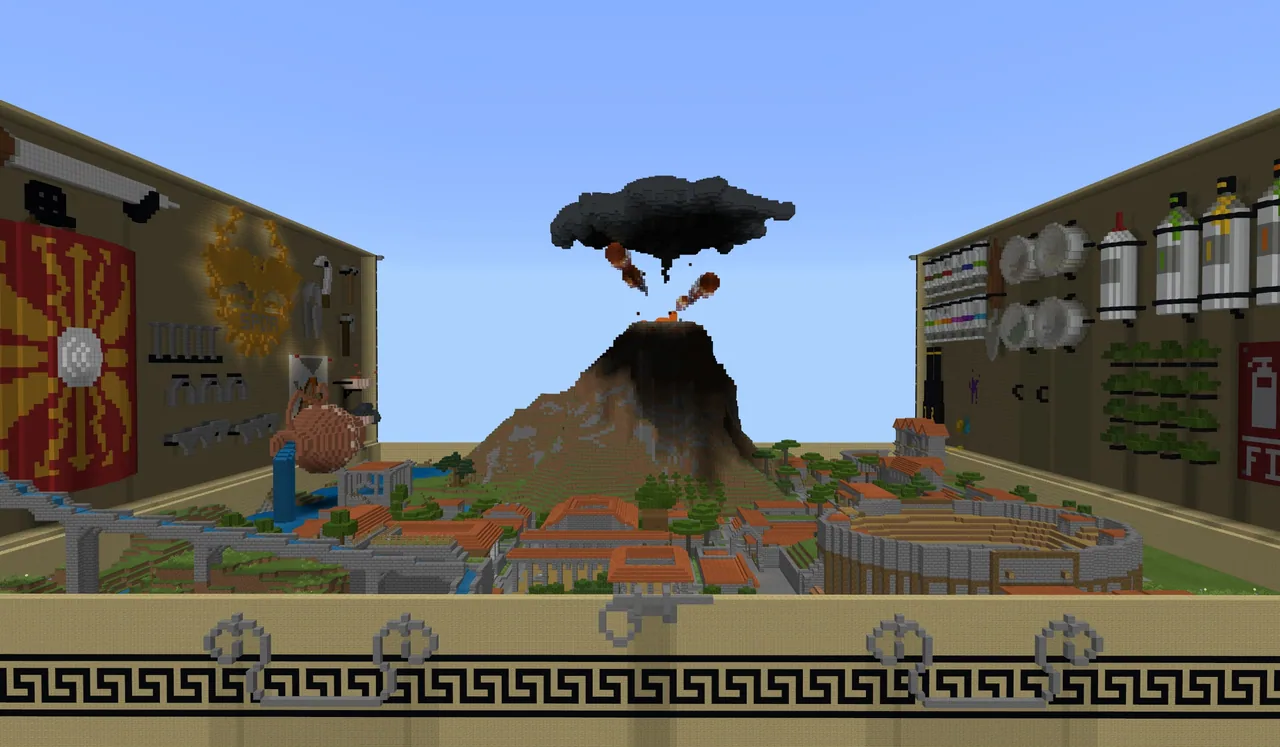
Students spawn outside the toybox and spend time walking or flying around Pompeii. They inspect the layout of the city, the surrounding natural features, and the location of Mount Vesuvius before any destruction occurs.
- Locating Octavia and Preparing Notes10 min
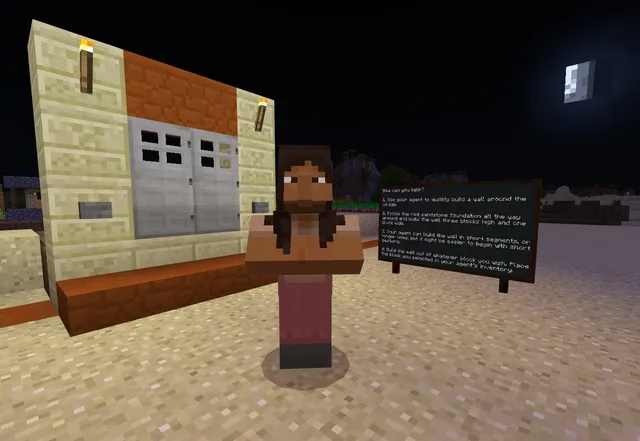
Learners navigate to coordinates -222 63 -155 near the base of the volcano to meet the non-player character Octavia. Before pressing the eruption trigger, students open their notetaking tool and set up a two-column chart labeled Natural Occurrences (Cause) and Impact on Environment (Effect).
- Simulating the Eruption20 min
Students press the button near Octavia to run the eruption code. As the simulation unfolds, learners observe and log key events:
- Ash falling from the sky over the region
- Lava pouring from Mount Vesuvius and accumulating across the terrain
- Chat warnings indicating rising local temperatures
- Chat updates and in-game visuals showing villagers succumbing to intense heat
- Debrief and Cause-and-Effect Synthesis15 min
Bring the class together to review their observation charts. Students share recorded evidence illustrating how physical volcanic events directly produced biological and structural consequences across the Pompeii ecosystem.
Assessment: success criteria
- Student charts clearly separate volcanic causes (falling ash, flowing lava, heat) from ecosystem effects.
- Observation logs account for chat message alerts regarding rising temperatures and the fate of the city's inhabitants.
- Students can explain in discussion how the simulated disaster disrupted both the physical terrain and living organisms.
Differentiation
Pair students so one operates the device controls while the other records notes, ensuring learners do not miss fast-moving eruption events.
Have advanced students research the chemical composition of volcanic magma or determine the precise environmental temperatures that human bodies cannot survive.
Knowledge check
5 questions to check understanding after the lesson. Tap an answer to see if it is right; the score appears at the end.
1Where in the Minecraft world can students find the NPC named Octavia?
Answer: B. Octavia is stationed near the base of Mount Vesuvius at location -222 63 -155.
2According to NPC Octavia, in what time period did the historical disaster at Pompeii occur?
Answer: C. Octavia dialogue notes that a great natural disaster occurred in the fall of 79 AD.
3Why must students keep a clean backup copy of the world file on a drive?
Answer: A. The eruption alters and destroys the original map, making backup copies necessary for subsequent building and testing.
4Which two column headings are recommended for the student observation charts?
Answer: D. The lesson specifically suggests organizing notes into Natural occurrences (Cause) and Impact on environment (Effect).
5What happens to the simulated inhabitants of Pompeii during the eruption sequence?
Answer: C. The eruption simulation features chat messages describing rising heat and villagers perishing as a result.
Resources
- Lesson package (.zip)Everything the author attached to this lesson in one download.
- Pompeii Toybox RubricResource
- Lesson worldOpens the world page in Minecraft Education (sign-in with a school account may be needed).
Frequently Asked Questions
Why do students need backup copies of the world before running the eruption?
The code causes widespread lava and ash to destroy the landscape. Because students will need to build and test mitigation systems in later lessons of this unit, having an untouched copy saved on a USB or cloud drive is essential.
Does this simulation provide a completely realistic replica of the eruption of Mount Vesuvius?
No. The source specifies that the eruption is not a perfect historical or geological model, but rather a game-based simulation intended to engage student thinking and demonstrate broad environmental impacts.
Adapted from Pompeii Toybox Lesson 1 of 5 by Phygital Labs on Minecraft Education, last updated Jul 14, 2022. This classroom version, the timings and the quiz were written by 9Minecraft Education.