- Type
- Lesson plan
- Ages
- Ages 11-13
- Duration
- 2 hours
- Level
- Beginner
- Includes
- Quiz: 5 questions
How do our interactions with others and our social environment influence who we are and how we are seen?
Overview
Identity is shaped both by internal self-awareness and social interaction. This lesson invites students to examine how they see themselves versus how their peers view them, opening up discussions around community, perception, and personal expression.
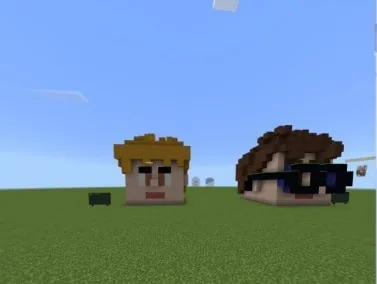
Working in creative mode, learners plan on graph paper and construct pixel art representations of their peers using set grid dimensions. They pair their builds with in-game narrative tools to articulate identity traits and curate an outdoor art exhibition.
Learning objectives
By the end of this lesson students will be able to:
- Discuss how personal identity is shaped by social interactions and the surrounding environment.
- Plan a pixel art design on graph paper using designated grid constraints and block choices.
- Build a pixel art portrait of a peer in Minecraft using a 9x9 or 16x16 format.
- Document the finished artwork and personal reflections using in-game narrative and recording tools.
Blocks and items used in this lesson


Key vocabulary
- Identity
- The qualities, beliefs, personality traits, and looks that make a person who they are.
- Pixel
- The smallest individual square of color that makes up a digital image on a screen.
- Social Construct
- An idea or perception created and accepted by people in a society through cultural interactions.
- Narrative Tools
- In-game Minecraft items such as boards, posters, slates, signs, or non-player characters used to display written information.
Before class
Lesson sequence
Suggested timing: about 120 minutes in total.
- Identity Discussion and Pixel Introduction25 min
Introduce the history and structure of pixels. Transition to a group conversation exploring identity, relationships, physical characteristics, race, ethnicity, and gender. Prompt students to consider how their peers perceive them and how first impressions operate.
- Off-Screen Pixel Planning20 min
Assign students to work with a partner. Have each student sketch a version of their peer on graph paper using either a 9x9 or 16x16 grid, deciding whether to depict just the face or the entire body while mapping specific Minecraft block types to colors.
- In-Game Construction45 min
Students enter the downloadable world in creative mode, find an open build area near the starting point, and build their peer portrait along with an optional support structure. Beside the build, they place a narrative item like a slate, poster, board, sign, or NPC to serve as an ID card or self-description.
- Gallery Walk and Portfolio Reflection30 min
Learners tour the outdoor pixel art exhibition, viewing how classmates portrayed one another. Each student uses the in-game camera and portfolio to photograph their peer portrait and document written reflections on self-image.
Assessment: success criteria
- Student demonstrates understanding of personal and social identity during group discussions.
- Pixel portrait adheres to the specified grid limits of 9x9 or 16x16 blocks.
- Build includes an adjacent narrative item or ID card describing the individual.
- Student captures their completed build and written thoughts using the in-game camera and portfolio.
Differentiation
Allow learners to choose the smaller 9x9 grid focused strictly on the peer's face to simplify block placement.
Have students record an extended reflection on mindfulness and identity using Flipgrid.
Knowledge check
5 questions to check understanding after the lesson. Tap an answer to see if it is right; the score appears at the end.
1What two grid dimensions are suggested for the peer pixel portraits?
Answer: B. The activity instructions specify using either a 16x16 or 9x9 size for the peer representation.
2What should students do on graph paper before opening Minecraft?
Answer: C. Learners take a few minutes on graph paper to strategize which blocks to use for each color in their design.
3Which game mode is designated for this building project?
Answer: A. The lesson instructions state that students will construct their pixel art using creative mode.
4What item should accompany the completed pixel portrait in the game?
Answer: D. Students are asked to place a narrative tool or ID card right beside their build to describe themselves.
5How do students capture and document their completed work inside Minecraft?
Answer: A. The lesson directs pairs to register and reflect upon their completed work using the camera and portfolio.
Frequently Asked Questions
Do students represent themselves or their classmates in the pixel art build?
Students create a portrait of an assigned peer based on their perspective of that peer, which prompts reflection on how individuals are seen by others.
Can students choose what part of the peer to build?
Yes, students have the option to depict either just the face or the entire body within the selected grid size.
Adapted from Pixel Identity by Talita Destro on Minecraft Education, last updated Jun 26, 2022. This classroom version, the timings and the quiz were written by 9Minecraft Education.