- Type
- Lesson plan
- Subject
- History & Social Studies
- Ages
- Ages 6-10
- Duration
- about 1.5 hours (suggested)
How do cooperation, planning, and resource management help a new settlement survive in an unfamiliar land?
Overview
Early European settlers in North America faced harsh conditions, limited resources, and critical decisions when attempting to build a sustainable life in unfamiliar territory. In this simulation, learners examine the real-world obstacles encountered by the Pilgrims, exploring how budgeting, teamwork, and cross-cultural trade influenced survival and settlement growth.
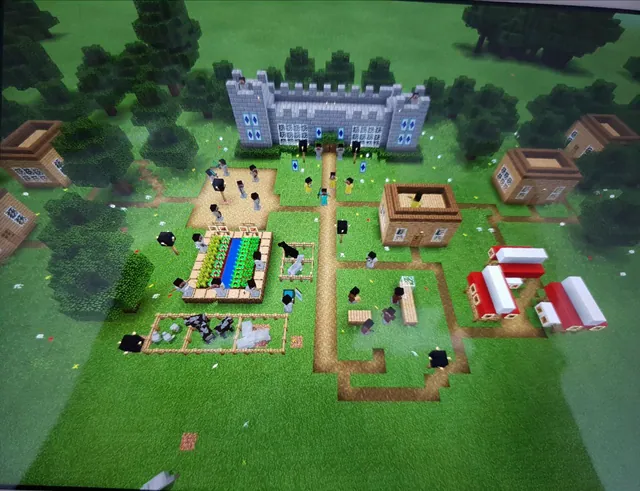
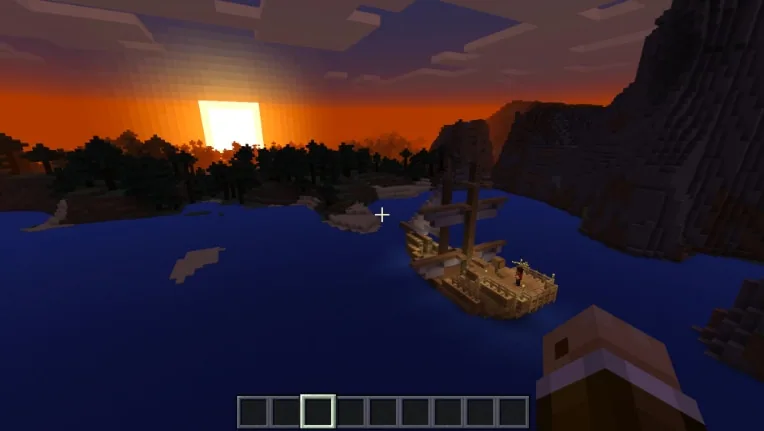
Using a custom Minecraft world featuring the Mayflower anchorage and a neighboring Wampanoag village, student groups select a settlement site, gather materials, produce food, and collect furs to repay debts incurred for initial supplies. This shared virtual environment allows students to directly experience the balance between resource management and community collaboration.
Learning objectives
By the end of this lesson students will be able to:
- Balance an initial supply budget while considering long-term debt repayment.
- Collaborate in teams to construct shelter and establish sustainable food sources.
- Locate and trade with the nearby Wampanoag community to secure necessary supplies and furs.
- Compare simulation experiences with the historical challenges faced by the Pilgrims.
Blocks and items used in this lesson
 Rabbit Hide
 Leather
 Fishing Rod
 Chest
 Raw Rabbit
Key vocabulary
- Colony
- A settlement established by a group of people in a new territory.
- Debt
- Something, such as money or goods, that is owed to someone else.
- Harvest
- The gathering of mature crops, food stores, and agricultural produce.
- Wampanoag
- The Indigenous people native to the area where the Pilgrims arrived in Massachusetts.
Before class
Lesson sequence
Suggested timing: about 90 minutes in total.
- Packing and Budgeting15 min
Introduce the simulation and discuss the historical context of the Pilgrims' journey. Working in small teams, students can use the Resource Worksheet to select essential tools, food, and building supplies while managing a set budget, knowing that larger purchases increase the debt they must repay later.
- Landing and Settlement25 min
Student groups spawn at the Mayflower anchorage site and explore the immediate coast to find a suitable location for their colony. Teams cooperate in survival mode to gather local building materials, craft simple tools, and set up basic shelters.
- Food Production and Trade30 min
Colonies focus on securing a bountiful harvest by hunting, farming, or fishing. When ready, students follow the river northeast (around coordinates x505, y67, z530) to interact with the Wampanoag settlement, trading for vital goods and gathering rabbit pelts or leather furs to load onto the Mayflower for debt repayment.
- Harvest Assessment and Reflection20 min
Teams capture screenshots of their food stores and completed colony buildings. Students then complete a written or verbal reflection comparing their gameplay challenges to the historical reality of the 1620 settlers using a Venn diagram or T-chart.
Assessment: success criteria
- Successful establishment of a colony shelter with sufficient food reserves gathered before the end of the simulation.
- Repayment of initial debts through collected rabbit pelts or leather loaded back onto the Mayflower.
- Completion of a comparative T-chart or Venn diagram contrasting Minecraft challenges with real Pilgrim history.
Differentiation
Provide a pre-packed standard supply chest on the Mayflower and leave the Samoset NPC active on the beach to guide students toward the trading village.
Require advanced teams to calculate exact debt margins from their worksheet and repay every unit of supply using hunted or traded furs exclusively.
Knowledge check
5 questions to check understanding after the lesson. Tap an answer to see if it is right; the score appears at the end.
1What happens if a student team purchases a large amount of supplies at the start?
Answer: B. Purchasing extra items creates a larger debt that teams must work to repay before the simulation ends.
2Which direction should students follow along the river to find the Wampanoag village?
Answer: A. The source identifies the village location along the river northeast of the Mayflower spawn point.
3What items are used to pay off the colony's initial debt?
Answer: C. Debts are paid back by gathering rabbit pelts or leather, which are loaded onto the ship.
4Why might a teacher choose to remove the Samoset NPC on the beach?
Answer: B. Removing Samoset prevents the village location from being given away immediately at the start.
5What is the primary food-related objective by the conclusion of the activity?
Answer: C. Each colony's ultimate goal is to produce a bountiful harvest using farming, hunting, or trading.
Resources
- Lesson package (.zip)Everything the author attached to this lesson in one download.
- Resource WorksheetSheet to log which supplies teams wish to bring
Frequently Asked Questions
Can I use this lesson if we have not studied American history?
Yes. You can remove specific historical names and run the activity as an open-ended frontier survival and settlement simulation to teach geography and resource planning.
How do students prove they met their food and debt goals?
Students can capture in-game screenshots showing their colony layout and food storage, while debt furs are placed directly into the cargo chests on the Mayflower for inspection.
Adapted from Pilgrim Simulation by Simon Vasey on Minecraft Education, last updated Jul 14, 2022. This classroom version, the timings and the quiz were written by 9Minecraft Education.