How can we use perimeter calculations to determine the exact amount of fencing needed to enclose an animal pen?
Overview
In this lesson, students explore geometric measurement by applying perimeter concepts to practical scenarios. By designing boundaries for animals, learners recognize perimeter as a linear measure that defines the outer edge of a two-dimensional space, directly contrasting it with interior area.
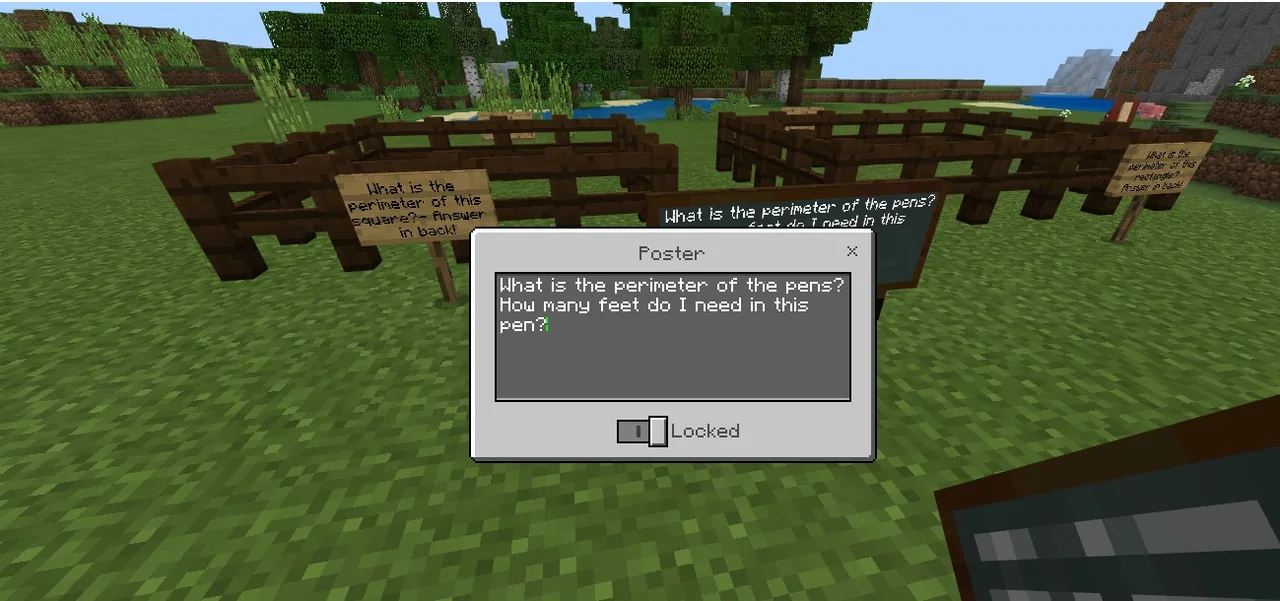
Using the downloadable Perimeter World, students place fence blocks to create rectangular enclosures. They calculate total fence lengths needed, solve for missing boundary dimensions, and investigate how shapes with the same perimeter can enclose different areas.
Learning objectives
By the end of this lesson students will be able to:
- Calculate the perimeter of rectangular animal enclosures by determining total fence units needed.
- Solve real-world mathematical problems involving polygon perimeters and unknown side lengths.
- Distinguish between linear perimeter measurements and enclosed area measurements.
- Build rectangular pens to compare shapes with identical perimeters and different areas.
Blocks and items used in this lesson


Key vocabulary
- Perimeter
- The total distance around the outer boundary of a closed two-dimensional shape.
- Linear Measure
- A measurement taken along a line or boundary using one-dimensional units.
- Area
- The amount of two-dimensional space contained inside a boundary.
- Polygon
- A closed flat shape with straight sides.
Before class
Lesson sequence
- Introduction to Boundary Measurement
Introduce the concept of perimeter as the outer edge of a space. Discuss real-life situations where perimeter is essential, such as buying fencing to contain farm animals.
Review the difference between linear measure around an edge and the area covered inside the pen.
- Building Animal Enclosures
Have students load into the Perimeter World and choose an animal pen project. Students use fence blocks to build rectangular enclosures, counting each block as a unit of measurement.
- Build a fence with specified side lengths.
- Add the sides together to find the total perimeter needed.
- Solving Unknown Side Problems
Present perimeter challenges where one or more side lengths are unknown. Students construct or adjust fencing to determine the missing dimensions while maintaining a designated total perimeter.
- Comparing Perimeter and Area
Instruct students to create two different rectangular enclosures that have the exact same perimeter but contain different internal floor areas.
Conclude with a reflection where students share their enclosure designs and explain their calculations.
Assessment: success criteria
- Student correctly counts and adds fence blocks to find the total perimeter of a pen.
- Student accurately determines an unknown side length given the total perimeter.
- Student constructs distinct rectangles that exhibit identical perimeters but different areas.
- Student clearly explains the difference between boundary fencing and interior area.
Differentiation
Provide pre-laid corner posts so students only need to bridge the gaps with fences and count the individual blocks along each side.
Challenge students to design multiple pens that hold the same interior area while requiring completely different amounts of fencing.
Knowledge check
5 questions to check understanding after the lesson. Tap an answer to see if it is right; the score appears at the end.
1What does perimeter measure when designing an animal pen?
Answer: A. Perimeter is the linear measurement around the outer edge or boundary of a shape.
2A rectangular animal pen has two sides of 6 blocks and two sides of 4 blocks. What is its perimeter?
Answer: C. Adding all four sides together (6 + 6 + 4 + 4) gives a total perimeter of 20 blocks.
3How does perimeter differ from area?
Answer: B. Perimeter is a linear boundary measurement, whereas area measures two-dimensional enclosed surface space.
4Which investigation can students carry out using rectangular fences in this lesson?
Answer: D. The lesson includes exhibiting rectangles with identical perimeters and different areas.
5Which Minecraft item is placed to build enclosures and calculate perimeter in this lesson?
Answer: A. Students place fencing blocks around animals to determine the total units of boundary needed.
Resources
- Lesson package (.zip)Everything the author attached to this lesson in one download.
- Perimeter WorldDownload perimeter World
Frequently Asked Questions
What downloadable file is included with this lesson?
This lesson includes a downloadable file named Perimeter World for students to explore and build within.
What age groups is this lesson designed for?
The lesson materials are adaptable across a wide range of ages, including 6-7, 8-10, 11-13, and 14-18.
Which subjects are connected to this perimeter activity?
The lesson integrates Math & Economics, Art and Design, and Animals through hands-on enclosure building.
Adapted from Perimeter by Bobby Brian Lewis on Minecraft Education, last updated Jul 14, 2022. This classroom version, the timings and the quiz were written by 9Minecraft Education.