- Type
- Lesson plan
- Ages
- Ages 8-18
- Duration
- 45 min
- Level
- Beginner
- Skills
- Project Based Learning
How can conservation actions help restore and protect vulnerable marine ecosystems?
Overview
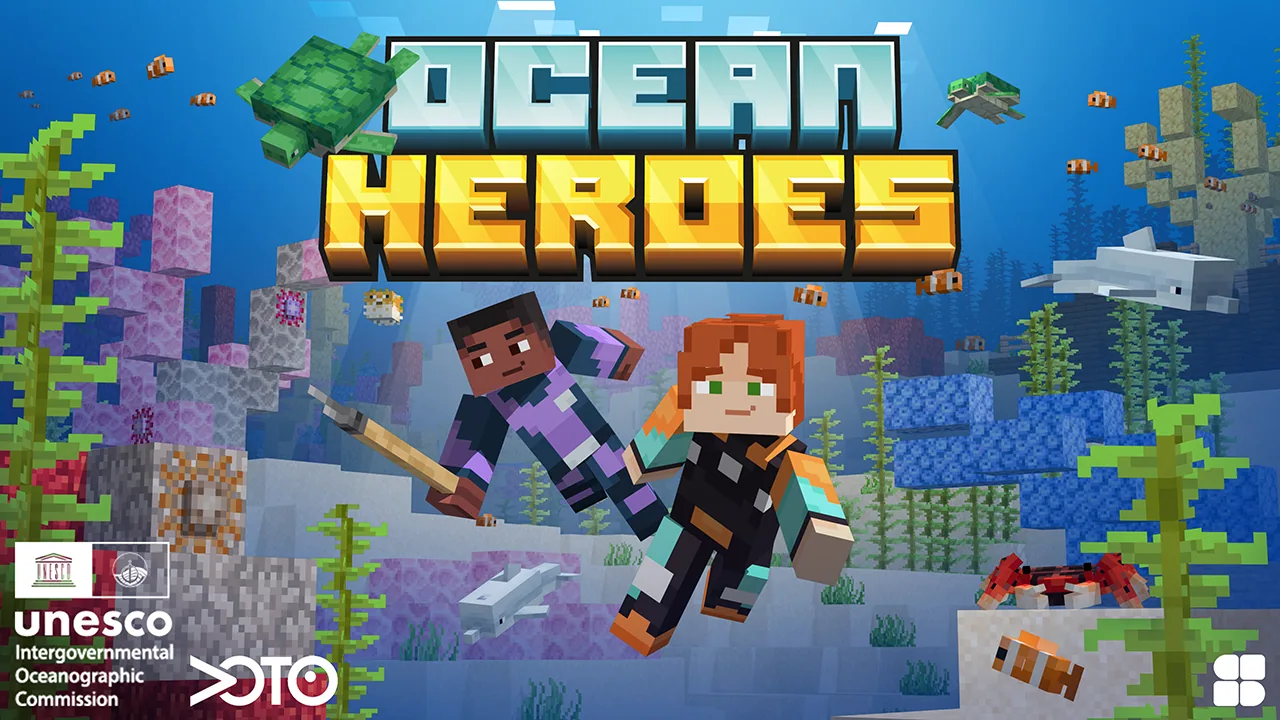
Marine ecosystems face complex environmental challenges that threaten global biodiversity. In this lesson, students investigate the ecological importance of mangrove forests, coral reefs, and kelp forests, discovering how these distinct underwater habitats support diverse marine species and maintain ecological balance.
Using the downloadable Minecraft world, learners take part in a conservation mission where they examine environmental threats firsthand. Students apply problem-solving techniques directly in the game to restore damaged habitats and build practical ocean literacy.
Learning objectives
By the end of this lesson students will be able to:
- Identify the environmental roles of coral reefs, mangroves, and kelp forests.
- Investigate environmental challenges that threaten marine biodiversity.
- Apply problem-solving strategies to restore ocean habitats within the game world.
Blocks and items used in this lesson
 Kelp
 Brain Coral
 Tropical Fish
 Sea Pickle
 Mangrove Leaves
 Dolphin
Key vocabulary
- Marine Biodiversity
- The variety of plant and animal life found within ocean and coastal environments.
- Conservation
- The protection, preservation, and careful management of natural resources and habitats.
- Mangrove Forest
- A coastal wetland ecosystem of salt-tolerant trees that shelters marine species.
- Coral Reef
- An underwater ecosystem created by colonies of tiny animals that support abundant ocean life.
- Kelp Forest
- A shallow ocean ecosystem dominated by dense growth of large seaweeds.
Before class
Lesson sequence
Suggested timing: about 45 minutes in total.
- Introduction to Marine Habitats10 min
Introduce the three focal ecosystems: mangroves, coral reefs, and kelp forests. Ask students to share what they already know about marine biodiversity and why ocean health connects to global climate science.
- In-Game Ecosystem Exploration20 min
Have students load the Ocean Heroes world and begin their quest. Learners navigate through each ecosystem to observe marine life, identify signs of damage, and record environmental threats highlighted in the mission.
- Habitat Restoration Challenges10 min
Students complete targeted restoration tasks within the Minecraft world, using critical thinking to solve ecological problems and protect affected marine species across the three habitats.
- Class Debrief and Reflection5 min
Gather the class to discuss their findings. Ask students to summarize the actions they took to restore each habitat and explain how virtual conservation tasks mirror real-world ocean stewardship.
Assessment: success criteria
- Students can name and describe the three marine ecosystems featured in the lesson.
- Students explain at least two environmental challenges affecting ocean wildlife.
- Students demonstrate active participation in completing in-game restoration objectives.
Differentiation
Pair students needing assistance with a peer partner so they can navigate the underwater world and complete restoration steps cooperatively.
Ask fast finishers to compare the specific environmental pressures affecting mangroves versus kelp forests and summarize their findings in a brief written report.
Knowledge check
5 questions to check understanding after the lesson. Tap an answer to see if it is right; the score appears at the end.
1Which three marine ecosystems are featured in this lesson?
Answer: B. The lesson specifically focuses on restoring coral reefs, mangroves, and kelp forests.
2What core skill framework does the Ocean Heroes lesson utilize?
Answer: D. The source lists Project Based Learning as the primary skill developed in this lesson.
3Which organizations presented the Ocean Heroes educational content?
Answer: A. The learning objectives credit the project as presented by UNESCO-IOC and Voice of the Ocean.
4What is the primary objective of the in-game quest?
Answer: C. The lesson centers on tackling environmental challenges, rescuing habitats, and learning conservation skills.
5What experience level is required for students starting this lesson?
Answer: B. The source specifies that the lesson is suitable for a beginner experience level.
Resources
- Lesson package (.zip)Everything the author attached to this lesson in one download.
- Educator MaterialsFull lesson plan with additional details and learning principles.
- Lesson worldOpens the world page in Minecraft Education (sign-in with a school account may be needed).
Frequently Asked Questions
What age ranges are suitable for this lesson?
The source curriculum is structured to support learners across three age brackets: 8 to 10, 11 to 13, and 14 to 18 years old.
What should I do if a 45-minute period feels too short?
You can divide the lesson across multiple sessions by dedicating one session to initial exploration of the ecosystems and a second session to completing the restoration challenges and class reflection.
Adapted from Ocean Heroes by Shapescape ApS on Minecraft Education, last updated Apr 3, 2026. This classroom version, the timings and the quiz were written by 9Minecraft Education.