Can a community create a successful, cohesive town when every citizen contributes to every municipal service?
Overview
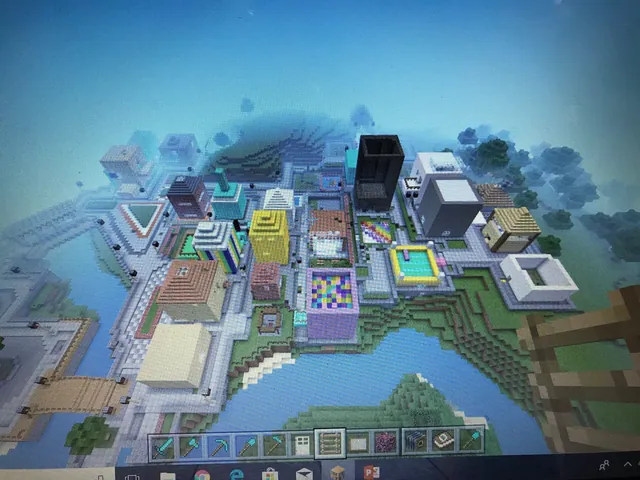
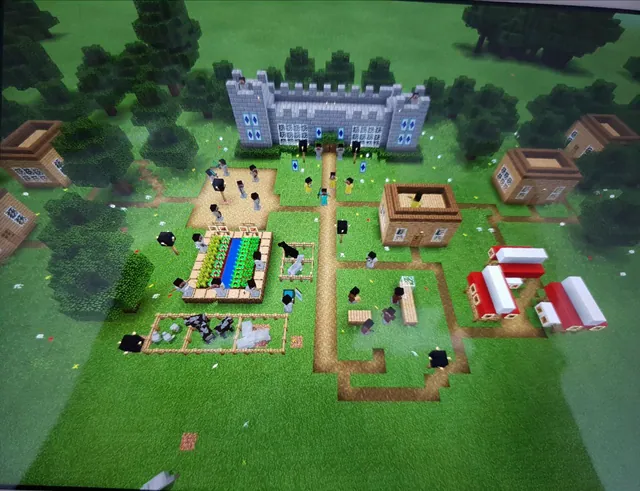
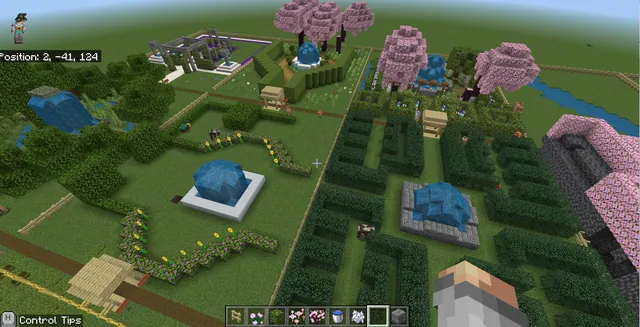
In this community-planning project, learners explore how shared civic responsibility shapes urban development. Instead of working in isolation on individual structures, the class establishes shared criteria for what makes a functional town and then shares ownership of every build site through a structured rotation model.
Using a world seed that features a village near spawn, each student starts an assigned municipal service station before rotating to peer builds when prompted. At each new stop, students evaluate existing progress, contribute purposeful architectural or infrastructure improvements, and document their specific additions on in-game signs.
Learning objectives
By the end of this lesson students will be able to:
- Identify essential municipal services needed to upgrade a basic village into a functioning town.
- Construct and improve community service buildings based on realistic and safe engineering practices.
- Evaluate peer builds and add constructive, purposeful improvements at each rotation station.
- Summarize personal building contributions concisely using in-game signs at every station.
Blocks and items used in this lesson


Key vocabulary
- Municipal Service
- A public service or facility provided to support the everyday needs and safety of people living in a community.
- Co-construct
- Working together as a group to decide on shared rules, standards, or criteria.
- Station
- A designated building site assigned to a specific community service within the town.
- Redstone
- A Minecraft material that conducts power and can be used to engineer mechanical systems and automation.
Before class
Lesson sequence
- Criteria Co-Construction
Lead a class discussion to brainstorm what essential services a settlement needs to transform from a simple village into a full town. Work together to establish shared criteria for safety, realism, and responsible civic design.
- Station Setup and Initial Build
Assign or let students randomly draw a service number. Students travel to their pre-determined building zone, place an introductory sign stating their assigned station number and name, and begin constructing the core structure.
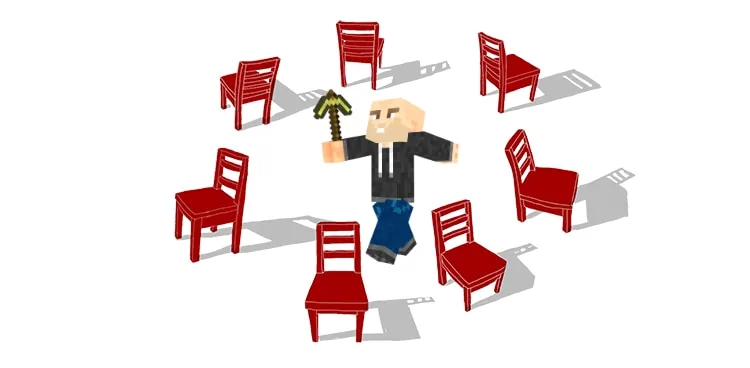
- Musical Chairs Rotations
When the teacher signals that time is up, learners place a sign detailing what they built and rotate to the next station. At each new site, students assess the current structure, add positive enhancements, and leave a descriptive sign before moving on.
- Final Return and Reflection
Continue rotations until students cycle back to their starting station or the teacher calls time. Students review the collective improvements made to their original site and evaluate how shared input shaped the completed town.
Assessment: success criteria
- Student accurately establishes an assigned station marked with their name and service role.
- Student writes concise sign logs at each station describing specific contributions made during the rotation.
- Student demonstrates critical thinking by adding constructive, safe, and realistic features to peer structures.
- Student incorporates civic responsibility and ethical design principles that benefit the entire community.
Differentiation
Provide a structured checklist of basic service features (such as doors, lighting, or pathways) for learners to reference when deciding what to add at a new station.
Challenge advanced students to integrate functional Redstone mechanisms into the municipal services they visit to introduce automated infrastructure.
Knowledge check
5 questions to check understanding after the lesson. Tap an answer to see if it is right; the score appears at the end.
1What is the primary goal of the initial class discussion in this lesson?
Answer: B. The project begins with students and the teacher co-constructing criteria for the services needed in a complete town.
2What should a student do immediately before rotating away from a building station?
Answer: C. Before moving to the next site, students place a sign noting their name and what positive additions they made.
3How might the teacher signal within Minecraft that a build round has ended?
Answer: A. The source notes that teachers can use in-game signals such as setting the time to night to cue station rotations.
4What is expected of students upon arriving at another learner's service station?
Answer: B. Learners look over the current build and determine what positive attributes, large or small, they can contribute.
5Which tool can be added to the project to bring in computational thinking?
Answer: D. The source highlights using Redstone to incorporate computational thinking within the civic engineering tasks.
Resources
Frequently Asked Questions
What type of Minecraft world is best suited for this lesson?
Select a world seed that generates a village near the initial player spawn point so the class can immediately begin expanding existing settlement structures into a town.
How many times should students rotate stations?
Rotations can continue for several cycles until learners complete a full circuit back to their original station, or until the teacher determines the town builds are sufficiently developed.
Can this rotational method be used for topics other than towns?
Yes. The musical chairs collaborative approach can be applied to any large-scale shared build, such as modeling a school campus or recreating a local neighborhood.
Adapted from MC:EE Musical Chairs Project! by Benjamin Kelly on Minecraft Education, last updated Jan 3, 2017. This classroom version, the timings and the quiz were written by 9Minecraft Education.