- Type
- Lesson plan
- Ages
- Ages 11-13
- Includes
- Quiz: 5 questions
How do human organs and systems fit and work together within the body?
Overview
Understanding internal anatomy can be challenging when viewing flat diagrams. In this lesson, students explore major organs and body systems, investigating how shapes, locations, and physiological functions work together to support human life.
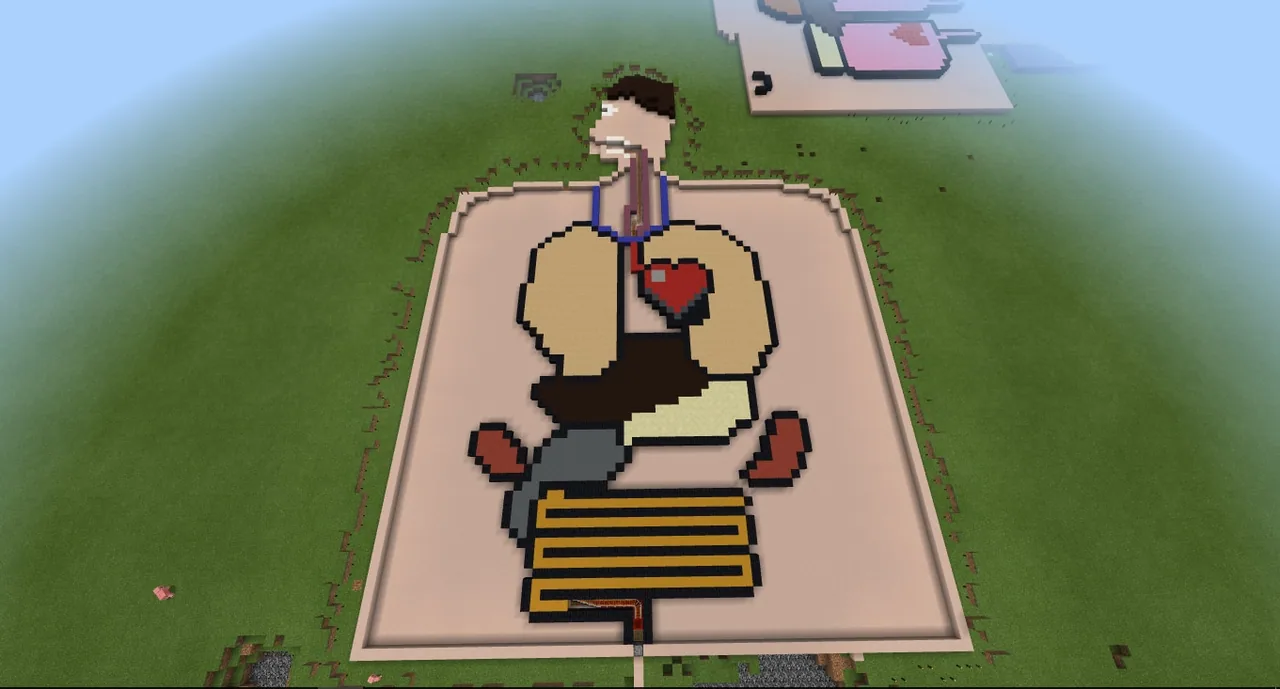
Working collaboratively in Minecraft, students first construct an outer body frame before building internal organs. They lay rails from the heart to simulate blood circulation and place non-player characters with web links to connect external anatomical research directly to their in-game models.
Learning objectives
By the end of this lesson students will be able to:
- Identify major human organs along with their shapes, colors, and functions.
- Examine major bodily systems, focusing on the circulatory network.
- Construct a collaborative three-dimensional model of the human body and internal organs in Minecraft.
- Document anatomical details using in-game signs, NPCs, and portfolio tools.
Blocks and items used in this lesson


Key vocabulary
- Organ
- A specialized structure in the body that carries out a particular vital function.
- Circulatory System
- The bodily system responsible for transporting blood and nutrients through vessels.
- Blood Vessel
- A tubular structure, such as an artery or vein, that carries blood through tissues and organs.
- NPC
- A non-player character in Minecraft used to present information and provide clickable links to external websites.
Before class
Lesson sequence
- Warm-up and Prior Knowledge
Conduct a brainstorming session with the class to assess existing knowledge about the human body, organ names, and general systems.
- Online Anatomy Research
Direct students to online anatomy resources and 3D models to study organ functions, shapes, colors, and systemic connections.
- Constructing the Outer Frame
Students collaborate in Minecraft to build the outer surface of the human body, creating the container for internal structures.
- Building Organs and Vessels
Teams construct individual organs inside the body frame. When assembling the heart, students lay rails to represent blood vessels and visualize the circulatory system.
- Adding Documentation and Information
Students place signs or NPCs by each organ to explain its function and link directly to external reference websites.
- Portfolio Capture and Presentation
Students use the in-game camera tool to photograph their build, then assemble their findings into an Office Mix or free website presentation.
Assessment: success criteria
- The Minecraft model includes accurately shaped and colored representations of major organs.
- Rails are used effectively to demonstrate blood vessels extending through the circulatory system.
- NPCs or signs provide accurate functional descriptions and relevant external research links.
- The student presents their finished build through a digital portfolio or presentation.
Differentiation
Provide an organ reference checklist with basic shape and color guidelines to guide students during construction.
Have advanced learners configure multiple NPCs with detailed links explaining how various organ systems interact.
Knowledge check
5 questions to check understanding after the lesson. Tap an answer to see if it is right; the score appears at the end.
1Which Minecraft item is specifically suggested to represent blood vessels connected to the heart?
Answer: B. The lesson specifically notes that students can use rails to represent vessels carrying blood when building the heart.
2Why is using an NPC preferred over a standard sign when labeling organs in this project?
Answer: C. NPCs are preferred because students can attach outside web links to connect external research to Minecraft builds.
3What should students build first when constructing the body in Minecraft?
Answer: A. According to the lesson activities, students first need to create the outer surface of the human body.
4Which in-game tool is recommended for collecting visual evidence of the build?
Answer: D. The lesson mentions using the camera tool in Minecraft to compile images for a digital portfolio.
5What activity is recommended immediately after the initial brainstorming discussion?
Answer: B. The guiding ideas recommend following the brainstorming session with online research using 3D anatomy sites.
Frequently Asked Questions
Is there a custom world file required to run this lesson?
No custom world download is required. Students can build in a standard creative world, such as a flat or open landscape.
What formats can students use to present their final work?
Students can document their build using the camera tool and present their findings through Office Mix or free website builder platforms.
Can students use signs instead of NPCs to describe organs?
Yes, signs can be used, though NPCs are preferred because they enable students to include direct links to external research websites.
Adapted from Human Body and Organs by Yunus Emre Calik on Minecraft Education, last updated Nov 10, 2017. This classroom version, the timings and the quiz were written by 9Minecraft Education.