
- Type
- Lesson plan
- Ages
- Ages 8-18
- Duration
- 1 hour
- Level
- Beginner
How can communities balance their land-use needs while protecting the clean, cool river habitats that hellbenders require to survive?
Overview
Hellbenders serve as vital biological indicators for river health because they rely on cool, clean, oxygen-rich waterways with plenty of large shelter rocks. In this lesson, students explore the real-world tensions between community land use and freshwater ecology, examining how agricultural runoff, construction sediment, and livestock access degrade aquatic ecosystems.
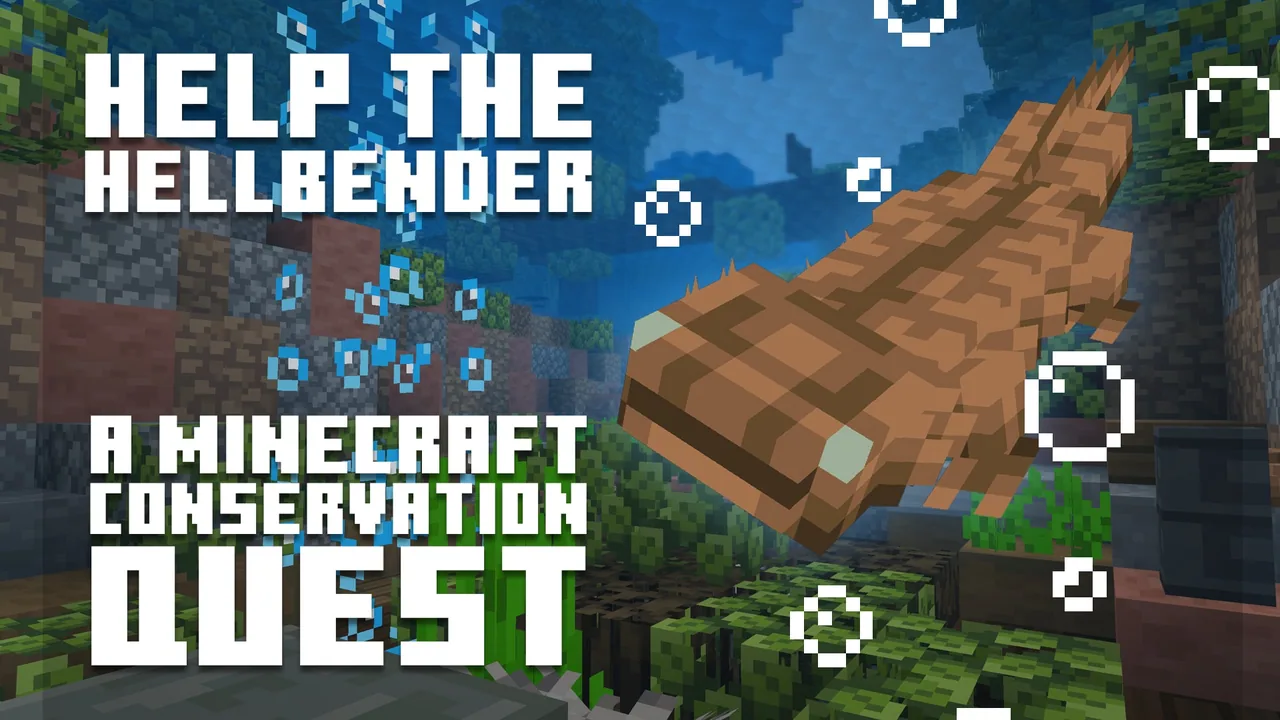
Using the custom Minecraft world, learners experience the river from an amphibian perspective, track the species through its life stages, and evaluate practical conservation interventions. Working collaboratively, student teams apply claim, evidence, and reasoning to redesign an impaired river reach and install working mitigation features.
Learning objectives
By the end of this lesson students will be able to:
- Explain the specific habitat conditions hellbenders require across their life cycle stages.
- Identify human activities that harm river quality and evaluate matching conservation remedies.
- Construct and defend a river habitat redesign using claim, evidence, and reasoning.
- Communicate the environmental mechanisms of land-management solutions using in-game signage.
Blocks and items used in this lesson


Key vocabulary
- Keystone Species
- An organism that plays an essential role in maintaining the structure and health of its ecological community.
- Buffer Strip
- A planted area of vegetation along a waterway that filters runoff and traps sediment before it enters the stream.
- Riparian Replanting
- Restoring native plants and trees along riverbanks to prevent soil erosion and provide shade.
- Sediment Controls
- Measures such as silt fences that prevent loose soil from washing off construction sites into natural waters.
- Contour Planting
- Farming along the natural slope contours of the land to slow water runoff and reduce soil erosion.
Before class
Lesson sequence
Suggested timing: about 60 minutes in total.
- Introductory Discussion5 min
Introduce the mission and prompt prior knowledge about river quality. Discuss what wildlife requires from clean water versus human impressions of clear streams, and review how students will gather valid evidence inside the world.
- Ecology and Perspective Exploration15 min
Meet Dr Riverstone to review key terms including keystone species, habitat, and pollution. Students then complete the life cycle mini-game to collect eggs and log stages from larvae to adults, followed by a first-person river segment where they navigate food, shelter, and nesting hazards.
- Landowner Challenge Investigations15 min
Groups rotate through three designated challenge stations in the map to evaluate human impacts and potential remedies:
- Farm Runoff: Compare buffer strips, cover crops, and contour planting.
- Construction Sites: Test silt fences, staging areas, and sediment barriers.
- Livestock Access: Assess riparian bank replanting, fencing, and off-stream watering points.
- Collaborative Habitat Redesign and Pitch15 min
Teams enter creative mode to rebuild an impaired river section, adding structures that solve their chosen threat. Students place NPC boards or signs detailing the mechanism and expected environmental benefit, finishing with a one-minute gallery walk pitch sharing their claim and evidence.
- Synthesis and Reflection10 min
Gather the class to consider how improved conditions for hellbenders benefit the entire river system upstream and downstream. Learners record final insights via a written response, short video reflection, or recorded screen walkthrough.
Assessment: success criteria
- Accurately links hellbender life stages to habitat requirements such as sheltering rocks and oxygen-rich water.
- Identifies a specific land-use threat and matches it to an appropriate mitigation technique.
- Defends the river redesign choice using a structured claim, evidence, and reasoning framework.
- Communicates solutions clearly to peers through in-game signage or gallery walk presentations.
Differentiation
Provide a pre-formatted CER sentence frame and limit student focus to evaluating a single landowner challenge area.
Have students rank their proposed interventions by effort versus ecological impact and justify their priority order.
Knowledge check
5 questions to check understanding after the lesson. Tap an answer to see if it is right; the score appears at the end.
1What physical river features are essential for hellbenders to survive and reproduce?
Answer: B. Hellbenders require cool, clean, highly oxygenated river currents with large rocks that offer shelter and nesting spaces.
2Which farming method helps prevent agricultural runoff from entering a nearby stream?
Answer: B. Vegetative buffer strips trap sediment and filter agricultural chemicals before runoff flows into river channels.
3What tool helps keep construction sediment out of river habitats in the lesson?
Answer: C. Silt fences act as temporary sediment controls to block loose soil from washing off active construction sites.
4What can landowners install to keep livestock from trampling riverbanks and eroding the soil?
Answer: A. Fencing cattle away from the river and supplying alternative drinking stations prevents bank erosion and protects water clarity.
5Which sequence correctly reflects the life cycle stages tracked in the in-game mini-game?
Answer: B. Students follow the hellbender life cycle in sequence from eggs to larvae, juveniles, and finally mature adults.
Resources
- Lesson package (.zip)Everything the author attached to this lesson in one download.
- Full Lesson PlanHelp the Hellbender: A Conservation Quest to Protect and Preserve their Habitat.
- Class PPT PresentationClassroom presentation with visuals.
- Lesson worldOpens the world page in Minecraft Education (sign-in with a school account may be needed).
Frequently Asked Questions
Can this lesson be taught in a standard 60-minute science block?
Yes. The plan is designed for an hour-long session divided into a five-minute launch, forty-five minutes of guided world exploration and building, and a ten-minute final reflection.
Do students need advanced building skills to participate?
No. The experience level is beginner-friendly, and students can use provided structural templates, simple placement tools, and in-game text boards to explain their ecological solutions.
Adapted from Help the Hellbender. A Minecraft Conservation Quest by Adam Clarke on Minecraft Education, last updated Sep 8, 2026. This classroom version, the timings and the quiz were written by 9Minecraft Education.






































