- Type
- Lesson plan
- Topics
- Math & EconomicsGaming
- Grade
- Primary (Grades 3-5)
- Ages
- Ages 8-10
How can visual models show that two different fractions represent the exact same amount?
Overview
Fractions can often feel abstract when students only see them written on a page. In this lesson, learners explore the relationship between equivalent fractions by building physical representations out of blocks. By visualizing how different fractional parts represent the exact same value, students discover underlying number patterns such as multiples and deepen their understanding of fractions as specific amounts.
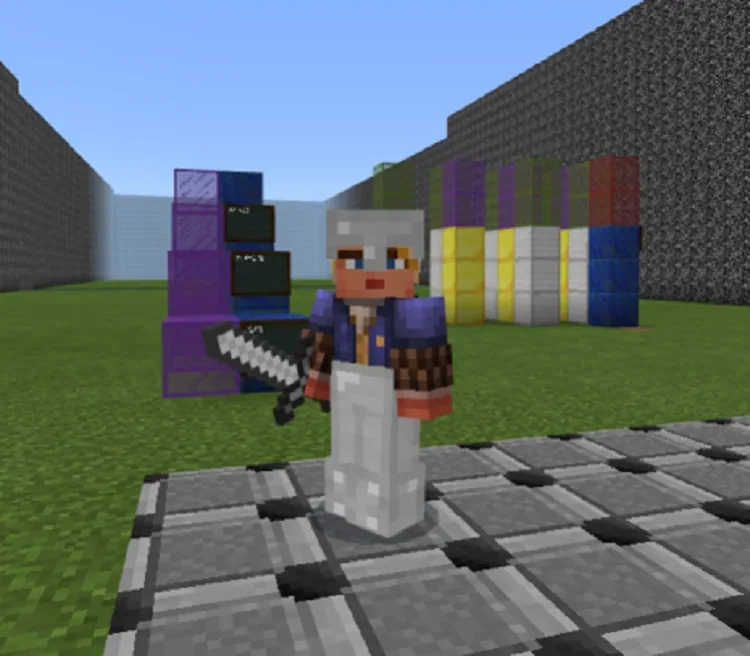
Minecraft Education turns this mathematical exploration into a dynamic arena. Students build isolated fraction models that double as tactical obstacles on a custom map, label their work with signs, and review each other's structures before entering a team-based Capture the Flag match where they defend their flag and break the opposing team's blocks to win.
Learning objectives
By the end of this lesson students will be able to:
- Explain the equivalence of fractions by comparing the size of visual models.
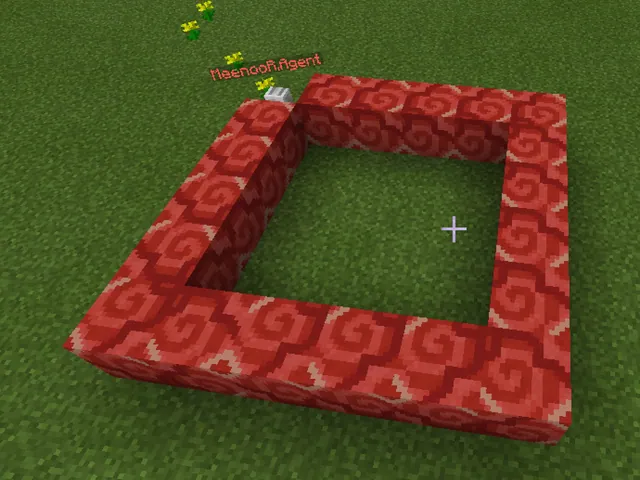
- Build and label Minecraft models that accurately show equivalent fractions using signs.
- Evaluate peers' fraction models for accuracy and propose additional equivalent fractions.
- Document completed math models using pictures in a student portfolio.
Blocks and items used in this lesson


Key vocabulary
- Equivalent Fractions
- Fractions that have different numerators and denominators but name the exact same amount.
- Multiple
- The product of a given number multiplied by an integer, showing predictable patterns in equivalent fractions.
- Model
- A visual or physical structure built to represent and explain a mathematical concept.
Before class
Lesson sequence
- Direct Instruction and Note-Taking
Present the slideshow file to teach students how to construct and interpret fraction models. Project example models on the whiteboard while students take notes, sketch designs on graph paper, and record fraction equations in their math notebooks.
- World Entry and Model Construction
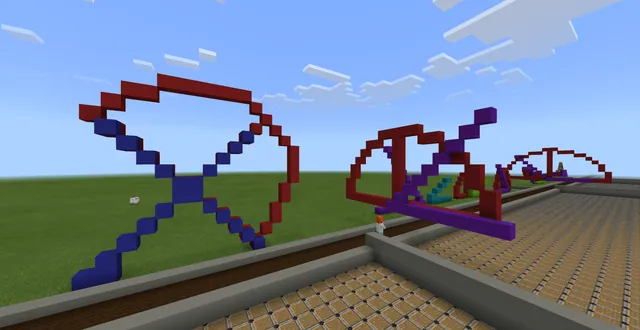
Students join the world, choose their team skin (Gold or Purple), and wait for the teacher to trigger the map-building phase. Players teleport through the team room onto the arena floor, where each student constructs one to three fraction models. Models must remain separated and cannot touch each other.
- Peer Review and Documentation
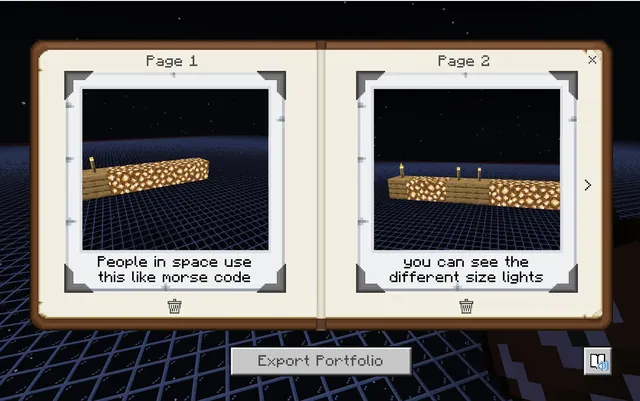
Students examine at least three math models built by their peers, checking the structures for mathematical accuracy and suggesting additional equivalent fractions on slates or signs. Students also take pictures of their own structures to include in their portfolios.
- Capture the Flag Match
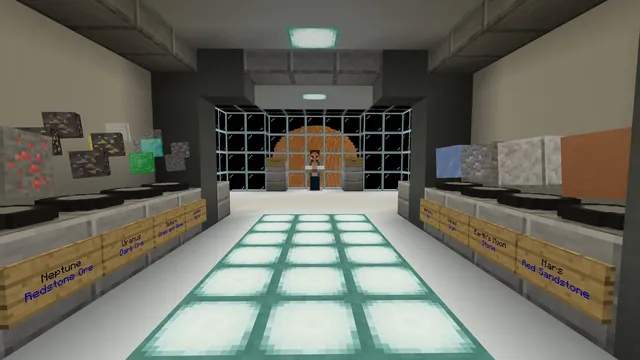
The teacher activates the game button, teleporting teams into locker rooms to pick their characters. Teams enter the arena and use their fraction models as defensive cover. The first team to break every block of the opponent team's flag wins the match.
- Debrief and Reflection
Gather students to reflect on the relationship between numbers and amounts. Discuss why one-half is identical in value to four-eighths and identify the number patterns observed when generating equivalent fractions.
Assessment: success criteria
- Student accurately builds at least two distinct models demonstrating equivalent fractions.
- Student correctly labels structures with fraction values using in-game signs.
- Student successfully reviews at least three peer models and records an additional equivalent fraction.
- Student explains the difference between a numerical fraction and the physical amount it represents during the debrief.
Differentiation
Allow students to build simpler halves and fourths on graph paper before constructing them with blocks in Minecraft.
Challenge students to build models representing complex equivalent fractions with higher multiples and integrate tactical defensive features into their arena placement.
Knowledge check
5 questions to check understanding after the lesson. Tap an answer to see if it is right; the score appears at the end.
1What requirement must students follow when building fraction models inside the arena?
Answer: C. The activity rules state that each student should create one to three models and that the models should not touch.
2How does a team secure a victory during the Capture the Flag match?
Answer: A. The game rules specify that the first team to break all blocks of the other team's flag wins the game.
3How many peer models is each student required to review before the match begins?
Answer: B. The peer review guidelines direct each student to review at least three math models.
4Why is 1/2 equivalent to 4/8?
Answer: B. Equivalent fractions describe the same amount or portion of a whole even though they use different numbers.
5Which tool do students use to document their finished models for assessment?
Answer: B. The performance expectations state that students document their models by taking pictures for their portfolios.
Resources
- Lesson package (.zip)Everything the author attached to this lesson in one download.
- How to Play Capture the FlagInstruction for how to play Capture the Flag in Minecraft.
- Rubric
- Slideshow
- Student PortfolioExample of what students' portfolio will look like.
Frequently Asked Questions
What happens if a student builds their fraction model directly against another player's model?
Models must remain visually distinct so they can be reviewed and navigated during the game. Remind students before building starts to leave clear space around each structure so that models do not touch.
How do fraction models impact the Capture the Flag gameplay?
The fraction models act as physical obstacles within the arena. Students can strategically plan their models to provide cover, navigate around opponents, or protect the route toward their team's flag.
Adapted from Fraction Capture the Flag by Minecraft Education on Minecraft Education, last updated Dec 19, 2022. This classroom version, the timings and the quiz were written by 9Minecraft Education.