- Type
- Lesson plan
- Subject
- Science
- Topics
- Science
- Ages
- Ages 8-18
- Duration
- about 60 min (suggested)
- Skills
- Creativity
- Includes
- Quiz: 5 questions
Why do different chemical compounds produce distinct flame colors when burned?
Overview
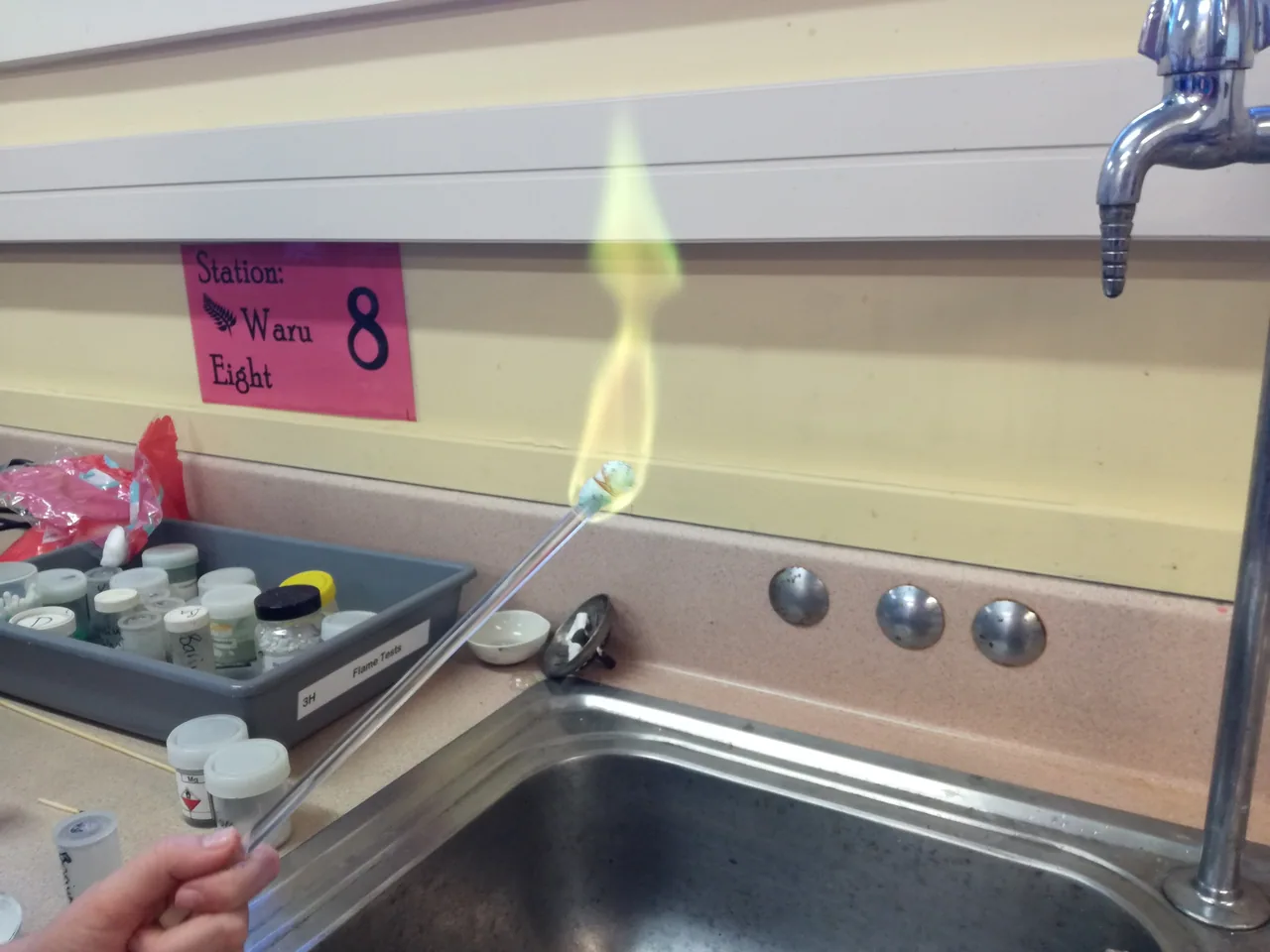
Different chemical elements release distinct wavelengths of light when burned, producing characteristic flame colors known as emission spectra. This chemical principle is widely applied in real-world contexts, including colorful fireworks displays and agricultural soil testing.
Using Minecraft Education chemistry features, students construct individual atoms and combine them into chloride salts. These salts are then crafted with torches to display different flame colors, simulating laboratory flame tests safely in the digital world.
Learning objectives
By the end of this lesson students will be able to:
- Build chemical elements in the Element Constructor by balancing subatomic particles.
- Form chloride salts by combining elements in the Compound Creator.
- Craft colored torches by pairing chloride salts with standard torches.
- Explain how differing electron arrangements produce unique flame emission colors.
Blocks and items used in this lesson
 Element Constructor
 Compound Creator
 Chlorine (Element 17)
Key vocabulary
- Emission spectrum
- The specific pattern of light wavelengths emitted by a chemical element when heated or burned.
- Element Constructor
- A chemistry block used to assemble protons, neutrons, and electrons into chemical elements.
- Compound Creator
- A chemistry block used to combine different elements into chemical compounds in set ratios.
- Chloride salt
- A compound formed when chlorine bonds with another element, such as copper, sodium, or strontium.
Before class
Lesson sequence
Suggested timing: about 60 minutes in total.
- Warm-up and Guiding Questions10 min
Introduce flame colors by discussing how fireworks work. Ask students why elements require equal numbers of protons and electrons, and examine how electrons fill outer shells.
- Constructing Elements15 min
Students open the Element Constructor to build necessary elements, such as chlorine, sodium, and copper, by adjusting the counts of protons, neutrons, and electrons.
- Creating Compounds and Torches20 min
Learners take their elements to the Compound Creator to make chloride salts. They then combine these salts with standard torches in a crafting grid to produce colored torches.
- Discussion and Reflection15 min
Have students place and compare their torches. Discuss why each salt produced a different flame color and connect this to electron configurations and real-world uses like soil testing.
Assessment: success criteria
- Students successfully balance protons and electrons to build elements in the Element Constructor.
- Students combine correct ratios of elements to form chloride salts in the Compound Creator.
- Students craft colored torches and correctly associate specific salts with their flame colors.
- Students explain that distinct electron structures cause elements to emit different wavelengths of light.
Differentiation
Provide a simple recipe card detailing the number of protons, neutrons, and electrons needed for each required element.
Have students analyze why different metal elements require different numbers of chlorine atoms to complete their outer shells.
Knowledge check
5 questions to check understanding after the lesson. Tap an answer to see if it is right; the score appears at the end.
1What causes different elements to produce different colored flames when burned?
Answer: B. Different electron arrangements produce distinct emission spectra, leading to different flame colors.
2Which Minecraft chemistry station is used to assemble protons, neutrons, and electrons?
Answer: C. The Element Constructor is specifically designed to build elements from subatomic particles.
3Which flame color is produced by copper chloride?
Answer: A. According to the flame test reference, copper chloride produces a blue flame.
4Why should mercuric chloride be avoided during hands-on flame test demonstrations?
Answer: B. Mercuric chloride is toxic and should not be used, especially with younger students.
5What is combined with a standard torch in Minecraft to create a colored flame torch?
Answer: B. Crafting a chloride salt together with a torch produces a colored flame torch.
Frequently Asked Questions
Does the Element Constructor show advanced electron configurations?
No. For older or advanced chemistry students, note that the Element Constructor does not display s, p, or d electron subshell configurations.
What real-world applications connect to flame emission colors?
Flame emission spectra are commonly observed in firework displays and are also used practically in scientific fields such as soil testing to detect mineral content.
Adapted from Flaming torches by Rachel Chisnall on Minecraft Education, last updated Jun 21, 2018. This classroom version, the timings and the quiz were written by 9Minecraft Education.