- Type
- Lesson plan
- Subject
- Math
- Topics
- Math & Economics
- Ages
- Ages 11-13
- Duration
- 1 hour
- Level
- Beginner
How do external pressures and financial limits shape the purchasing choices we make as consumers?
Overview
In this financial literacy lesson, students examine how external factors such as peer opinions, advertisements, technology, and economic conditions shape everyday consumer decisions. Before entering the digital environment, learners practice identifying persuasive marketing techniques by designing quick sales pitches for common teenage products.
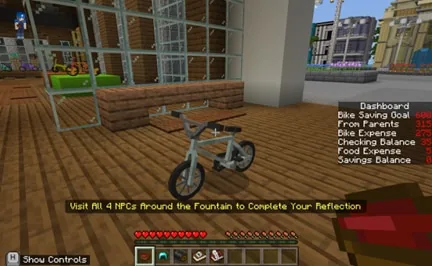
Inside Minecraft, students visit a bicycle store where they must balance their wants against their available savings and checking balances. After navigating advertisements and peer suggestions, they choose an affordable bicycle and helmet, take a test ride around the city, and reflect on how their actual purchases matched their original spending plans.
Learning objectives
By the end of this lesson students will be able to:
- Explain how peers, advertising, and technology influence consumer buying decisions.
- Select an affordable bicycle and required helmet based on available in-game funds.
- Formulate a purchasing plan that accounts for item styles, features, and payment methods.
- Reflect on how actual buying choices compared with original purchasing plans.
Blocks and items used in this lesson


Key vocabulary
- Consumer
- An individual who buys goods or services for personal use.
- Peer Influence
- The effect that friends and classmates have on a person's choices and purchasing behavior.
- Comparison Shopping
- The practice of reviewing different prices, features, and reviews to get the best value before buying.
- Budget
- A plan balancing available money against planned expenditures.
Before class
Lesson sequence
Suggested timing: about 60 minutes in total.
- Reflect and Brainstorm10 min
Have students pair up to share one insight about themselves as consumers from the previous lesson, then invite volunteers to share with the whole group. Ask the class what influences them to buy items, such as family, friends, commercials, or apps, and record their responses on chart paper or a digital board.
- Influence Warm-Up Activity15 min
Group students and hand each team a secret slip of paper with a teen-oriented product (such as sneakers, a tablet, or snacks). Give groups ten minutes to design a short pitch using physical craft supplies or digital presentation apps to persuade classmates to buy their item, followed by rapid two-minute presentations.
- The Minecraft Bike Shop20 min
Direct students into the Minecraft world outside the bike shop, or have them teleport there from their previous location. Students meet an NPC at the entrance who directs them inside to review their current savings and spending accounts. Each bicycle style features three distinct models with different costs and features.
As students browse, they will encounter store ads, social media posts, and peer opinions designed to steer their choices. After picking a bike, students must purchase a helmet. If funds run out, the game teleports them to the cashier to borrow a store helmet instead.
- City Test Ride5 min
Once purchases are complete, students can take their new bicycles for a test ride around the city circle or along the outer dirt path. Ensure all students notice the camera and portfolio added to their inventory for use in the upcoming lesson.
- Reflection10 min
Have students complete a reflection using a OneNote journal, Flip video, or another chosen format. Prompt them to evaluate whether their actual purchases aligned with their starting plan and to identify any external influences that swayed their choices.
Assessment: success criteria
- The student delivers a clear sales pitch that incorporates recognizable marketing techniques.
- The student selects a bicycle and safety helmet that remain within their available in-game funds.
- The student completes a reflection comparing their initial spending plan to their final purchase decisions.
Differentiation
Pair students who need financial navigation support with a classmate to help compare bicycle prices and verify savings balances before buying.
Have advanced students research a real-world purchase plan that compares prices across multiple stores, reviews return policies, and incorporates sales or coupons.
Knowledge check
5 questions to check understanding after the lesson. Tap an answer to see if it is right; the score appears at the end.
1What additional safety item are students required to acquire after selecting their bicycle?
Answer: C. After choosing a bicycle, students must purchase or borrow a helmet before riding.
2What happens if a student does not have enough money left to buy a helmet?
Answer: A. Students lacking funds for a helmet are sent to the cashier to borrow one so they can still ride.
3Which items are placed into student inventories after completing their shopping for use in the next lesson?
Answer: D. A camera and portfolio are added to student inventories to prepare them for documentation in the subsequent lesson.
4What influences do students encounter while browsing bicycles inside the store?
Answer: B. The lesson specifically exposes students to peer opinions, social media messages, and advertisements inside the shop.
5Where are students permitted to ride their bicycles after concluding their transactions?
Answer: A. After the lesson activities, students may ride their bicycles around the city circle or locate the dirt path encircling the city.
Resources
- Lesson package (.zip)Everything the author attached to this lesson in one download.
- Printable version of lesson 4: Time to buyPDF
Frequently Asked Questions
How should students get to the bicycle shop if they spawn in the wrong area?
Students who do not spawn immediately outside the bicycle shop can use an in-game teleport command to move directly to the store from their previous lesson location.
What determines which bicycle a student is able to buy in the store?
The choice depends on the student's total funds, including any accumulated savings and current spending balances, because each of the available bicycle styles features three models with different prices and features.
Adapted from Financial Literacy 4: Time to Buy by Phygital Labs on Minecraft Education, last updated Feb 28, 2025. This classroom version, the timings and the quiz were written by 9Minecraft Education.