- Type
- Lesson plan
- Subject
- Math
- Topics
- Math & Economics
- Ages
- Ages 11-13
- Duration
- 1 hour
- Level
- Beginner
How do our everyday decisions about needs, wants, and donations impact our ability to reach long-term savings goals?
Overview
Balancing immediate desires against long-term financial goals is a vital life skill. In this lesson, students investigate the differences between essential needs, discretionary wants, and charitable giving. By evaluating how personal spending choices affect savings targets, learners develop practical budgeting habits and discover how peer pressure and unexpected expenses can steer people off track.
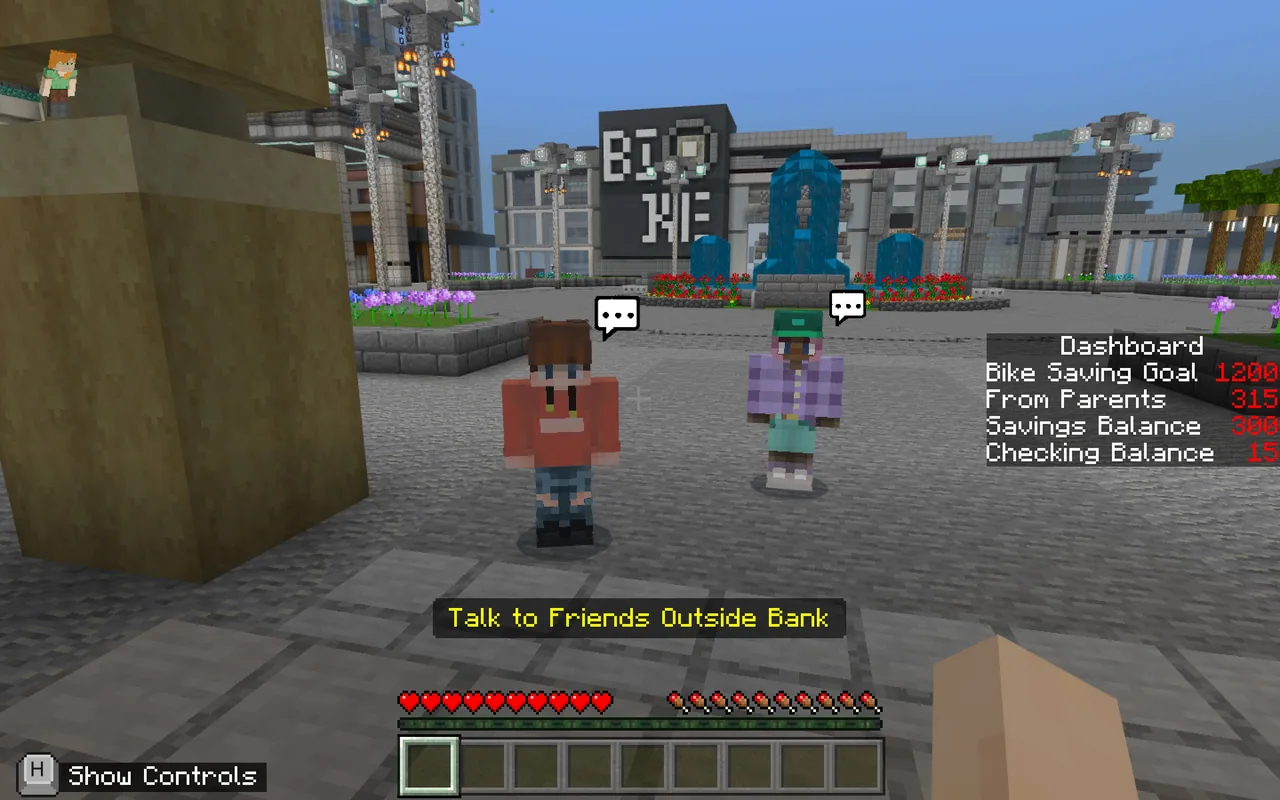
Inside Minecraft, students travel from the bank to a local shopping center with NPC peers. With debit card funds at their disposal, they must decide what goods to buy, what to donate to local causes, and what to keep set aside in savings toward their ultimate goal of purchasing a bicycle. In-game mechanics such as hunger reinforce the reality that some purchases are essential for survival.
Learning objectives
By the end of this lesson students will be able to:
- Distinguish between needs, wants, and charitable donations using realistic spending criteria.
- Manage a personal budget in Minecraft to balance immediate purchases with a long-term goal of buying a bicycle.
- Evaluate how unexpected needs, such as food, and donation requests influence savings and checking balances.
Blocks and items used in this lesson
 Tropical Fish
 Bucket of Tropical Fish
 Bread
 Chest
Key vocabulary
- Need
- An essential item or expense required to survive and function safely in daily life.
- Want
- A non-essential good or service that a person desires but can live without.
- Donation
- Money, goods, or services given voluntarily to help a charity or community cause.
- Budget
- A structured plan that tracks income, expenses, and savings over a set period.
Before class
Lesson sequence
Suggested timing: about 60 minutes in total.
- Warm-up and Reflection10 min
Review prior lessons covering banking and earning an income. Distribute sticky notes and direct students to post reflections under three prompts: I like..., I wish..., and I wonder... to activate prior financial knowledge.
- Needs, Wants, and Budgeting Discussion15 min
Watch instructional videos addressing needs versus wants and youth budgeting strategies. Introduce two guiding test questions: Can I still function in life without this? and Will something bad happen if I do not have this? Introduce charitable donations as a third spending category.
- Collaborative Sorting Activity15 min
Place students in small groups with sorting envelopes and graphic organizers to classify everyday items into needs and wants. Introduce a scenario requiring a major purchase, such as a school laptop, and prompt groups to adjust their categories to accommodate saving for that larger target.
- Minecraft Shopping Simulation15 min
Students log in outside the bank and travel with NPC friends to the shopping center. While browsing stores, they make spending choices using debit cards while tracking funds saved for their target bicycle. Depending on whether they buy a pet fish or head to the restaurant, students encounter donation opportunities and must address character hunger before traveling to the bike shop.
- Debrief and Wrap-up5 min
Regroup to discuss how in-game hunger influenced spending choices and how donating or buying non-essential items affected each student's progress toward buying the bicycle.
Assessment: success criteria
- Accurately sort item cards into needs and wants using the guiding criteria.
- Maintain accurate records of checking and savings balances while shopping in Minecraft.
- Demonstrate understanding of charitable sharing by identifying donation opportunities encountered in the lesson.
Differentiation
Provide pairs with the teacher sorting key criteria list to help them debate borderline items during the unplugged activity.
Have students apply the 30-60-10 budgeting model to design a full personal spending and charity plan based on a mock job income.
Knowledge check
5 questions to check understanding after the lesson. Tap an answer to see if it is right; the score appears at the end.
1What long-term purchase goal are students working to save for throughout the Minecraft simulation?
Answer: B. The lesson scenario specifies that students are keeping their savings focused on buying a new bicycle.
2Which question is introduced to help students decide whether an item is truly a need?
Answer: D. The lesson uses the questions 'Can I still function in life without this?' and 'Will something bad happen if I don't have this?' to identify needs.
3What happens in the Minecraft simulation if a hungry player does not purchase food at the restaurant?
Answer: A. The source notes that skipping food causes a woozy effect and instructs the player to return and buy food.
4Beyond needs and wants, what third way to spend money is introduced before entering the world?
Answer: C. The teacher prompts students to consider donations as an additional way to allocate money outside of basic needs and personal wants.
5If a student decides to purchase a fish at the pet shop, what situation do they encounter upon returning home?
Answer: B. Taking the pet fish home triggers an encounter where a neighbor requests a charitable donation for a fundraising event.
Resources
- Lesson package (.zip)Everything the author attached to this lesson in one download.
- Printable lesson: I want it, but do I need it?PDF
- I want it, but do I need it? Sort activityPDF
Frequently Asked Questions
How does hunger function as an educational mechanic in this lesson?
Hunger represents an unavoidable life need. Because students must buy food to cure the woozy effect, they learn firsthand that essential living expenses take priority over discretionary purchases.
What happens if a student does not buy the pet fish?
Students who bypass the pet shop go to a restaurant with friends, where they encounter a different donation option that contributes a portion of their meal cost to a school esports team.
Adapted from Financial Literacy 3: I want it, but do I need it? by Phygital Labs on Minecraft Education, last updated Feb 28, 2025. This classroom version, the timings and the quiz were written by 9Minecraft Education.