- Type
- Lesson plan
- Subject
- Math
- Topics
- Math & Economics
- Ages
- Ages 11-13
- Duration
- 1 hour
- Level
- Beginner
How do the effort, time, and skills required for different jobs affect your ability to earn money and reach a savings goal?
Overview
In this introductory personal finance lesson, students explore the connection between work requirements and earning potential. Through small-group brainstorming and class discussion, learners evaluate realistic jobs for middle schoolers and classify them by skill, experience, and time commitment. This establishes a foundational understanding of how different types of labor yield different financial rewards.Learning objectives
By the end of this lesson students will be able to:
- Categorize youth jobs into four tiers of difficulty based on time, effort, and required skill.
- Select a target bicycle in Minecraft and navigate parkour-based jobs to earn income toward purchasing it.
- Compare the earnings and effort experienced during the in-game activity with real-world job expectations.
Blocks and items used in this lesson


Key vocabulary
- Income
- Money received on a regular basis in exchange for work or completed services.
- Savings Goal
- A specific target amount of money set aside over time to purchase a desired item.
- Time Commitment
- The total amount of hours or effort needed to carry out a specific responsibility or job.
Before class
Lesson sequence
Suggested timing: about 60 minutes in total.
- Brainstorming Middle School Jobs15 min
Divide students into small groups to complete an initial brain dump of potential jobs on their graphic organizer. Groups then sort their listed jobs into four difficulty brackets—easiest, average, harder, and hardest—evaluating the skills, prior experience, and time commitment each role demands.
- Class Comparison and Individual Ranking10 min
Facilitate a whole-class share-out and record suggested jobs on chart paper. Afterward, have each student independently select four jobs, sequence them from least to most demanding, and share their conclusions within their small groups while considering income potential.
- Bicycle Shop Exploration10 min
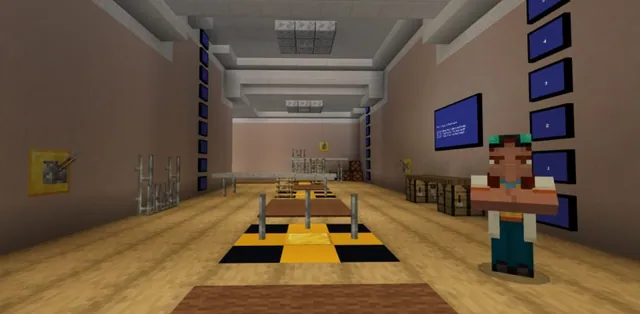
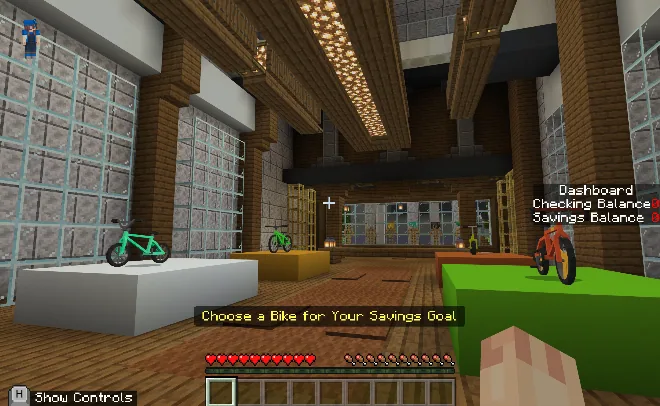
Introduce the Minecraft activity and direct students to spawn outside the bicycle shop. Learners interact with shop NPCs to review four distinct bicycle options, choose the specific model they want to save for, and speak with the counter NPC to teleport to the job arena.
- Job Arena Parkour15 min
Learners meet the greeter NPC and work through parkour courses ranked from easiest to hardest, collecting a paycheck after each successful run. Harder levels yield higher paychecks. Students receive up to three attempts per course before additional practice is required, working for roughly five minutes to gather funds.
- Earning Logs and World Pause10 min
When the arena timer concludes or all courses are finished, learners automatically teleport to the bank, where they must pause. Students log their earnings in their notebooks and verify their in-game savings record, saving their world file to external storage or cloud accounts if devices are shared.
Assessment: success criteria
- Student accurately sorts real-world youth jobs into four tiers using the criteria of skill, time, and effort.
- Student selects a target bicycle and completes job challenges to generate savings within the game.
- Student accurately records earnings and explains how task difficulty influences compensation.
Differentiation
Provide a starter list of common neighborhood jobs on the organizer and allow extra attempts during the parkour challenges.
Have students calculate how many repetitions of an easier job would be needed to match the payout of a single advanced job.
Knowledge check
5 questions to check understanding after the lesson. Tap an answer to see if it is right; the score appears at the end.
1What specific item are students working to purchase throughout this lesson?
Answer: B. The lesson scenario revolves around setting an earning goal to buy a bicycle from the shop.
2Into how many categories do students sort their brainstormed jobs during the opening activity?
Answer: D. Students organize their jobs into four categories: easiest, average, harder, and hardest.
3How does the earning potential of harder parkour jobs compare to easier jobs in the arena?
Answer: A. The easiest job requires the least effort and pays the least, while harder jobs earn larger paychecks.
4How many failed attempts does a player receive on a parkour job before being prompted to practice the course again?
Answer: B. Players restart from the beginning on their first two failures, and after three failed attempts they are asked to practice again.
5Where are students teleported after finishing the job arena, marking the pause point for Lesson 2?
Answer: C. Once the arena finishes or time runs out, learners teleport to the bank, where they must pause until the next lesson.
Resources
- Lesson package (.zip)Everything the author attached to this lesson in one download.
- Savin Up Graphic OrganizerGraphic organizer to support lesson one
- Printable version of lesson 1: Savin' UpPDF
Frequently Asked Questions
What should students do as soon as they arrive at the bank?
Students must immediately pause their game when they reach the bank, as that location marks the beginning of Lesson 2.
What happens if a student struggles and earns very little money during the arena session?
The game provides a safety net by placing a guaranteed minimum balance into the learner's account so that every student can afford the base model BMX bike.
How can students keep their game data safe if computers are shared across periods?
Students should export their world files to cloud storage or an external flash drive at the end of class so their savings and location are preserved.
Adapted from Financial Literacy 1: Savin' Up by Phygital Labs on Minecraft Education, last updated Feb 28, 2025. This classroom version, the timings and the quiz were written by 9Minecraft Education.