- Type
- Lesson plan
- Subject
- MathHistory & Social Studies
- Grade
- Primary (Grades 3-5)
- Ages
- Ages 8-10
- Duration
- about 80 min (suggested)
- Skills
- Critical thinking
- Includes
- Quiz: 5 questions
How can we create, scale, and communicate systems of measurement to construct objects accurately?
Overview
Students examine how ancient civilizations, particularly ancient China, applied systems of measurement to organize large-scale engineering and artistic projects such as the Terracotta Army. They explore how standardized units allow people to communicate precise dimensions and scale objects accurately.Using Minecraft, learners build everyday structures, calculate scale reductions, and experiment with alternative measurement units including slabs, coordinates, item drops, and player movement steps.
Learning objectives
By the end of this lesson students will be able to:
- Formulate a hypothesis regarding how ancient builders used measurement to create the Terracotta Army.
- Build a 3D model and clearly describe its dimensions to another builder using block units.
- Recreate a design at one-fourth scale by expressing larger units in terms of smaller fractions.
- Evaluate alternative in-game units of measurement, such as slabs, coordinates, and character steps.
Blocks and items used in this lesson


Key vocabulary
- Terracotta Army
- A collection of ancient Chinese clay sculptures depicting soldiers and horses, built using precise proportions.
- Scale
- The proportional ratio between the size of a model and the real or original object.
- Unit of Measurement
- A standard quantity used to specify the physical dimensions, distance, or size of an object.
- Slab
- A Minecraft block that represents exactly one-half the height of a standard full block.
Before class
Lesson sequence
Suggested timing: about 80 minutes in total.
- Historical Background & Hypothesis15 min
Introduce historical information about the Terracotta Army and ancient Chinese measurement units like the chi. Discuss why accurate measurement was necessary to assemble thousands of figures and equipment. Ask students to formulate and write down a hypothesis explaining how ancient Chinese builders relied on measurement systems to complete the project.
- Base Build & Unit Description25 min
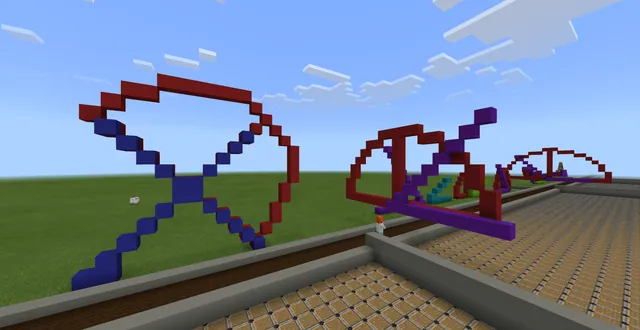
Direct students to design an everyday object or structure, such as a house or a person, in Minecraft. Once built, students formulate precise instructions describing their object to a partner using block counts (for example, building a 4x4x4 cube row by row).
- Scaling Down to One-Fourth15 min
Challenge students to build a second version of their original design at one-fourth (1/4) scale. Have them describe the scaled-down structure to another student, detailing how their measurements changed between the larger and smaller units.
- Exploring Alternative Units15 min
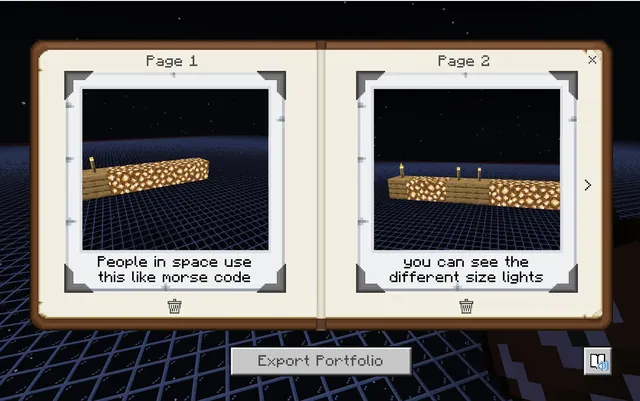
Ask students to measure and rebuild their designs using units other than full blocks. Suggested units include half-block slabs, player steps based on character movement speed, fallen items, or coordinate values. Discuss which measurement systems make construction easier and which make it more challenging.
- Reflection & Synthesis10 min
Have students write a short reflection answering guiding questions about the history of Chinese measurement, the challenges they faced when inventing their own Minecraft measurement units, and how they resolved those difficulties.
Assessment: success criteria
- Student writes a testable hypothesis linking ancient measurement systems to historical construction.
- Student accurately calculates and constructs a model at one-fourth scale.
- Student communicates build instructions clearly using defined measurement units.
- Student completes a written reflection comparing the effectiveness of different measurement units.
Differentiation
Encourage students to design their initial object using whole numbers easily divisible by four, such as dimensions of 4, 8, or 12 blocks.
Have students investigate how their custom measuring systems relate to modern SI units or compare them to historical systems from ancient Egypt, Greece, India, or Mexico.
Knowledge check
5 questions to check understanding after the lesson. Tap an answer to see if it is right; the score appears at the end.
1Which historical artifact is examined in this lesson to study ancient measurement?
Answer: A. The lesson introduces the history and construction of the ancient Chinese Terracotta Army.
2If a student builds a cube measuring 4 blocks long, 4 blocks wide, and 4 blocks high, what are its dimensions at 1/4 scale?
Answer: C. Dividing each 4-block dimension by 4 results in a scaled size of 1 block on each side.
3Which in-game element is suggested as an alternative unit representing a half-block?
Answer: B. Slabs are explicitly identified as half-block units in the lesson activities.
4Which of the following is tested as an alternative unit of measurement in the lesson?
Answer: D. Character steps based on movement speed are listed as an alternative measurement system to test.
5What is the primary math objective practiced when redesigning objects with smaller blocks or slabs?
Answer: A. The learning objective focuses on expressing measurements in a larger unit in terms of a smaller unit within a single system.
Frequently Asked Questions
Do I need a special downloaded Minecraft world for this lesson?
No custom world download is required. Students can complete all building and measurement exercises in any standard flat or open Minecraft world.
What subjects does this lesson integrate alongside mathematics?
This lesson integrates history, geography, economics, and critical thinking by connecting measurement systems to ancient Chinese engineering.
Adapted from Exploring Systems of Measurement by Minecraft Education on Minecraft Education, last updated Apr 7, 2017. This classroom version, the timings and the quiz were written by 9Minecraft Education.