- Type
- Lesson plan
- Ages
- Ages 6-13
How can observation, teamwork, and problem-solving help us navigate the challenges of an ancient Egyptian pyramid?
Overview
Students journey to ancient Egypt to tackle an escape room set deep within a pyramid. Working either individually or in cooperative teams of three to four, learners practice critical thinking and problem-solving to unlock successive chambers without relying on written prompts.
Using Minecraft Education, students observe environmental visual cues, such as colors and block patterns, to decipher each puzzle. All classroom challenges rely on basic redstone wiring, allowing learners to analyze the engineering behind the traps, document their steps with an in-game camera, and optionally examine or recreate the rooms in creative mode.
Learning objectives
By the end of this lesson students will be able to:
- Navigate and interact inside the Minecraft world to discover puzzle solutions.
- Solve room challenges creatively by analyzing visual clues like colors and patterns.
- Document progress through each pyramid chamber using the in-game camera and an adventure diary.
- Examine or rebuild basic redstone mechanisms used to power the escape room challenges.
Blocks and items used in this lesson


Key vocabulary
- Pyramid
- A monumental stone structure with a square base and sloping triangular sides built in ancient Egypt.
- Pharaoh
- A ruler or monarch of ancient Egypt.
- Redstone
- A Minecraft material used to build electrical circuits and power automated mechanical contraptions.
Before class
Lesson sequence
- Briefing and Orientation
Introduce the ancient Egypt setting and direct students to read the starting NPC or board. Explain that there are no written clues inside the chambers, so teams must pay close attention to colors and block patterns.
- Pyramid Escape Room
Students work individually or in small groups to navigate through the sequence of puzzle rooms. If students make a mistake, they lose only time and may retry as many times as needed to solve the room and unlock the next door.
- Camera Documentation
In each room, students use their camera to capture a screenshot of the challenge. They record their observations in an adventure diary, explaining the clues and logic they used to progress.
- Redstone Analysis and Recreation
After escaping the pyramid, switch students to creative mode with worldbuilder permissions. Students inspect the redstone wiring powering the room mechanics and attempt to rebuild one of the puzzle systems.
- Desert Exploration and Debrief
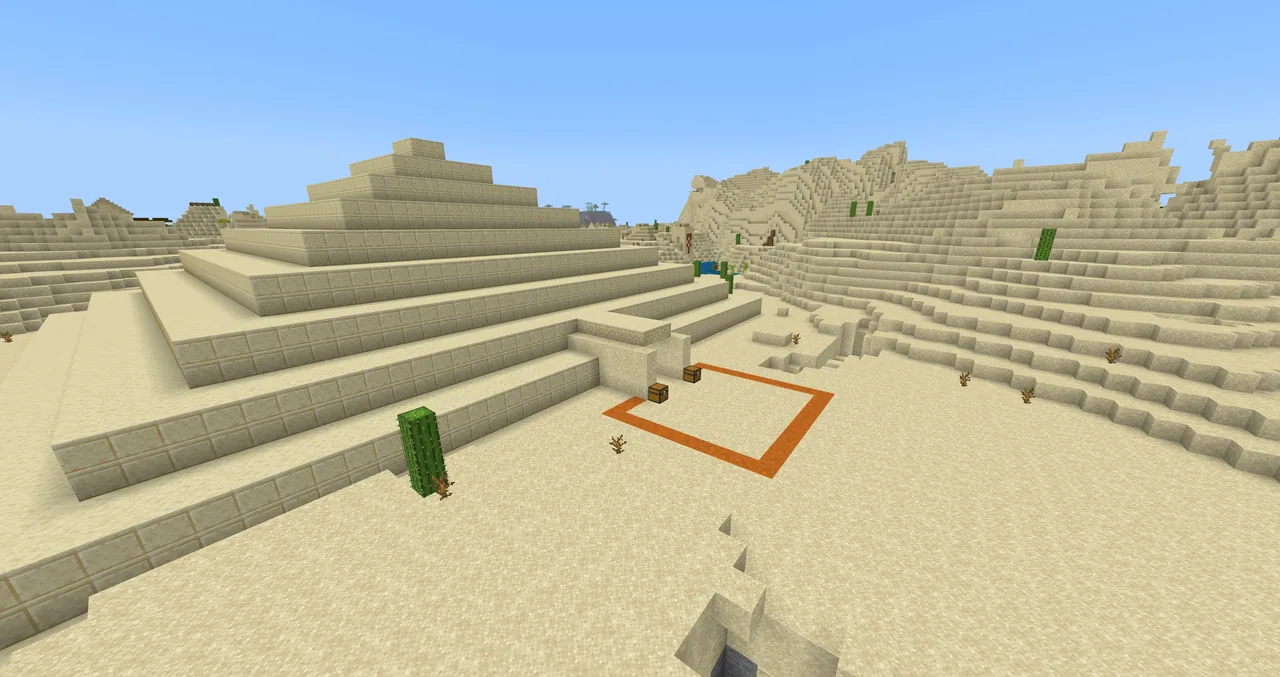
Students exit into the surrounding desert area to explore the exterior landscape, discussing how ancient Egyptian architecture and desert climates connect to their in-game experience.
Assessment: success criteria
- Student successfully navigates through the puzzle chambers without skipping rooms.
- Adventure diary includes screenshots and written explanations for each room's solution.
- Student demonstrates basic understanding of redstone mechanics during the creative mode investigation.
Differentiation
Allow students to collaborate in small teams of three or four and use the teacher solutions guide to provide gentle hints when groups are stuck.
Grant worldbuilder status in creative mode so advanced students can design and wire their own redstone-powered puzzle chamber.
Knowledge check
5 questions to check understanding after the lesson. Tap an answer to see if it is right; the score appears at the end.
1What powers all the puzzle mechanisms found inside the pyramid?
Answer: A. The source notes that all pyramid mechanics are basic and powered entirely by redstone without command blocks.
2What are students instructed to look for when trying to solve each chamber?
Answer: C. Because there are no written instructions, students must look around at colors and patterns to find the answers.
3What is the penalty if a student fails a puzzle attempt inside the pyramid?
Answer: B. There is no punishment for mistakes; students simply lose time and can retry as many times as needed.
4How can students document their progress across each room of the pyramid?
Answer: D. Teachers can ask students to take photos using the camera and build an adventure diary explaining each room.
5What can students do once they successfully solve the escape room and exit the pyramid?
Answer: A. At the end of the adventure, students exit the pyramid and can explore the desert to learn about Egypt or climate.
Resources
- Lesson package (.zip)Everything the author attached to this lesson in one download.
- GuidePDF Guide with the solution to each room
- WorldM:EE world
Frequently Asked Questions
How can I tell how far along each student or group is during the lesson?
Because learners cannot skip rooms to progress, you can gauge each student's progress simply by checking their screen to see which chamber they currently occupy.
What should I do if my students get completely stuck on a puzzle?
You can refer to the downloadable solutions guide provided with the lesson materials to give targeted hints to struggling groups.
Adapted from Escape the pyramid by Leticia Ahumada on Minecraft Education, last updated Apr 28, 2022. This classroom version, the timings and the quiz were written by 9Minecraft Education.