- Type
- Lesson plan
- Ages
- Ages 8-13
- Duration
- 45 min
- Level
- Beginner
How do layered authentication methods and coordinated response teams protect digital networks during a cyber attack?
Overview
In this cybersecurity unit, students discover how organizations protect critical networks from intruders through authentication and rapid incident management. Learners examine the differences between what a user knows, what a user has, and who a user is to see why combining multiple security layers makes data significantly harder to compromise.
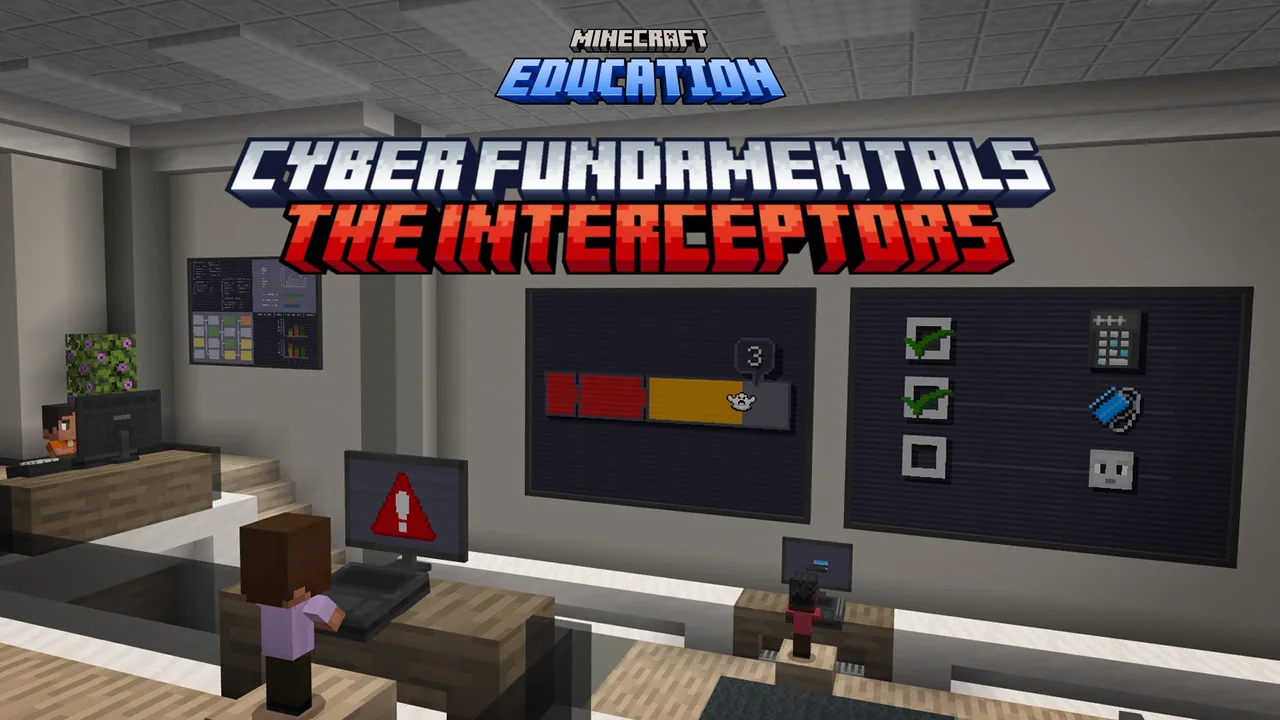
Using the Minecraft world, players rescue staff members by finding security items, operate authentication consoles to halt a network intruder, and explore the Security Operations Center. Students then pair cybersecurity specialists with their proper workstations and fill out an incident report in sequential order.
Learning objectives
By the end of this lesson students will be able to:
- Identify the three primary types of authentication: something you know, something you have, and something you are.
- Explain how multi-level authentication creates a stronger defense against network intruders.
- Describe the core responsibilities of members on an incident response team.
- Complete a sequential incident report following a simulated cybersecurity breach.
Blocks and items used in this lesson


Key vocabulary
- Authentication
- Verifying that an individual is truly who they claim to be.
- Biometrics
- Authentication based on physical traits, such as fingerprints or eye scans.
- Multi-level Authentication
- The practice of using more than one method to verify identity.
- Incident Response Team
- A specialized group that responds to, investigates, fixes, and communicates about security breaches.
- Security Operations Center (SOC)
- The central facility housing workstations where specialists monitor and defend the network.
- Forensic Analyst
- A team member who inspects system logs to trace breach origins and assess damage.
Before class
Lesson sequence
Suggested timing: about 45 minutes in total.
- Authentication and Intrusion Defense20 min
Students search desks to locate a digital security key and a keycard to release the teacher and Cybersecurity Specialist. Working quickly at network consoles, learners input passwords, scan biometrics, and use keycards to block an intruder before data is stolen across network segments.
- Formative Reflection 15 min
Students open the Book and Quill in their hotbar to answer reflection prompts about multi-factor authentication, listing real-world examples and personal security applications directly onto a blank page.
- Assembling the Incident Response Team15 min
Students explore the Security Operations Center (SOC) to inspect workstations and their tools. They interview various specialists, matching the Lead, Analyst, Forensic Analyst, Engineer, Communications Specialist, and Legal Expert to their appropriate stations before recording the incident report sequentially.
- Formative Reflection 2 and Wrap-Up5 min
Learners use their in-game book to define an incident response team, outline specialist duties, and explain response procedures, earning their CyberFUNdamentals Certificate upon completing the world.
Video
Assessment: success criteria
- Student successfully halts the intruder by applying distinct authentication types at each console.
- Student correctly assigns all six incident response specialists to their designated SOC workstations.
- Student completes sequential steps of the in-game incident report.
- Student records clear definitions of multi-factor authentication and response team roles in the Book and Quill.
Differentiation
Allow students to review the student activity workbook for role descriptions when matching specialists to SOC workstations.
Have students write additional real-life scenarios in their Book and Quill explaining when a Legal Expert or Communications Specialist would be vital during a breach.
Knowledge check
5 questions to check understanding after the lesson. Tap an answer to see if it is right; the score appears at the end.
1Which of the following is an example of authentication based on 'something you are'?
Answer: C. Biometrics, such as scanning fingerprints or eyes, authenticate a user through physical traits that represent who they are.
2What happens in Lesson 1 if the intruder escapes to a new network segment before authentication is complete?
Answer: A. If an intruder reaches a new segment, players are required to restart the authentication steps.
3Which team member analyzes system logs to investigate incident damage and determine the attack source?
Answer: B. The Forensic Analyst specifically checks system logs alongside the analyst to identify damage and origins of a cyber attack.
4What is the primary role of the Engineer on the Incident Response Team?
Answer: C. The Engineer is responsible for applying network security updates to contain and remove threats.
5How do students record their answers for both formative assessments in this lesson?
Answer: A. Both formative assessments instruct players to open the Book and Quill in their hotbar and type their responses on a new page.
Resources
- Lesson package (.zip)Everything the author attached to this lesson in one download.
- Educator GuideEducator Guide - Lesson Plan and Standards
- Presentation SlidesPowerPoint Presentation Slides
- Student Activities WorkbookStudent Activities Workbook
- Formative Assessment 1Knowledge Check 1
- Formative Assessment 2Knowledge Check 2
- CertificateCertificate of Completion
- Lesson worldOpens the world page in Minecraft Education (sign-in with a school account may be needed).
Frequently Asked Questions
What materials are provided to support this lesson?
The lesson includes an Educator Guide, Presentation Slides, Student Activities Workbook, two formative assessments, a downloadable Minecraft world, and a completion certificate.
What age group is this cybersecurity unit intended for?
The activities are designed for students ages 8 to 13, covering Lower Secondary grades 6 through 8 at a beginner experience level.
What occurs if students fail to stop the intruder at the consoles?
If the intruder manages to gather all of the network data, the players lose the challenge and must try again.
Adapted from Cyber Fundamentals 2: The Interceptors by Minecraft Education on Minecraft Education, last updated Oct 18, 2023. This classroom version, the timings and the quiz were written by 9Minecraft Education.