- Type
- Lesson plan
- Ages
- Ages 8+
- Duration
- 45 min
- Level
- Beginner
- Includes
- Quiz: 5 questionsMinecraft world
How can teams use effective communication, coding, and structured reflection to succeed in an esports build battle?
Overview
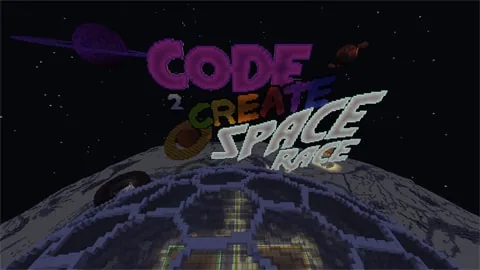
This lesson blends computer science with esports competition by challenging students to work as high-performing teams. Learners practice 3D spatial thinking, strategic planning, and peer assessment while building within an engaging lunar environment. The experience emphasizes communication and self-evaluation alongside core technical skills.Using Minecraft Education, teams of four to six participants compete in a space-themed build arena on a giant moon surrounded by celestial bodies. Spectating classmates participate actively as coaches, shoutcasters, and analysts before casting peer votes on dedicated platforms to determine the winning team.
Learning objectives
By the end of this lesson students will be able to:
- Collaborate within a small team to plan and execute a space-themed build using coding skills.
- Translate two-dimensional geometric concepts into three-dimensional in-game structures.
- Establish and apply fair peer evaluation criteria using designated in-game voting areas.
- Reflect on team dynamics and personal performance using a structured play journal.
Blocks and items used in this lesson


Key vocabulary
- Esports
- Organized, team-based competitive gaming centered on strategy, collaboration, and sportsmanship.
- Shoutcaster
- A commentator who provides real-time play-by-play commentary during a competitive match.
- Peer Assessment
- The process of learners providing constructive feedback and scoring each other based on agreed standards.
- 3D Visualization
- The ability to mentally picture, translate, and construct shapes with height, width, and depth.
Before class
Lesson sequence
Suggested timing: about 45 minutes in total.
- Introduction and Strategy Briefing10 min
Introduce the moon setting and present the space-themed build challenge. Divide the class into teams of four to six players and invite groups to formulate their communication strategy and design plan.
- 3D Thinking Warm-Up5 min
Display a two-dimensional geometric shape and prompt teams to reproduce it in three dimensions, or challenge them to sketch a 3D build onto paper to reinforce spatial visualization skills.
- Setting Evaluation Criteria5 min
Collaborate with the class to establish clear assessment standards for the competition. Assign non-building participants to supportive roles such as shoutcasters, media reporters, or gameplay analysts.
- Space Race Build Battle15 min
Launch the build battle. Teams code their structures in the lunar world while spectator roles monitor progress, broadcast updates, and cheer on the competitors.
- Voting and Journal Reflection10 min
Direct students to cast their votes within a set time limit by standing on their chosen team platform. Conclude by having learners complete entries in their Professional Play journals to set goals for future matches.
Assessment: success criteria
- Teams demonstrate active communication and shared responsibility during the coding build phase.
- Completed builds reflect the agreed space theme and demonstrate 3D spatial awareness.
- Students evaluate other teams fairly and decisively using established criteria at the voting platforms.
- Individual journals contain thoughtful reflections on personal strengths, teamwork, and goal setting.
Differentiation
Provide reference cards with simple 2D space diagrams and clearly assign single, focused tasks to each member of the team.
Encourage advanced teams to write automated code scripts for complex structures or appoint students to deliver live match commentary as shoutcasters.
Knowledge check
5 questions to check understanding after the lesson. Tap an answer to see if it is right; the score appears at the end.
1What is the recommended number of players per team for this build battle?
Answer: B. The lesson specifically recommends forming teams of between four and six players.
2Where does this competitive build battle take place?
Answer: D. The source describes the environment as a giant moon surrounded by planets and satellites.
3How do student spectators cast their votes to determine the winning build?
Answer: C. Students finalize their decision by moving their characters onto the allocated voting platforms.
4What tool do students use to record their personal reflections and evaluate their growth?
Answer: A. The plan prompts students to record thoughts and set future goals in a Professional Play journal.
5Which of the following is an auxiliary role mentioned for students not actively building?
Answer: B. Spectators can participate as shoutcasters, press and media, coaches, or gameplay analysts.
Resources
Frequently Asked Questions
How can spectating students stay engaged during the build match?
Spectators can take on official tournament positions such as shoutcasters providing live commentary, press reporters documenting builds, team coaches, or gameplay analysts.
How does this lesson incorporate spatial thinking?
Teachers can challenge students to translate 2D reference drawings into 3D Minecraft structures or reverse the exercise by drawing in-game builds in two dimensions.
Why must assessment criteria be defined before the build starts?
Setting criteria ahead of time ensures that students evaluate peer builds objectively when making quick decisions on the voting platforms.
Adapted from Code 2 Create: Space Race by Minecraft Education on Minecraft Education, last updated Apr 15, 2025. This classroom version, the timings and the quiz were written by 9Minecraft Education.