- Type
- Lesson plan
- Ages
- Ages 8+
- Duration
- 45 min
- Level
- Beginner
- Includes
- Quiz: 5 questions
How can teams use effective communication, planning, and reflection to succeed in a collaborative design challenge?
Overview
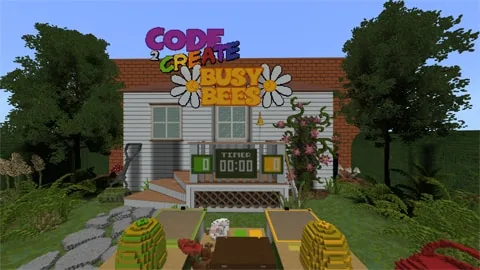
Working in teams requires clear communication, shared strategy, and the ability to evaluate performance objectively. In this esports-style lesson, students explore what makes a team effective by participating in a structured build battle focused on nature, bees, and the environment.
Using Minecraft Education, teams apply coding skills, computational thinking, and 3D visualization to construct their garden projects. Spectators engage through specialized roles and evaluate builds on designated voting platforms, while participants document their progress and set goals using a personal reflection journal.
Learning objectives
By the end of this lesson students will be able to:
- Collaborate in small groups to design and construct a garden-themed model in Minecraft.
- Apply coding skills and 3D visualization to complete a collaborative build challenge.
- Evaluate peer builds objectively using pre-determined success criteria.
- Reflect on individual and group performance using a dedicated learning journal.
Blocks and items used in this lesson


Key vocabulary
- Structure Block
- An in-game block used to capture and export 3D models for printing or saving.
- Success Criteria
- Pre-agreed guidelines or standards used to judge the quality of a project.
- Shoutcaster
- A commentator who provides live commentary and play-by-play analysis during a competitive match.
- Peer Assessment
- The process of students reviewing and evaluating the work of their classmates.
- Computational Thinking
- A problem-solving approach that breaks complex tasks into structured, logical steps.
Before class
Lesson sequence
Suggested timing: about 45 minutes in total.
- Strategy and Criteria Setup10 min
Introduce the natural world and bee theme. Establish clear success criteria with the class, form teams of four to six learners, and assign non-builder roles such as shoutcasters, media reporters, or analysts to spectators.
- 3D Visualization Exercise5 min
To build spatial reasoning, provide groups with a 2D geometric shape to recreate as a 3D structure in-game, or have learners draft 2D sketches of their planned 3D builds.
- Collaborative Build Battle15 min
Teams compete in the build arena to create their garden-themed designs using coding and construction tools. Spectators, shoutcasters, and team coaches observe, encourage, and commentate during the match.
- Peer Evaluation5 min
Students inspect the completed builds and evaluate each creation against the agreed rubric. Spectators make their final decisions within a limited timeframe by standing on designated voting platforms.
- Reflection and Goal Setting10 min
Learners complete entries in their Professional Play journal using guided stimulus questions. They reflect on communication, teamwork, areas for improvement, and set goals for future team play.
Assessment: success criteria
- Learners demonstrate active communication and collaboration during the team build challenge.
- Student models reflect the chosen natural world or bee theme using computational design skills.
- Students apply the established criteria accurately when voting on peer creations.
- Journal entries document meaningful self-reflection, identification of strengths, and actionable goals.
Differentiation
Provide struggling teams with reference cards showing 2D geometric shapes to guide their 3D structures.
Challenge advanced teams to export their completed builds for 3D printing using the in-game structure block.
Knowledge check
5 questions to check understanding after the lesson. Tap an answer to see if it is right; the score appears at the end.
1What is the central theme of the build challenge in this lesson?
Answer: C. The lesson specifically focuses on natural world themes, bees, and the environment.
2Which tool in Minecraft Education is used to capture designs for 3D printing?
Answer: B. The source specifies using the in-built structure block to 3D print builds.
3How do spectating students cast their votes after the build battle concludes?
Answer: D. Students cast their votes by standing on allocated voting platforms within a set time limit.
4What is the recommended number of players for each build battle team?
Answer: A. The source recommends organizing teams of 4 to 6 players.
5What tool do students use to document self-evaluation and personal growth throughout the lesson?
Answer: B. Students maintain a Professional Play journal to record stimulus reflections, self-evaluations, and future goals.
Frequently Asked Questions
What roles can students take if they are not actively building on a team?
Spectators can participate as shoutcasters, media reporters, team coaches, or gameplay analysts to support and analyze the event.
Do I need a downloadable world file to run this lesson?
No special world download is required; the activity can be conducted in any standard Minecraft world with space for building and voting platforms.
Adapted from Code 2 Create: Busy Bees by Minecraft Education on Minecraft Education, last updated Apr 15, 2025. This classroom version, the timings and the quiz were written by 9Minecraft Education.