- Type
- Lesson plan
- Grade
- Early years (Pre-K to Grade 2)Primary (Grades 3-5)Middle school (Grades 6-8)High school (Grades 9-12)
- Ages
- All ages
- Duration
- 1 hour
- Level
- Intermediate
- Includes
- Quiz: 5 questions
How do human actions cause different types of pollution across unique ecosystems, and what targeted solutions can restore balance?
Overview
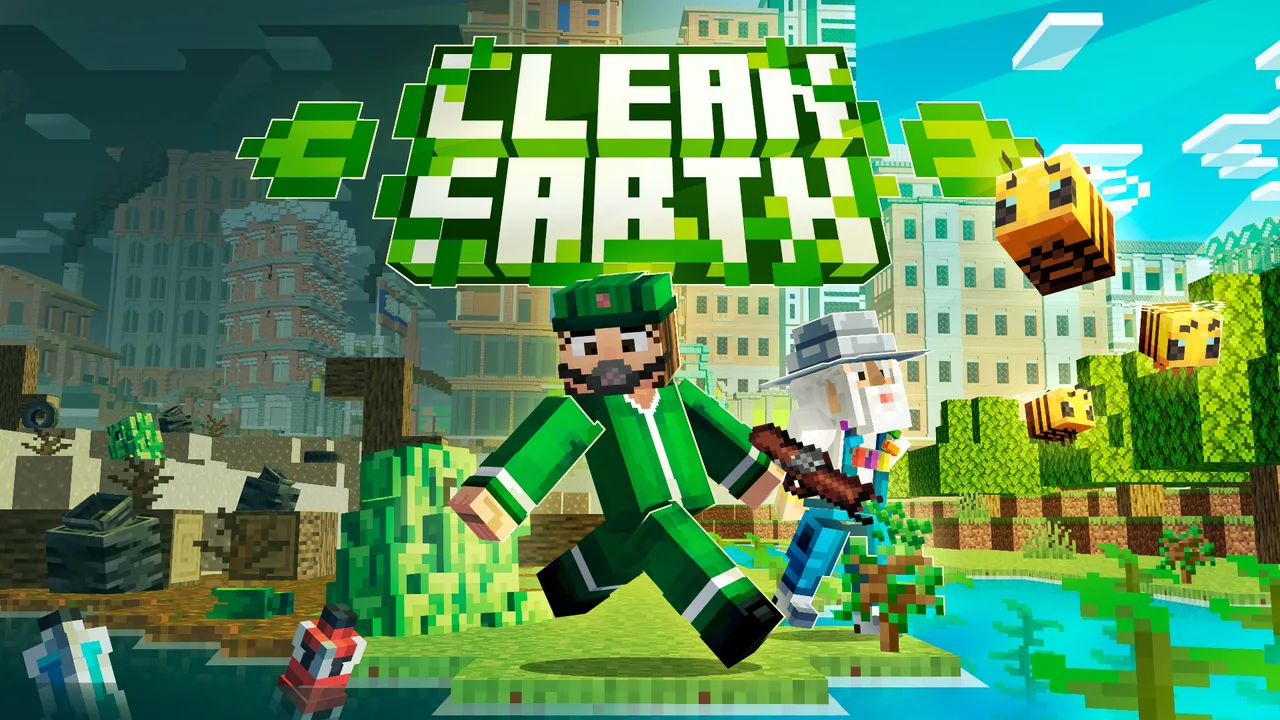
Environmental degradation is a global challenge, but understanding how human actions affect distinct habitats can help learners build sustainable habits. By addressing simulated environmental crises across forests, oceans, deserts, and urban areas, students explore how ecological care must adapt to the specific needs of each ecosystem.
Using the Clean Earth Minecraft world in Adventure Mode, students take on the role of environmental stewards guided by non-player characters. Learners progress through sequential quests where they use specialized gear to clear debris, restore plant life, cleanse waterways, and activate green technologies across four separate regions.
Learning objectives
By the end of this lesson students will be able to:
- Identify distinct forms of pollution found across forest, ocean, desert, and city environments.
- Operate specialized in-game cleanup and repair equipment to complete twelve restoration objectives.
- Explain how local environmental remediation efforts connect to broader global sustainability practices.
- Formulate real-world cleanup or conservation actions that mirror simulated in-game solutions.
Blocks and items used in this lesson


Key vocabulary
- Ecosystem
- A community of living organisms interacting with their physical environment.
- Stewardship
- The responsible use and protection of the natural environment through conservation.
- Smog
- Air pollution produced by smoke, gases, and atmospheric moisture that reduces visibility and air quality.
- Renewable Energy
- Power generated from natural resources that replenish continuously, such as wind or solar power.
Before class
Lesson sequence
Suggested timing: about 60 minutes in total.
- Introduction and Orientation10 min
Introduce the lesson by asking students to name different types of environmental pollution they have observed. Explain that learners will travel through four distinct biomes to resolve environmental damage using specialized tools provided by non-player characters.
- Forest and Ocean Quests20 min
Students log in and complete the first two biomes in order:
- Forest: Pick up plastic and paper waste with the Trash Collecting Tool, replant trees with the Sapling Planter, and purify dirty water with the Water Filter Tool.
- Ocean: Gather marine plastic using the Ocean Cleaning Net, restore bleached corals with the Coral Repair Tool, and remove hazardous oil using the Oil Cleaning Tool.
- Desert and City Quests20 min
Learners proceed into the remaining unlocked regions:
- Desert: Gather scattered paper and trash, revegetate the ground using the Desert Planting Tool, and fix dry wells with the Well Repair Kit.
- City: Filter atmospheric pollution using the Smog Purifier, activate Eco-Machines with Renewable Energy Cores, and collect fifty pieces of urban trash using the Recycling Collector Tool.
- Debrief and Reflection10 min
Conclude with individual journal writing and a brief class discussion. Prompt students to compare the challenges of each biome and identify parallel environmental problems within their own school campus or local community.
Assessment: success criteria
- Verification of completion for all twelve sequentially unlocked environmental quests.
- Correct selection and deployment of specialized tools appropriate to each ecological issue.
- Meaningful contributions to group discussions comparing pollution across different ecosystems.
- Written journal responses describing how simulated restoration tasks correspond to real-world conservation.
Differentiation
Pair struggling readers with a partner to read non-player character instructions aloud and help locate target quest markers.
Have early finishers draft a blueprint for a fifth game region that highlights an unrepresented ecological issue and proposes custom repair tools.
Knowledge check
5 questions to check understanding after the lesson. Tap an answer to see if it is right; the score appears at the end.
1Which tool do players use to clean polluted streams in the Forest biome?
Answer: A. Quest 3 in the Forest region requires students to clean polluted streams using the Water Filter Tool.
2What specific environmental hazard must be remediated in Quest 6 of the Ocean region?
Answer: B. Quest 6 directs learners to clean up hazardous oil spills using the Oil Cleaning Tool.
3How many trash items must players collect in the City region during Quest 12?
Answer: C. Quest 12 tasks students with gathering exactly 50 trash items using the Recycling Collector Tool.
4Why does the Clean Earth lesson use Adventure Mode instead of Survival or Creative?
Answer: D. Adventure Mode prevents unintended block breaking and ensures tool mechanics and quest progression function as planned.
5What damaged infrastructure is repaired during Quest 9 in the Desert biome?
Answer: B. Quest 9 requires learners to repair old desert wells using the Well Repair Kit.
Frequently Asked Questions
Can students explore the biomes in any order they choose?
No. The world uses sequential progression logic where players must complete all three quests in a given biome to unlock the next region.
What should students do if they miss instructions given by an in-game character?
Students can interact with the designated non-player character again to re-read dialogue prompts, tool instructions, and quest objectives.
Can this lesson be adapted for collaborative group work?
Yes. Teachers can have students work in pairs on shared devices or assign small groups to compare biome challenges and present findings to the class.
Adapted from Clean Earth by Pixel Creations on Minecraft Education, last updated Mar 31, 2026. This classroom version, the timings and the quiz were written by 9Minecraft Education.