- Type
- Lesson plan
- Topics
- ScienceTechnology
- Ages
- Ages 14+
- Duration
- 30 min
- Level
- Intermediate
How do internal combustion engine components work together across the four-stroke cycle, and how are engines classified and tuned?
Overview
Automotive vocational education requires both theoretical understanding and practical familiarity with internal combustion engines. This simulation guides students through core mechanical concepts, from identifying basic components and classifying engine types to working through capacity math and tuning workflows.
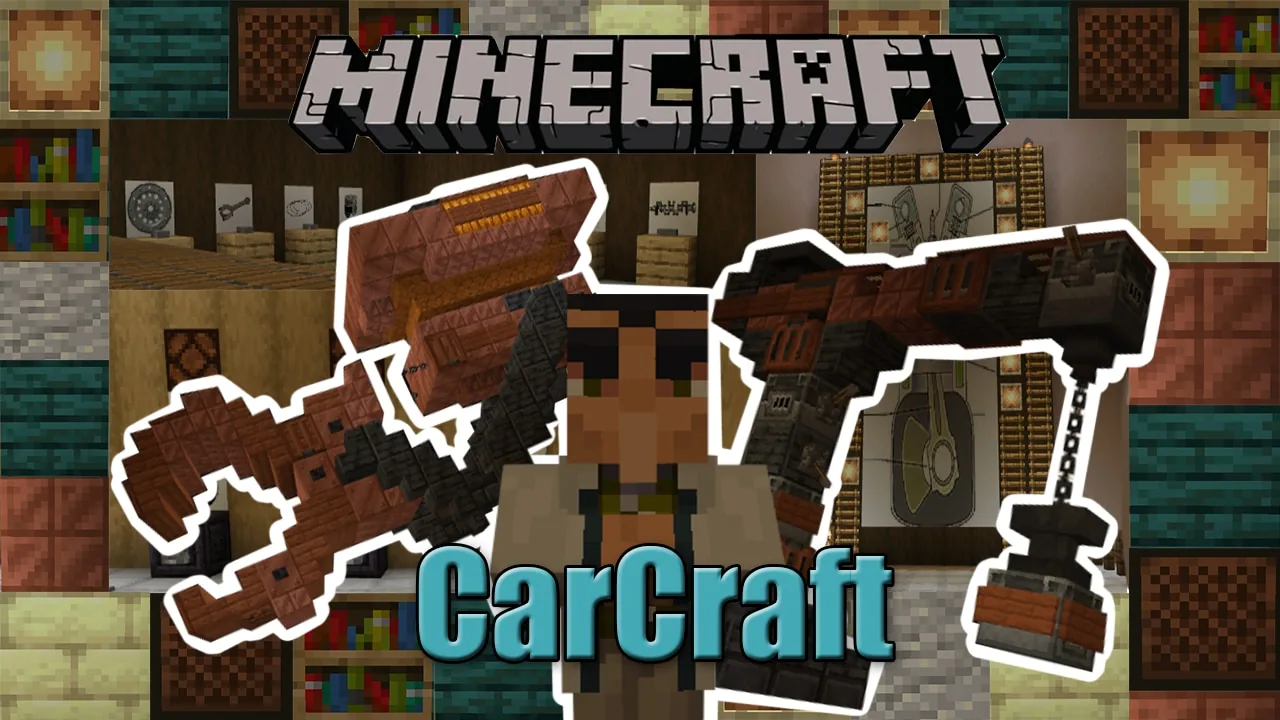
Inside the CarCraft workshop, learners tackle ten focused tasks. Students complete interactive text prompts, match parts to visual displays and item frames, order the strokes of a four-stroke engine, and accurately assemble tuning components according to mechanical requirements.
Learning objectives
By the end of this lesson students will be able to:
- Identify key internal combustion engine components and classification types.
- Calculate an internal combustion engine's capacity in terms of volume.
- Sequence the phases of a four-stroke engine cycle in the correct chronological order.
- Recognize and order engine tuning components according to mechanical procedures.
Blocks and items used in this lesson


Key vocabulary
- Internal Combustion Engine (ICE)
- An engine that generates power by burning fuel within enclosed combustion chambers.
- Engine Capacity
- The total volume displaced by an engine's cylinders, measured in volume units.
- Four-Stroke Cycle
- A recurring sequence of four distinct engine phases that generate mechanical power.
- Tuning Components
- Specialized mechanical parts installed or adjusted to optimize an engine's performance.
Before class
Lesson sequence
Suggested timing: about 30 minutes in total.
- Engine Foundations and Classifications5 min
Introduce the simulation and direct students to the first stations. Learners complete Challenge 1 by selecting terms to fill text gaps on engine roles, then complete Challenge 2 by matching classification types to engine categories.
- Component Identification and Capacity Math10 min
Students advance through Challenges 3 to 6. Learners match names to engine images, place items in corresponding frames, share screens to assist peers with part recognition, and form small groups to calculate engine capacity volume.
- Four-Stroke Engine Mechanics8 min
Students analyze four-stroke engine visuals in Challenges 7 and 8. Learners identify the highlighted engine components and arrange the operating strokes into their correct mechanical sequence.
- Tuning Selection and Assembly7 min
In Challenges 9 and 10, students identify 13 three-dimensional engine parts upon request from the mechanic. Learners then place the tuning parts in proper sequence, restarting the challenge if an incorrect placement occurs.
Assessment: success criteria
- Successful completion of gap-fill and matching tasks for engine terminology and categories.
- Accurate calculation of engine capacity volume during group or individual tasks.
- Correct chronological sequencing of the four-stroke engine operating phases.
- Accurate identification of 13 3D models and sequential placement of tuning parts without errors.
Differentiation
Allow learners to share screens and collaborate in pairs on component identification and engine volume calculations.
Have advanced learners complete the 13-part tuning sequence without restarting and assist classmates with simulation navigation.
Knowledge check
5 questions to check understanding after the lesson. Tap an answer to see if it is right; the score appears at the end.
1What calculation are students required to complete during Challenge 6?
Answer: B. Challenge 6 focuses specifically on calculating an engine's capacity in terms of its volume.
2How many 3D models of internal combustion engine parts are displayed in Challenge 9?
Answer: D. Challenge 9 requires students to select from 13 three-dimensional engine component models as requested.
3What happens when a student makes an error while placing parts in Challenge 10?
Answer: A. The activity rules state that whenever a mistake is made during the tuning placement in Challenge 10, the challenge restarts.
4What specific task must students perform in Challenge 8?
Answer: C. Challenge 8 focuses on placing the phases of a four-stroke engine in the correct operational sequence.
5Where can teachers find challenge solutions and world installation guidance?
Answer: B. The source notes that an extensive CarCraft handbook provided as a PDF includes challenge solutions and installation troubleshooting.
Resources
- Lesson package (.zip)Everything the author attached to this lesson in one download.
- Handbook of CarCraft gameThis document includes: Installation information. Description of the challenges as well as step by step solutions.
Frequently Asked Questions
How does the game handle student errors during the challenges?
Mistakes carry minimal penalty. Students usually only need to restart the specific challenge or repeat the task until they complete it correctly.
Does previous Minecraft experience affect student completion times?
Yes. Students with prior Minecraft familiarity typically finish faster because navigation is easier for them, regardless of their automotive experience.
Can students work collaboratively during these tasks?
Yes. The lesson encourages collaboration, including sharing screens to identify components and working in groups to solve capacity calculations.
Adapted from CarCraft by Konstantinos Roumpas on Minecraft Education, last updated Jul 13, 2023. This classroom version, the timings and the quiz were written by 9Minecraft Education.