- Type
- Lesson plan
- Subject
- Science
- Topics
- Science
- Ages
- Ages 14-18
- Duration
- about 60 min (suggested)
- Skills
- Critical thinking
- Includes
- Quiz: 5 questionsMinecraft world
How do the structures and functions of individual organelles contribute to essential cell processes like protein transport?
Overview
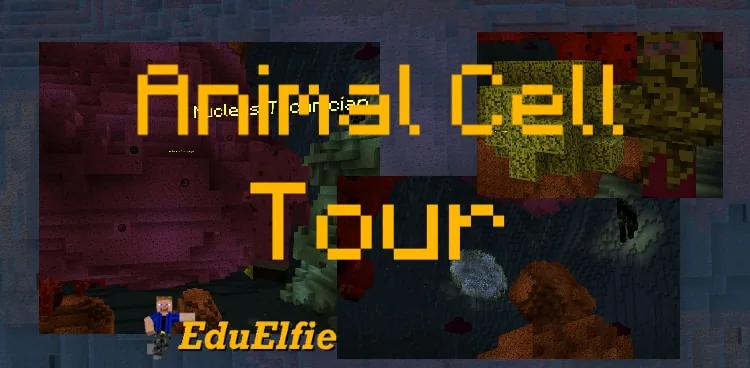
Understanding cellular biology requires students to visualize three-dimensional structures and recognize how microscopic parts interact. By stepping inside a scale model of an animal cell, learners gain spatial perspective on organelle arrangements and biological functions.
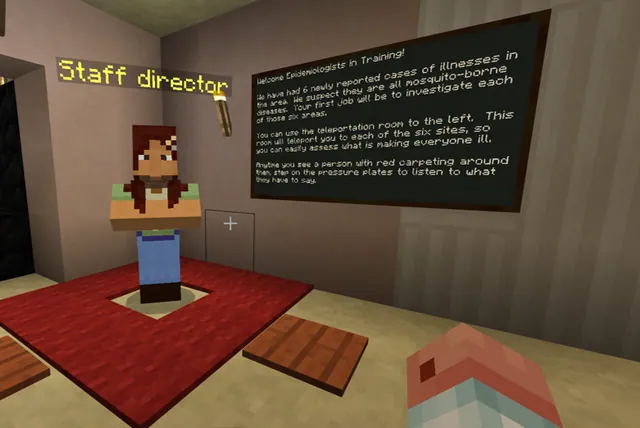
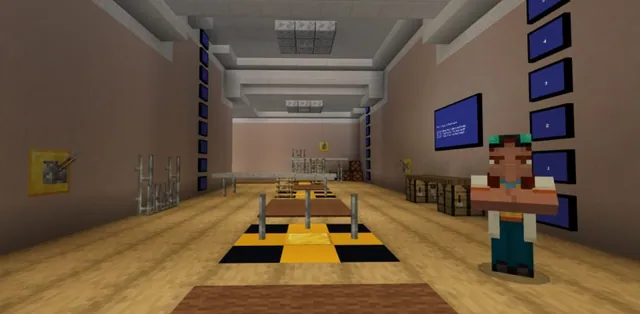
Using Minecraft Education, students navigate through the cell interior, consult with supportive researcher characters stationed near key organelles, and collect visual evidence alongside written notes to reinforce their understanding of cellular processes like protein export.
Learning objectives
By the end of this lesson students will be able to:
- Identify major animal cell organelles and their visual characteristics in a 3D environment.
- Describe the functions of key organelles, including ribosomes, endoplasmic reticulum, Golgi apparatus, and vesicles.
- Explain the pathway and mechanism of cellular protein export via exocytosis.
- Record detailed biological notes and capture visual representations for study revision.
Blocks and items used in this lesson


Key vocabulary
- Organelle
- A specialized subcellular structure that performs a specific job within a cell.
- Exocytosis
- The process by which cellular vesicles fuse with the plasma membrane to release materials outside the cell.
- Endoplasmic Reticulum
- A network of membranes involved in the production, processing, and transport of cellular materials.
- Golgi Apparatus
- An organelle responsible for modifying, sorting, and packaging proteins for secretion or delivery.
- Ribosome
- A cellular structure that synthesizes proteins.
Before class
Lesson sequence
Suggested timing: about 60 minutes in total.
- Introduction and Briefing10 min
Introduce the lesson focus on animal cell ultrastructure and protein export. Distribute the summary booklets, explain the goals of the tour, and instruct students on how to engage with the in-game researchers.
- Cell Exploration and Research35 min
Students navigate the 3D animal cell model in Minecraft. As they explore, they locate organelles, speak with in-game researchers to learn about functions and memory tips, and record their findings in their booklets.
- Visual Documentation and Wrap-Up15 min
Learners take screenshots of key organelles to keep as visual study aids for their revision. Conclude by checking booklet completion and summarizing how ribosomes, the endoplasmic reticulum, the Golgi apparatus, and vesicles cooperate during exocytosis.
Assessment: success criteria
- Accurate completion of organelle descriptions and memory aids in the student summary booklet.
- Correct identification of organelles involved in protein synthesis and exocytosis.
- Collection of appropriate in-game images corresponding to each assigned organelle.
Differentiation
Allow students to work in pairs so they can navigate the virtual cell together and cross-check their booklet notes.
Ask learners to diagram the exact sequence a synthesized protein follows from a ribosome until it exits the cell through exocytosis.
Knowledge check
5 questions to check understanding after the lesson. Tap an answer to see if it is right; the score appears at the end.
1Which cellular process involves vesicles releasing protein products outside of the cell?
Answer: A. Exocytosis is the process where vesicles transport and release cellular products such as proteins outside the cell membrane.
2What is the primary purpose of the researcher characters placed throughout the world?
Answer: B. The in-game researchers help students gather factual information about organelles and suggest ways to remember their functions.
3Which set of organelles is directly involved in the pathway of protein export?
Answer: A. Protein export requires ribosomes for synthesis, the endoplasmic reticulum and Golgi apparatus for processing, and vesicles for transport.
4What action are students asked to take inside the cell to help with personal revision?
Answer: C. The lesson directs students to take pictures representing the organelles to use as visual references during study revision.
5Where do students record the information they collect during the tour?
Answer: A. Students gather notes from the virtual experts and record their findings in a dedicated summary booklet.
Resources
Frequently Asked Questions
How long does the entire activity typically take?
According to the lesson details, students usually need approximately one hour to complete the exploration and fill in the companion booklet.
What age group is this lesson plan designed for?
The activity is tailored for secondary students aged 14 to 18 studying introductory or senior biology concepts.
Adapted from Animal Cell Tour by Stephen Elford on Minecraft Education, last updated May 23, 2025. This classroom version, the timings and the quiz were written by 9Minecraft Education.