- Type
- Lesson plan
- Ages
- Ages 8-18
How can teams design a balanced theme park layout that combines exciting rides with essential guest amenities?
Overview
Theme parks depend on careful spatial design and customer-focused planning to entertain and care for guests. Students investigate how service locations, clear navigation, organized queues, and main attractions work together to create an inviting leisure destination.
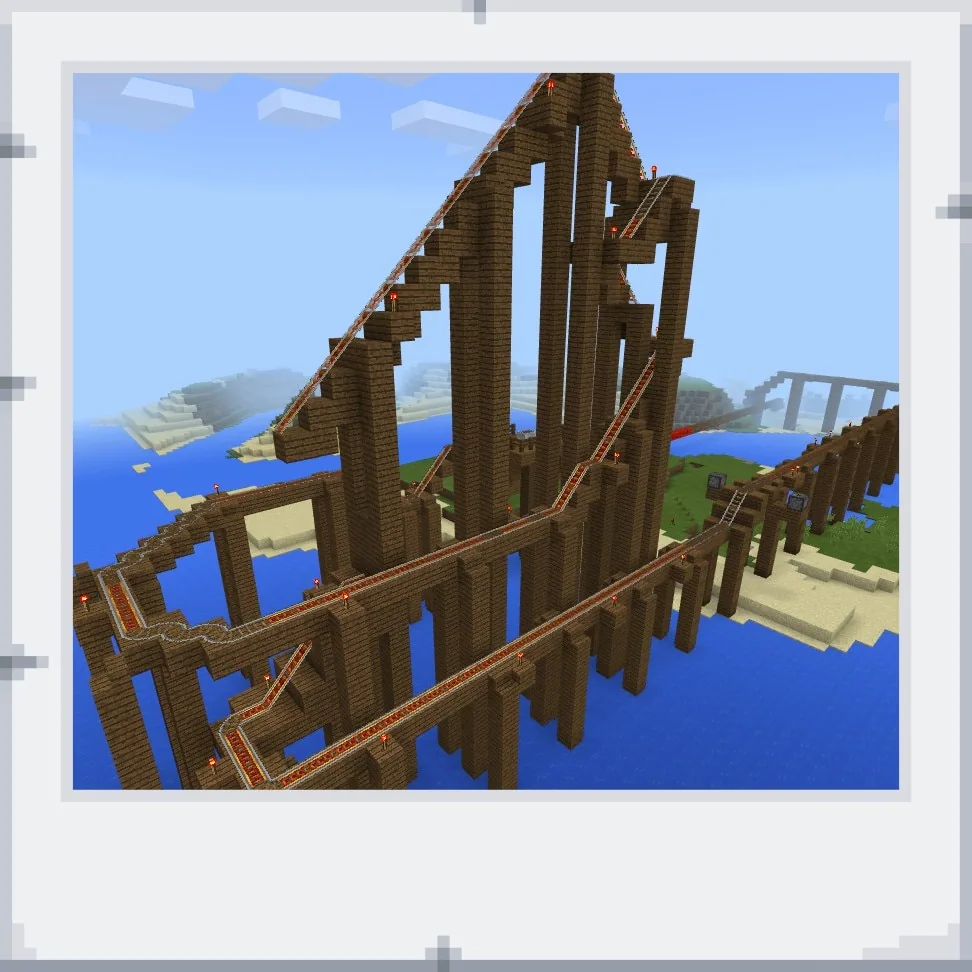
Inside Minecraft, student groups survey the terrain, construct an impressive entryway, and engineer a roller coaster using powered rails and redstone circuits. They also construct supporting infrastructure like walkways, ticket counters, and rest areas to meet visitor needs.
Learning objectives
By the end of this lesson students will be able to:
- Design a functional theme park layout that includes an entrance, guest services, and a central roller coaster.
- Construct an automated minecart track using powered rails and redstone circuitry.
- Collaborate with peers to allocate space for pathways, lines, and secondary attractions.
- Explain design decisions regarding visitor comfort, safety, and park efficiency.
Blocks and items used in this lesson


Key vocabulary
- Powered Rail
- A special track piece that accelerates minecarts when activated by redstone energy or slows them down when unpowered.
- Redstone Circuit
- A system of redstone dust, blocks, or switches that transmits power to activate devices like powered rails.
- Queue Line
- A designated waiting path created to organize guests before they board an attraction.
Before class
Lesson sequence
- Site Survey and Concept Planning
Student groups explore the landscape to select a build site. They discuss a central theme or concept and map out locations for the main gate, pathways, and attractions using the initial template.
- Redstone and Track Mechanics
Learners run short experiments with redstone blocks and rails. They measure how far a minecart travels after passing over a single powered rail on flat versus inclined tracks, and test using unpowered powered rails to halt the cart at the station.
- Main Attraction Construction
Teams build their roller coaster, making sure it features automated propulsion, a complete stop mechanism, waiting lines, and visually interesting scenery along the ride.
- Guest Facilities and Park Expansion
Students construct the main entryway along with essential visitor infrastructure, such as ticket booths, restrooms, food outlets, and seating areas. Groups may add secondary attractions, keeping them smaller than the roller coaster.
- Peer Review and Extension
Groups visit one another's parks to ride attractions and evaluate layout choices. Optionally, students can develop park menus, brochures, staffing lists, or promotional posters.
Assessment: success criteria
- The park includes an identifiable entrance, functional roller coaster, and visitor service facilities.
- The roller coaster reliably moves and stops using properly placed powered rails and redstone power.
- Pathways and queues are logically structured to support foot traffic and guest access.
- Students clearly articulate the reasoning behind their park layout and facility placement.
Differentiation
Provide students with a straightforward rail loop pattern and pre-spaced redstone blocks to simplify the roller coaster wiring.
Challenge advanced builders to implement switchable redstone circuits to toggle ride activation or design a complete park brochure and staffing plan.
Knowledge check
5 questions to check understanding after the lesson. Tap an answer to see if it is right; the score appears at the end.
1What is required as the primary attraction in each student theme park?
Answer: B. The source identifies the roller coaster as the main attraction that must be included in the park.
2Why is the park entrance considered the most important area to design carefully?
Answer: B. The source notes that the entrance is the first thing customers see and serves as a visual promise of a great visit.
3How can builders use an unpowered powered rail on a track?
Answer: C. The source recommends using unpowered powered rails as an effective way to slow down or halt minecarts.
4What guideline is given for adding secondary attractions beyond the roller coaster?
Answer: B. The lesson instructions specify that extra attractions should not outshine the primary roller coaster attraction.
5What component is needed alongside powered rails to make the roller coaster run automatically?
Answer: A. The source explains that redstone circuits or redstone blocks are required to activate powered rails so the ride operates automatically.
Resources
- Lesson package (.zip)Everything the author attached to this lesson in one download.
- Minecraft Roller Coast Theme Park IdeasA list of ideas that could get ideas flowing for your theme park.
Frequently Asked Questions
How much class time does this theme park build require?
The source lists the duration as unknown, allowing teachers to pace the build across multiple sessions or extend it into a larger cross-curricular project featuring park maps, speeches, and menus.
Can students work individually instead of in groups?
While individual work is technically possible, the lesson emphasizes collaboration and group planning to design the overall park layout and divide building responsibilities.
Adapted from Adventure Theme Park by Jason Marshall on Minecraft Education, last updated Feb 3, 2022. This classroom version, the timings and the quiz were written by 9Minecraft Education.