- Type
- Lesson plan
- Subject
- History & Social Studies
- Ages
- Ages 6-13
- Duration
- 45 min
- Level
- Beginner
- Includes
- Quiz: 5 questions
How did daily survival, tools, and community life change for the people living near Stonehenge across different historical eras?
Overview
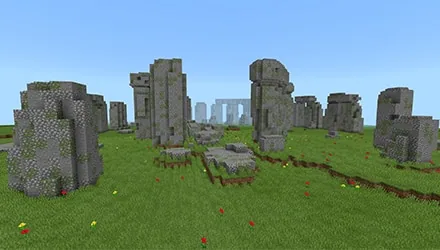
Students investigate the changing landscape and culture around Stonehenge by stepping into three key historical periods: the Mesolithic era, the Bronze Age, and the early 20th century. By meeting local community members and completing survival chores, learners develop a concrete perspective on prehistoric life and historical preservation.
Using a custom Minecraft world developed alongside archaeologists, pupils interact with non-player characters to uncover historical evidence. They gather wild foods, manage livestock, harvest crops, and document their findings inside an in-game workbook to compare ancient routines with contemporary society.
Learning objectives
By the end of this lesson students will be able to:
- Identify everyday tools, hunted animals, and gathered resources from the Mesolithic era.
- Describe Bronze Age farming practices, livestock management, and the arrival of metalworking culture.
- Complete hands-on historical tasks including foraging, animal penning, and grain harvesting.
- Document historical findings and answer comprehension questions within the student workbook.
Blocks and items used in this lesson


Key vocabulary
- Mesolithic Era
- A prehistoric middle Stone Age period when human groups survived by hunting, fishing, and gathering wild food.
- Bronze Age
- A historical era characterized by the introduction of metal tools, organized farming, and livestock keeping.
- Flint
- A hard type of stone commonly shaped by prehistoric people into sharp cutting tools and weapons.
- Aurochs
- A large, extinct species of wild cattle hunted by Mesolithic communities.
- Beaker People
- A prehistoric group that brought distinctive pottery styles and metalworking knowledge to Britain.
Before class
Lesson sequence
Suggested timing: about 45 minutes in total.
- Orientation and Departure5 min
Students spawn inside the Highways England offices and have five minutes to speak with office NPCs to collect initial information.
Regroup the class at the large computer at the end of the room and instruct learners not to click or teleport until you give the signal.
- Arriving at Stonehenge10 min
Students click the computer to teleport to modern Stonehenge, exploring the monument and speaking with local NPCs to gather historical facts.
When exploration time concludes, direct learners to locate and speak with Professor When to travel backward in time.
- The Mesolithic Era10 min
After arriving in the Mesolithic era, pupils speak with Professor When to receive a camera and workbook, then interview local hunters and gatherers.
Students complete the era task by collecting 10 hazelnuts and 10 crab apples for the community before heading to the time traveller's hut to record answers about flint tools and wild game.
- The Bronze Age15 min
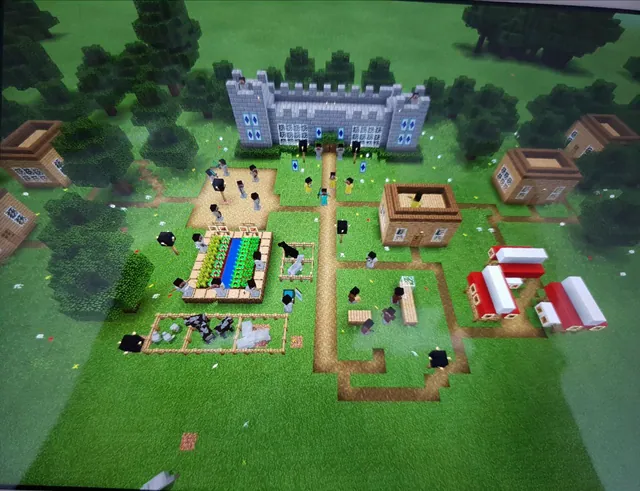
Students interact with Professor Where to teleport to the Bronze Age, listening to introductory details from Professor When before meeting local farmers.
Learners complete two community chores: sorting cattle and sheep into separate enclosures, and harvesting barley to bake bread and replant fields. Afterward, they visit the time traveller's hut to answer questions regarding Beaker culture and sheep wool.
- 20th Century and Debrief5 min
Students advance to the early 20th century to observe modern shifts and examine different job roles associated with the heritage scheme.
Conclude with a whole-class discussion addressing which time period students would prefer to inhabit and how their modern lives differ from earlier eras.
Assessment: success criteria
- Accurate completion of the community foraging and farming activities in each time period.
- Correct responses recorded in the workbook regarding Mesolithic tools, hunted wildlife, Beaker culture, and wool clothing.
- Photographic evidence collected in the workbook showing key historical features.
Differentiation
Allow students to team up in pairs so they can locate foraging items and manage livestock herding cooperatively.
Challenge early finishers to capture extra photos showing architectural or lifestyle contrasts between the eras and explain their preferred scheme career.
Knowledge check
5 questions to check understanding after the lesson. Tap an answer to see if it is right; the score appears at the end.
1What primary stone was utilized by Mesolithic people to craft their everyday tools?
Answer: C. Flint was the most common stone used for tool-making during the Mesolithic period.
2Which items are students required to collect during their Mesolithic community chore?
Answer: A. The foraging task in the Mesolithic era requires gathering ten hazelnuts and ten crab apples.
3Which culture introduced the knowledge of metalworking to Britain during the Bronze Age?
Answer: B. The Beaker people brought their techniques and knowledge of metal over to Britain.
4Which of these animals was hunted by people living during the Mesolithic era?
Answer: C. Mesolithic hunters targeted wild animals including aurochs, wild boar, and deer.
5What material did Bronze Age people rely on to produce warmer garments?
Answer: D. Wool sheared from sheep was utilized by Bronze Age communities to create warmer clothing.
Frequently Asked Questions
How do students move between different historical periods?
Students locate the time traveller's hut in each era and interact with the character named Professor Where to choose and teleport to the next historical destination.
What should students do if they cannot finish gathering all required items in time?
You can set a fixed timer of five minutes per task or allow learners to work until completed, moving them forward to the time traveller's hut once the time limit expires.
Adapted from A303 Stonehenge Through the Ages by Block Builders on Minecraft Education, last updated Jan 11, 2022. This classroom version, the timings and the quiz were written by 9Minecraft Education.