- Type
- Build challenge
- Subject
- ScienceArt, Music & Design
- Topics
- ScienceArt and Design
- Duration
- about 60 min (suggested)
How can we design a functional space station module that supports human researchers and scientific discovery in microgravity?
Overview
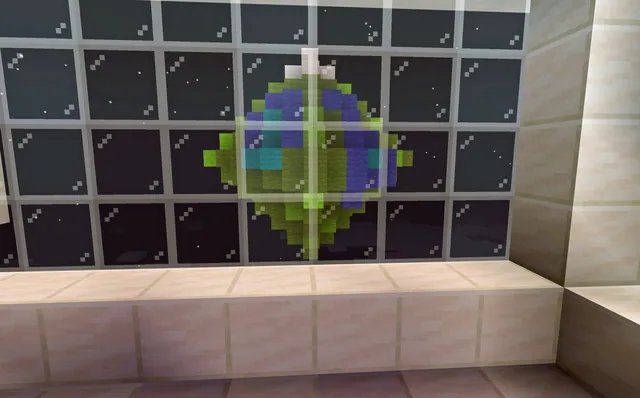
The International Space Station represents a major achievement in global scientific cooperation, maintaining continuous human occupation since November 2000. Powered by solar energy, the orbiting laboratory circles the Earth every 90 minutes and supports a regular crew of six. Inside, astronauts utilize specialized sleeping quarters, exercise facilities, bathrooms, and an observation bay window offering complete views of the planet below while conducting research across multiple disciplines.
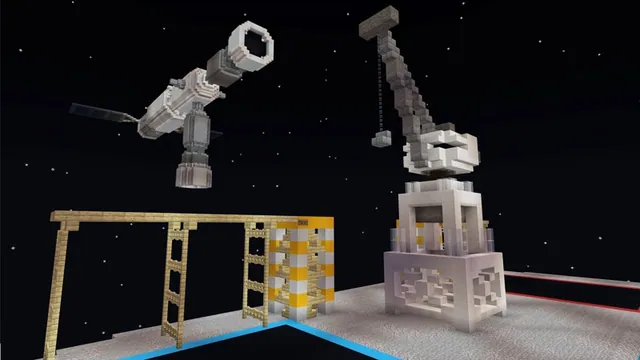
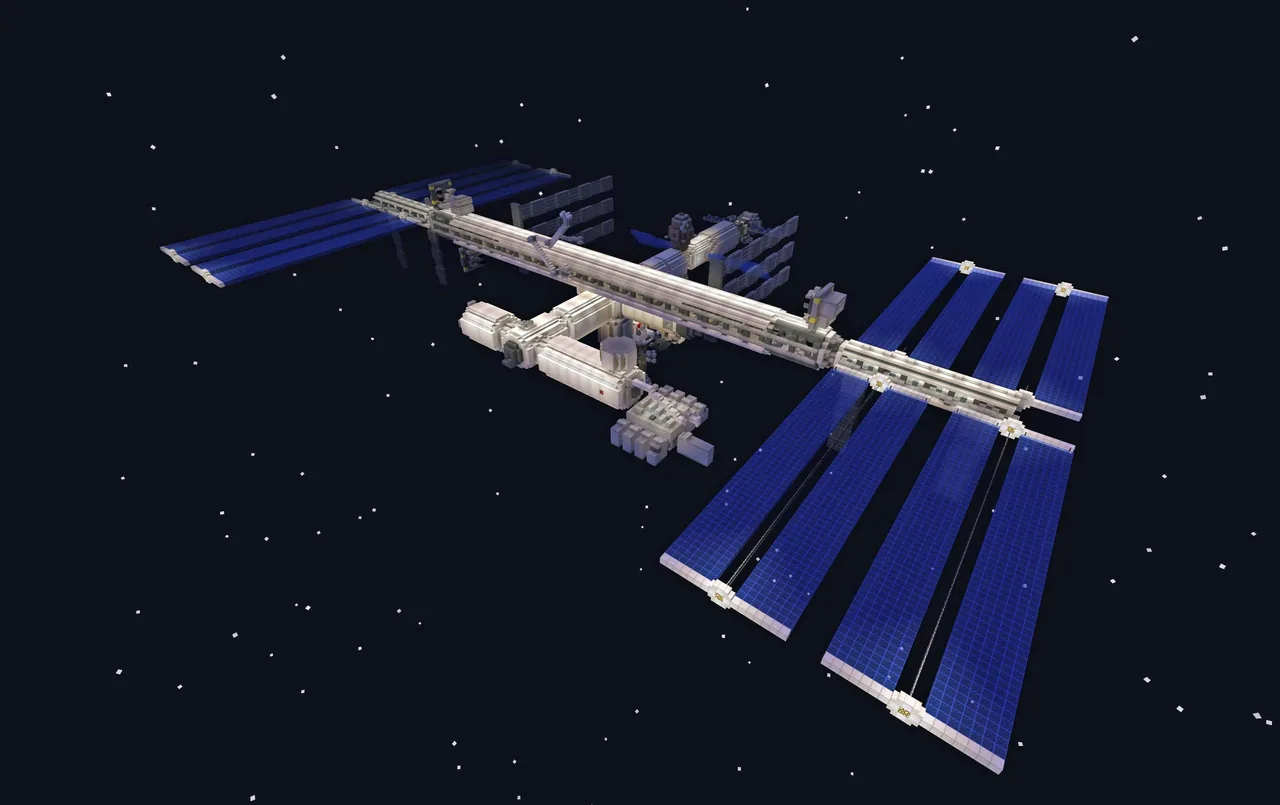
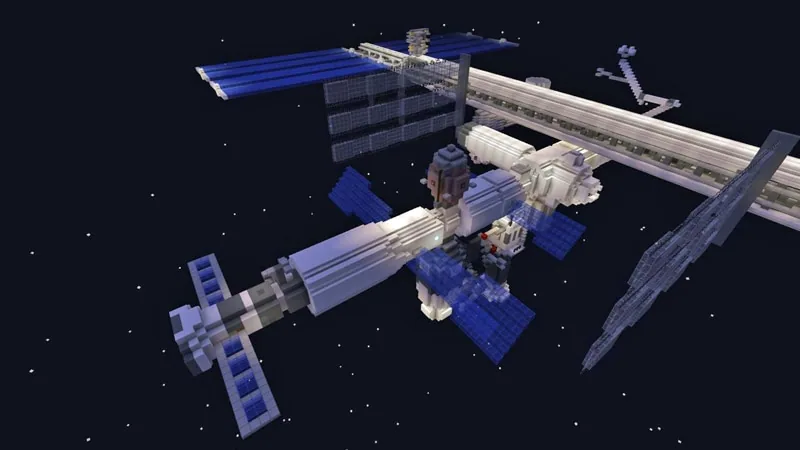
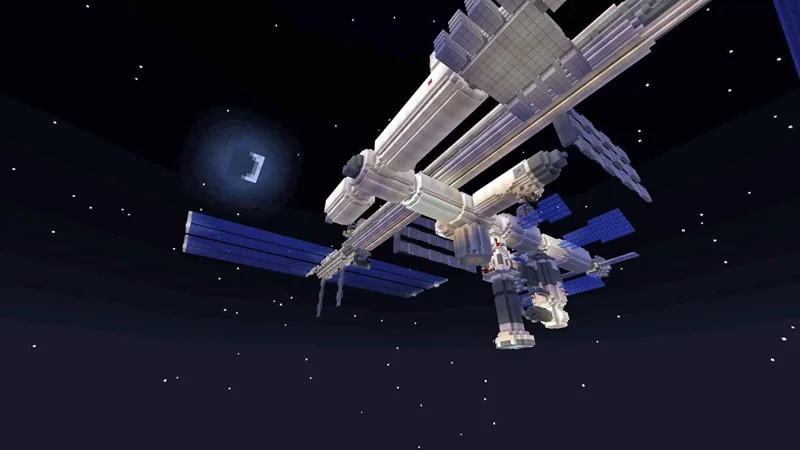
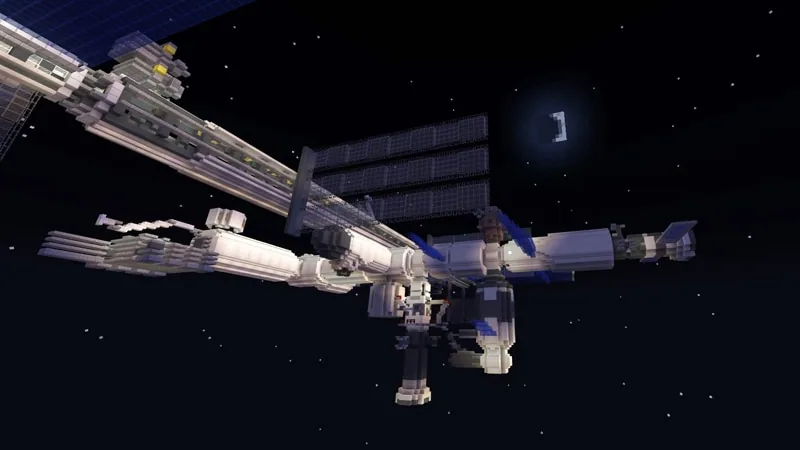
Through this Minecraft: Education Edition experience developed with NASA, students tour the digital recreation of the orbiting station to understand how humans live and work in microgravity. Learners then take on the role of orbital engineers by designing, building, and documenting a brand-new station module dedicated to their own hypothetical scientific investigations.
Learning objectives
By the end of this activity students will be able to:
- Identify key operational features and crew quarters aboard the International Space Station.
- Design and construct an original module that attaches logically to the existing space station in Minecraft.
- Describe the purpose of hypothetical scientific experiments to be conducted inside the new module.
- Document architectural and scientific work using in-game writing and photography tools.
Blocks and items used in this lesson


Key vocabulary
- Module
- A self-contained section or compartment of a spacecraft designed for a specific living or research function.
- Orbit
- The curved path that a spacecraft travels as it revolves around a planet or celestial body.
- Solar Power
- Energy captured directly from sunlight and converted into electricity to operate the space station.
Before class
Lesson sequence
Suggested timing: about 60 minutes in total.
- Orbital Station Briefing10 min
Introduce the history of the International Space Station, emphasizing that humans have continuously inhabited the facility since November 2000. Discuss the station's orbital speed of once every 90 minutes and review how researchers from over one hundred countries contribute to experiments on board.
- Virtual Station Walkthrough15 min
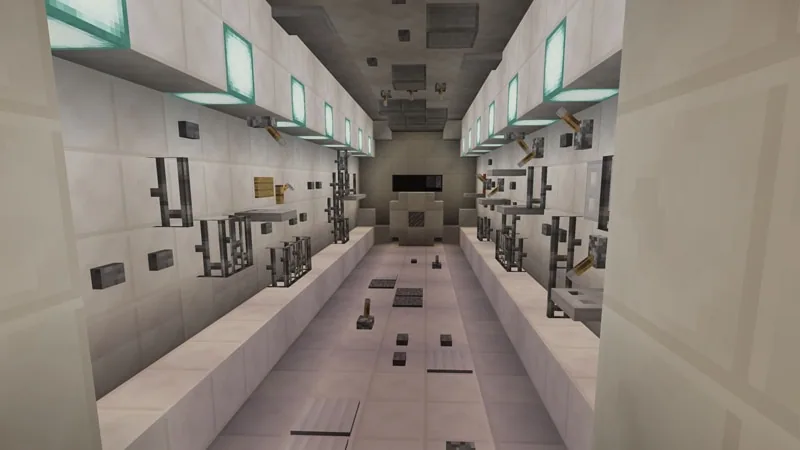
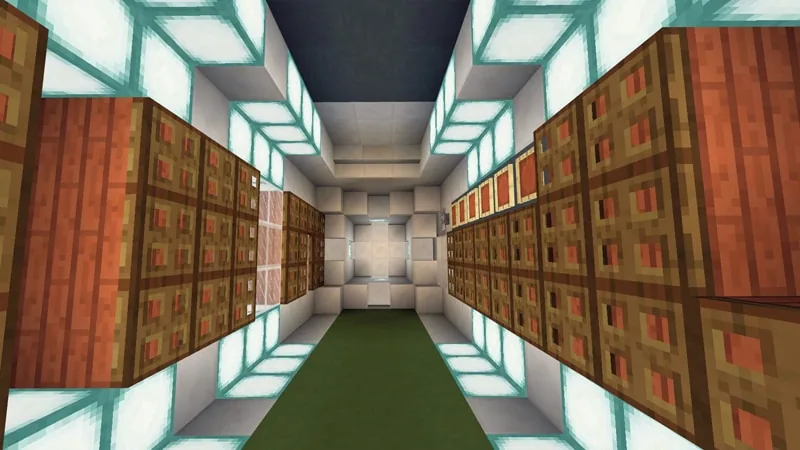
Direct students to explore the Minecraft model. Have them locate the core living and working amenities, including crew quarters, exercise equipment, hygiene areas, and the 360-degree observation window overlooking Earth.
- Module Engineering and Construction25 min
Task students with planning and building an original module attached to the station. Students must decide what scientific field their module investigates and place appropriate interior apparatus to support those hypothetical experiments.
- Research Documentation and Review10 min
Students record their finished build using the in-game Camera, placing descriptive Boards or compiling a Book and Quill report that explains how their module operates and what scientific questions it seeks to answer.
Inside the lesson world
Assessment: success criteria
- The student constructs a structural module connected directly to the space station.
- The interior contains clear spatial elements tailored to a specific scientific function.
- The student clearly explains at least one hypothetical experiment conducted in the new space.
- Documentation is completed using the Camera, Boards, or the Book and Quill.
Differentiation
Provide a simple planning checklist outlining essential components to include, such as lighting, research consoles, and an entry hatch connecting to the main station.
Have students run a full scavenger hunt across the station, labeling each existing module and writing a summary of its real-world function before starting their own build.
Knowledge check
5 questions to check understanding after the lesson. Tap an answer to see if it is right; the score appears at the end.
1Since what year has the International Space Station been continuously occupied?
Answer: B. The International Space Station has been continuously inhabited by humans since November 2000.
2How frequently does the space station complete a full orbit around Earth?
Answer: B. The space station orbits Earth once every 90 minutes.
3What is the standard crew capacity that lives and works aboard the station according to the challenge?
Answer: B. The station is designed to support a regular six-person crew.
4What powers the systems and equipment on the International Space Station?
Answer: A. The International Space Station relies on solar power to run its systems.
5Researchers from approximately how many countries have conducted experiments on the station?
Answer: D. Scientists and researchers from 103 countries have carried out experiments aboard the orbiting facility.
Resources
Part of the International Space Station curriculum
This is lesson 3 of 8 in International Space Station.
- Bone Loss in Space
- Filtering Water on the International Space Station
- International Space Station
- Invisible Forces at Work
- Plants vs. Gravity
- Rockets Away!
- Seeing Earth from the International Space Station
- Solar Panel Setback
Frequently Asked Questions
Which in-game tools should students use to document their scientific modules?
Students can capture images with the in-game Camera and record written explanations using Boards or the Book and Quill.
What online resources can students use to support their module designs?
Students can gather factual background information and visual references from the official NASA website and the Eyes on the Solar System digital tool.
Adapted from International Space Station by Minecraft Education on Minecraft Education, last updated Sep 30, 2026. This classroom version, the timings and the quiz were written by 9Minecraft Education.