- Type
- Lesson plan
- Ages
- Ages 3-10
How can digital environments in Minecraft enhance and bring a story to life for younger readers?
Overview
Students explore narrative structure and digital storytelling by adapting Michael Rosen's classic book, We're Going on a Bear Hunt. Older learners design and construct the key environments from the book, reinforcing sequence and setting comprehension while developing collaborative and digital literacy skills.
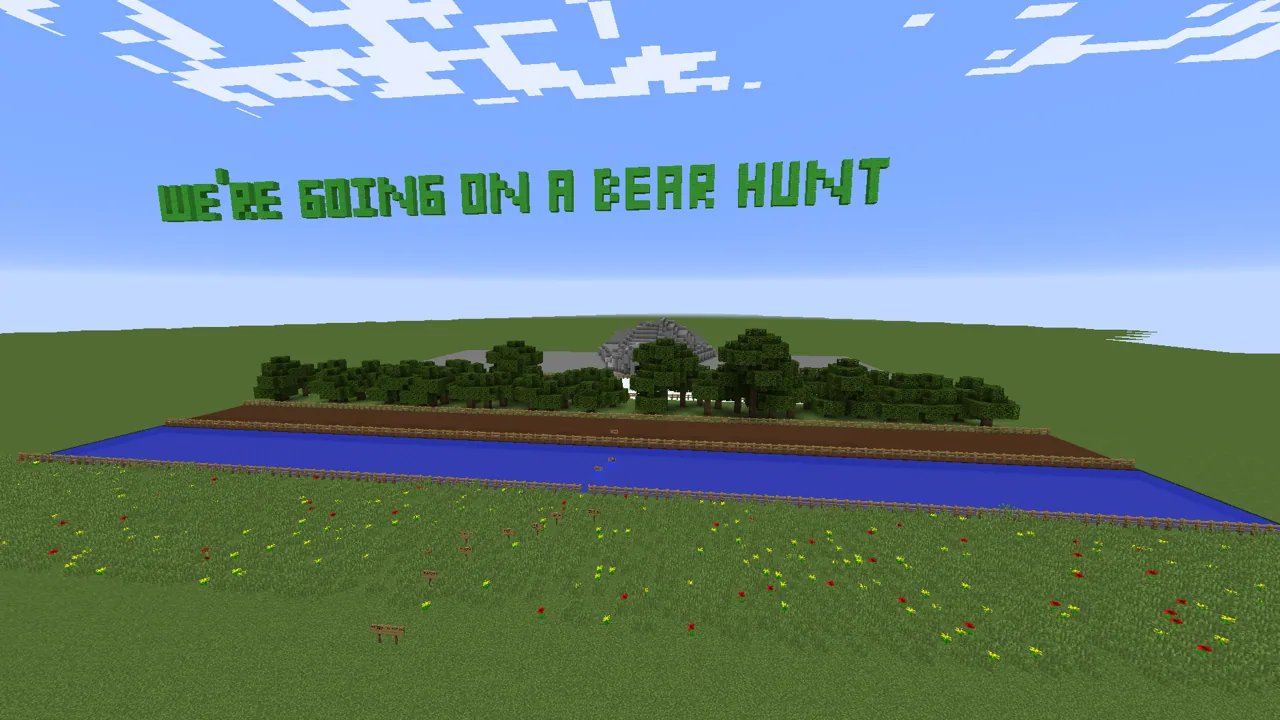
Using Minecraft, older pupils map out the sequential journey from the house through grass, river, mud, forest, snow, and the bear's cave, incorporating in-game signs to display story text. Younger children then navigate the virtual world, experiencing the story through a multi-sensory walkthrough or live dramatic reading.
Learning objectives
By the end of this lesson students will be able to:
- Recreate the sequential settings of the story inside a Minecraft world.
- Display the text of the story using in-game signs or narrative tools.
- Guide younger peers through the digital world to deliver a multi-sensory storytelling experience.
- Act out the narrative using the completed virtual scenes.
Blocks and items used in this lesson


Key vocabulary
- Digital storytelling
- Using digital tools and interactive media to present and explore a narrative.
- Sequence
- The specific chronological order in which events and settings occur in a story.
- Redstone
- An in-game material used to build mechanical devices and automated circuits.
- Command block
- An advanced Minecraft block that runs automated text or system commands when activated.
Before class
Lesson sequence
- Story Sequencing and World Planning
Review Michael Rosen's story to map out the required sequence of environments: house, grass, river, mud, forest, snow, and the bear's cave, followed by the retreat home.
- Building the Narrative Path
Older students construct the sequential story locations in Minecraft, placing in-game signs or similar narrative tools to display the text of the book along a clear, navigable path.
- Interactive Enhancements
Learners refine their worlds to ensure smooth navigation, optionally testing redstone mechanisms or command blocks that enhance the story without distracting from it.
- Cross-Age Exploration and Performance
Younger children explore the completed worlds with older peer guidance, or watch a live performance where one student reads the story while another acts it out in the game during class or assembly.
- Reflection and World Review
Students evaluate their finished worlds with peers, assessing how clearly the world structure communicates the narrative sequence and supports dramatic storytelling.
Assessment: success criteria
- The world contains all required story settings organized in the correct narrative order.
- In-game signs or narrative tools clearly display the text of the book along the route.
- The world layout is easy to navigate and interactive elements support the story rather than distract.
- Students successfully perform or guide a partner through the complete story using their world.
Differentiation
Provide a written checklist of the required story settings and pair students to build the trail cooperatively.
Incorporate advanced redstone mechanisms or command blocks to trigger interactive events and automated text as readers progress.
Knowledge check
5 questions to check understanding after the lesson. Tap an answer to see if it is right; the score appears at the end.
1Which book serves as the foundation for this Minecraft adaptation project?
Answer: B. The lesson adapts Michael Rosen's book We're Going on a Bear Hunt.
2What is the final setting students build before characters must run back home?
Answer: C. The final setting in the journey is a cave with a bear, after which the characters run back home.
3How do older students integrate the written words of the story into the build?
Answer: A. The source specifies using written words from the book placed on signs or similar narrative tools.
4What is the primary role of the younger children during the activity?
Answer: D. Younger pupils explore the story in a multi-sensory way while guided by older students.
5Which optional tools can students use to challenge themselves with interactive features?
Answer: B. Students can extend their builds by incorporating redstone contraptions or command blocks.
Resources
- Lesson package (.zip)Everything the author attached to this lesson in one download.
- Example world JavaAn example world built by me to demonstrate (Java edition)
- World ScreenshotsA collection of screenshots as an example.
Frequently Asked Questions
How can this project be adapted for an assembly or whole-class presentation?
One student can read the book aloud while another student navigates and acts out the sequence live within the Minecraft world on a shared display.
Which specific settings must students include along the story path?
Students must build a house, grass, a river, mud, a forest, snow, and a cave containing a bear, followed by the return route home.
Adapted from We're Going on a Bear Hunt by Joseph Hammond on Minecraft Education, last updated Aug 23, 2018. This classroom version, the timings and the quiz were written by 9Minecraft Education.