How can we design an interactive Minecraft world that teaches others about marine conservation and the impact of recycling?
Overview
Human activity and climate change have placed marine ecosystems under severe pressure, leading to the loss of half of all aquatic life over the past four decades. This project connects learners to Sustainable Development Goal 14 (Life Below Water) by exploring ocean warming, acidification, and practical local remedies such as school recycling programs to prevent plastic waste from reaching water systems.
Using Minecraft Education, student groups work through a project-based learning structure to translate these environmental concepts into interactive narratives. Learners utilize narrative elements like dialogue boxes and non-player characters to guide visitors, employ MakeCode and building commands for construction, and document their solutions using the in-game camera and external presentation tools.
Learning objectives
By the end of this lesson students will be able to:
- Explain the environmental threats facing marine ecosystems and the importance of recycling to protect life below water.
- Construct an interactive narrative world using storytelling items including slates, posters, boards, signs, and non-player characters.
- Apply MakeCode along with the fill and clone tools to build structures efficiently.
- Document and present the project using the in-game camera, portfolio, screencast recordings, or digital storyboards.
Blocks and items used in this lesson


Key vocabulary
- SDG 14
- A global goal focused on conserving and sustainably using oceans, seas, and marine resources.
- Ocean Acidification
- A reduction in the ocean pH levels caused by climate change that damages marine life.
- Non-Player Character (NPC)
- A placed character that can interact with players to share text, dialogue, and web links.
- Clone Tool
- A building command that copies blocks from one area to another to speed up construction.
- Fill Tool
- A building command used to quickly fill a defined region with a specific block type.
Before class
Lesson sequence
- Introduction and Mindmapping
Discuss the crisis facing global waters, highlighting that fifty percent of aquatic life has been lost over the past forty years and reviewing how school recycling helps reduce plastic pollution. In groups, students create mindmaps to plan their narrative settings, select materials purposefully, and plan sustainable practices like replanting harvested trees and planting crops.
- Narrative Design and Tool Setup
Groups develop their conservation story by outlining problems and solutions related to sustainable fishing and ocean protection. Students populate their inventories with essential storytelling tools, including slates, posters, boards, signs, and non-player characters (NPCs) to structure the visitor experience.
- World Building and Coding
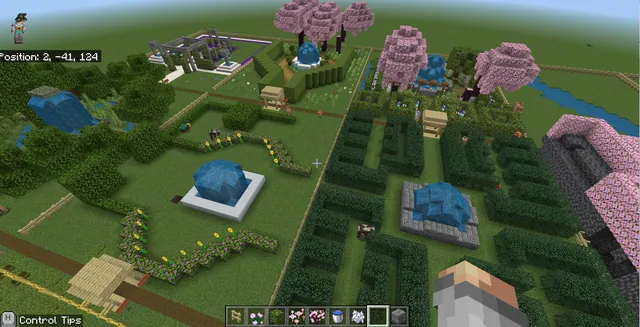
Students construct their settings using the fill and clone tools alongside MakeCode to generate large foundational structures efficiently. Groups can also incorporate redstone circuitry to introduce interactive features and automated elements into their story scenes.
- Testing and Documentation
Learners playtest their builds to verify that pathways, signs, and instructions are clear so players do not become lost. Students capture screenshots with the camera and portfolio, record video walkthroughs using screencast tools, and compile a digital storyboard using Sway.
- Export and Presentation
Teams export their completed builds as world files to share with classmates and wider audiences, demonstrating their proposed solutions for ocean conservation and sustainable resource management.
Assessment: success criteria
- The exported world file contains a fully traversable story path with clear directions so visiting players do not get lost.
- A variety of narrative items, such as slates, posters, boards, signs, and NPCs, are integrated to convey information about marine life.
- Students demonstrate building efficiency by using the fill tool, clone tool, or MakeCode scripts.
- The final portfolio, screencast video, or Sway storyboard clearly explains ocean conservation concepts and recycling solutions.
Differentiation
Provide pre-written text outlines for signs and NPCs so learners can focus on placing narrative items and building a basic walking path.
Challenge advanced students to program complex MakeCode scripts and redstone contraptions that trigger interactive environmental events as players walk through the story.
Knowledge check
5 questions to check understanding after the lesson. Tap an answer to see if it is right; the score appears at the end.
1According to the lesson background, what percentage of aquatic life has been lost in the last 40 years?
Answer: B. The source states that 50% of total aquatic life has been lost over the last 40 years.
2Approximately how many years does a plastic bottle take to decompose?
Answer: D. The lesson facts specifically state that a plastic bottle takes 500 years to decompose.
3Which Sustainable Development Goal does this Minecraft lesson support?
Answer: A. The project is explicitly aligned to SDG 14: Life Below Water.
4Which tools are recommended in the lesson to make building large structures more efficient?
Answer: C. Students are instructed to use MakeCode along with the fill and clone tools to simplify large builds.
5Which external application is suggested for creating a storyboard to document the project narrative?
Answer: B. The assessment expectations include creating a storyboard using Sway to present the story.
Frequently Asked Questions
What narrative tools are students required to use in their worlds?
Students are expected to incorporate slates, posters, boards, signs, and non-player characters (NPCs) to communicate their story and guide visitors.
How do students incorporate sustainability into their in-game construction?
Learners practice sustainability within the game world by replanting every tree they chop down and farming crops for food.
What media formats are recommended for recording project evidence?
Students can capture images with the in-game camera and portfolio, record video walkthroughs using screencasting tools, and compile a presentation in Sway.
Adapted from Water–the essence of life by Monica Joshi on Minecraft Education, last updated Jan 13, 2022. This classroom version, the timings and the quiz were written by 9Minecraft Education.