- Type
- Lesson plan
- Ages
- Ages 11-18
- Duration
- about 75 min (suggested)
- Includes
- Quiz: 5 questionsMinecraft world
How can primary diary accounts help us understand the personal qualities and hardships of soldiers at Anzac Cove?
Overview
During World War I, Australian and New Zealand forces landed on the Gallipoli Peninsula on 25 April 1915, enduring harsh conditions and intense fighting. In this lesson, students explore the human side of history by investigating the authentic written records and personal qualities of the soldiers who served at Anzac Cove.
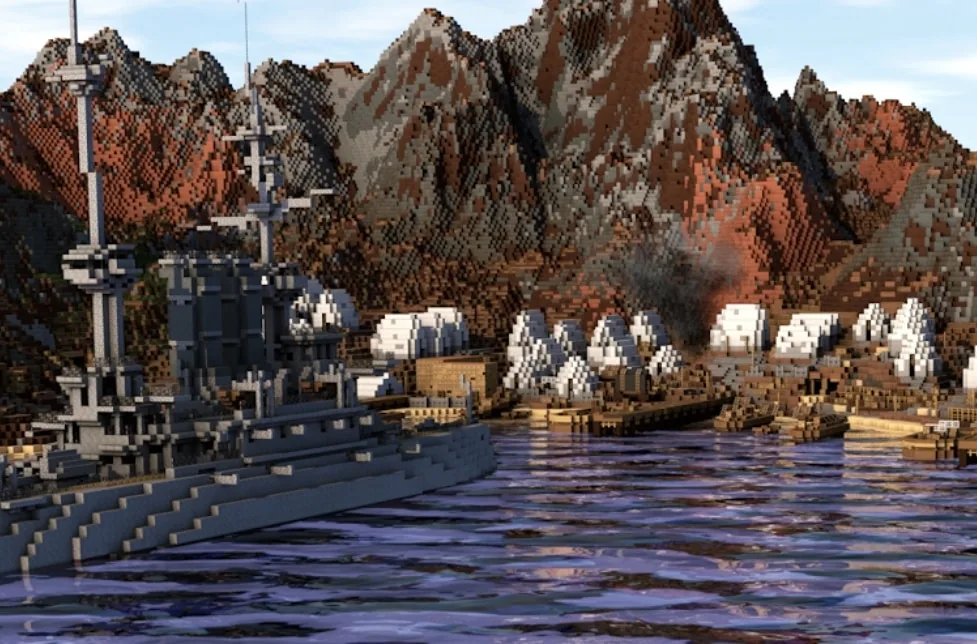
Using a shared Minecraft environment depicting Anzac Cove with historical camps and hospitals, learners bring the empty landscape to life. Each student configures a Non-Player Character (NPC) using primary diary accounts and places informational signage that details the soldier's background, emotions, and character traits.
Learning objectives
By the end of this lesson students will be able to:
- Investigate primary diary accounts of Australian and New Zealand soldiers who served at Gallipoli.
- Configure an in-game Non-Player Character (NPC) to convey a historical soldier's words and link to their diary.
- Summarize key biographical details, emotional responses, and character qualities on descriptive signs.
- Analyze differing perspectives of multiple soldiers stationed across the Anzac Cove environment.
Blocks and items used in this lesson


Key vocabulary
- ANZAC
- Australian and New Zealand Army Corps, the military forces that served together during World War I.
- Anzac Cove
- The coastal landing site on the Gallipoli Peninsula where ANZAC troops landed in April 1915.
- Amphibious Invasion
- A military attack launched from the sea onto a land area.
- NPC (Non-Player Character)
- A Minecraft character placed in the world that can display dialogue and external links.
Before class
Lesson sequence
Suggested timing: about 75 minutes in total.
- Historical Introduction and Context15 min
Introduce the 25 April 1915 landing at Anzac Cove during the First World War. Discuss the physical realities of the Gallipoli campaign and explain how diaries give modern readers direct insight into soldiers' thoughts and emotions.
- Explore the Cove and Assign Soldiers10 min
Students log into the shared Anzac Cove world and observe the empty surroundings, including tents, supply carts, dugouts, and field hospitals. Distribute soldier cards and direct students to review their assigned soldier's diary entries.
- Build and Configure Soldier NPCs20 min
Students place an NPC representing their assigned soldier. They set the NPC's display name, paste the soldier's authentic words into the dialogue box, and attach the web URL leading to the primary diary source.
- Add Informational Signage15 min
Around their NPC, students place signs recording the soldier's name, their age at Anzac Cove, the date of the diary entry, what they were feeling at that moment, and the personal qualities demonstrated in their writing.
- Peer Investigation and Reflection15 min
Learners tour the repopulated cove to read and interact with each other's NPCs and signs. Hold a concluding discussion examining the different viewpoints and common personal qualities evident across the historical accounts.
Assessment: success criteria
- The NPC is correctly named and includes authentic diary text from the assigned soldier.
- A working URL link to the soldier's diary source is embedded within the NPC interface.
- Signs display the soldier's name, age, diary date, emotional state, and observed personal qualities.
- The student can articulate how their assigned soldier's perspective compares to other soldiers at the cove.
Differentiation
Provide a pre-highlighted soldier card with designated sentences to copy directly onto the NPC and signboards.
Have students write a war correspondent news article using in-game photos, or write original soldier diary entries illustrated with black-and-white screenshots.
Knowledge check
5 questions to check understanding after the lesson. Tap an answer to see if it is right; the score appears at the end.
1On what date did the landing at Anzac Cove take place?
Answer: B. The landing at Anzac Cove occurred on Sunday, 25 April 1915.
2Which bodies of troops made up the majority of the assault force landing at Anzac Cove?
Answer: C. The assault troops were mostly from the Australian and New Zealand Army Corps (ANZAC).
3What feature is missing from the Anzac Cove Minecraft world when students first spawn in?
Answer: D. The world contains tents, supplies, carts, dugouts, and hospitals, but lacks the people.
4Which piece of information is required on the signs placed around each soldier NPC?
Answer: A. The instructions specify signs must list name, age in Anzac Cove, diary date, feelings, and personal qualities.
5What was the Ottoman Turkish name for the military engagement at the landing site?
Answer: B. The source notes that the landing was known to the Turks as the Ariburnu Battle.
Resources
Frequently Asked Questions
Can students work in a single-player world instead of a shared server?
While students can build NPCs in individual worlds, hosting a shared world allows the class to walk among everyone's historical figures and read each other's research seamlessly.
Where do students find the diary excerpts for their NPCs?
The teacher provides profile cards or reference slides with selected soldier diary extracts and internet links before students begin building.
Adapted from Understanding the ANZAC SPIRIT by Lynne Telfer on Minecraft Education, last updated Sep 14, 2021. This classroom version, the timings and the quiz were written by 9Minecraft Education.