- Type
- Lesson plan
- Topics
- Math & EconomicsScience
- Grade
- Primary (Grades 3-5)
- Ages
- Ages 8-10
- Duration
- 30 min
- Level
- Beginner
How does following the order of operations help us solve mathematical challenges accurately?
Overview
Understanding the order of operations provides students with a reliable framework for evaluating multi-step mathematical expressions. Introducing the PEMDAS acronym gives learners a memorable structure that clarifies when to address parentheses, exponents, multiplication, division, addition, and subtraction.
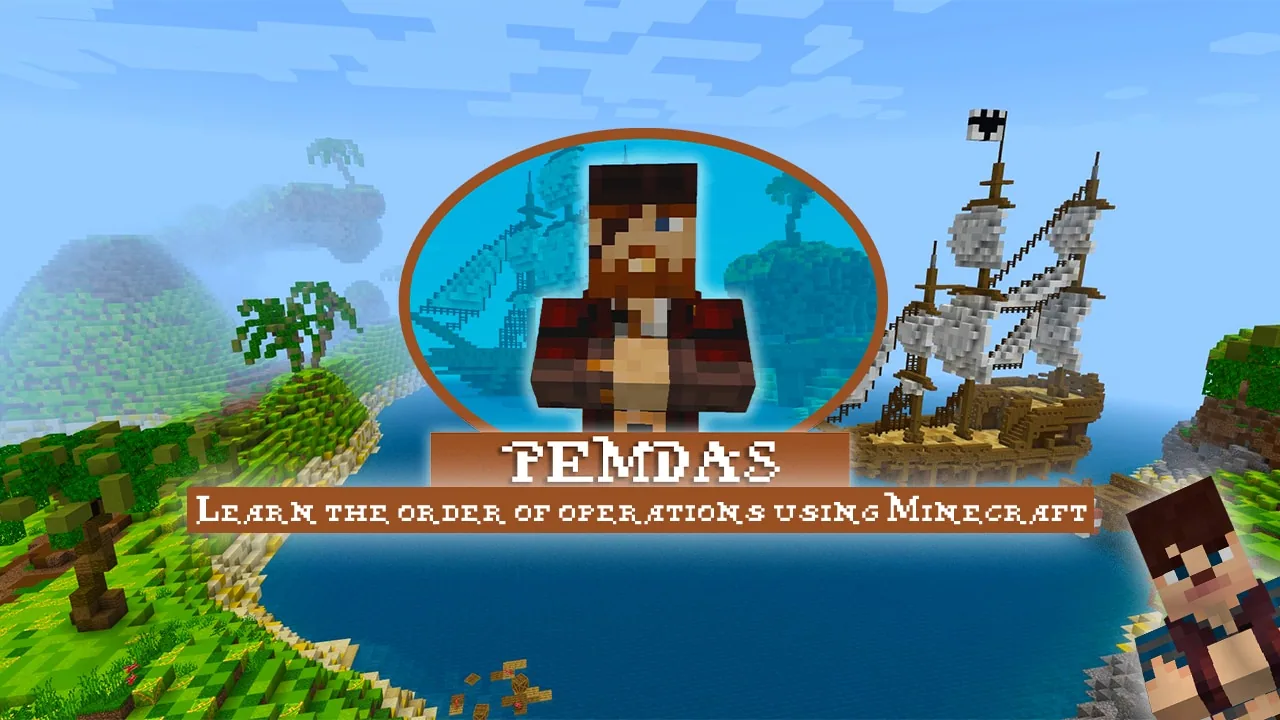
In this activity, students explore a tropical island complete with dense jungle terrain, rocky shores, and a pirate ship. By navigating six distinct routes, overcoming platforming mazes, and solving math challenges delivered by non-player characters, students collect labeled letter blocks and arrange them in the proper sequence aboard the ship.
Learning objectives
By the end of this lesson students will be able to:
- Identify the operational steps represented by the PEMDAS acronym.
- Solve order of operations equations presented by in-game non-player characters.
- Navigate island paths and platforming mazes to locate six labeled treasure blocks.
- Place the collected letter blocks in the correct PEMDAS order inside the pirate ship.
Blocks and items used in this lesson


Key vocabulary
- Order of Operations
- The standard sequence of mathematical rules determining which calculations must be solved first.
- PEMDAS
- A mnemonic standing for Parentheses, Exponents, Multiplication, Division, Addition, and Subtraction.
- Non-Player Character (NPC)
- An in-game character that delivers dialogue, clues, and math questions directly to the player.
Before class
Lesson sequence
Suggested timing: about 30 minutes in total.
- Introduction and PEMDAS Review5 min
Present the PEMDAS acronym using the classroom presentation. Review the role of parentheses, exponents, multiplication, division, addition, and subtraction using sample problems such as 12 * (12 + 3) to demonstrate how operation order determines the final answer.
- World Orientation and Controls5 min
Have students spawn onto the pirate ship. Direct beginner players to the optional tutorial route to get comfortable with game navigation, running, and jumping before setting out across the island.
- Island Paths and Math Challenges15 min
Students follow six separate paths across the jungle and rocky coastline. Along each path, students speak to NPCs, solve multiple-choice math questions, and navigate mazes to collect the blocks labeled P, E, M, D, A, and S.
- Ship Assembly and Reflection5 min
Learners return to the pirate ship to arrange their collected letter blocks in the correct PEMDAS sequence and claim their trophy. Gather the class to review anonymous missteps and discuss which calculation steps proved most challenging.
Assessment: success criteria
- Student accurately explains the calculation order represented by PEMDAS.
- Student selects correct solutions to multiple-choice math problems posed by NPCs.
- Student retrieves all six letter blocks by navigating island paths and mazes.
- Student deposits the letter blocks in correct sequential order inside the pirate ship.
Differentiation
Allow students to keep a printed PEMDAS reference strip at their desk and complete the movement tutorial route before entering math paths.
Provide advanced learners with higher-difficulty multi-step equations to evaluate independently before placing their final blocks.
Knowledge check
5 questions to check understanding after the lesson. Tap an answer to see if it is right; the score appears at the end.
1According to the PEMDAS rule, which part of a math problem must be completed first?
Answer: A. The letter P in PEMDAS stands for parentheses, which must always be evaluated first.
2What is the correct value for the expression 12 * (12 + 3)?
Answer: B. First add the numbers in parentheses to get 15, then multiply 12 by 15 to get 180.
3How do players trigger mathematical questions while exploring the island?
Answer: C. Questions appear one student at a time when an individual player interacts with an NPC.
4Where must students bring all six collected letter blocks at the end of the treasure hunt?
Answer: D. Players return to the pirate ship and place the letter blocks in proper order to complete the activity.
5How many separate paths must students explore to gather every letter block?
Answer: B. There are six distinct paths corresponding to the six letters of the PEMDAS acronym.
Resources
- Lesson package (.zip)Everything the author attached to this lesson in one download.
- PEMDAS PresentationSample lesson of what a lesson integrating this course might seem like. The lesson is short in order to fit the whole course in 45 minutes.
Frequently Asked Questions
Can students complete this lesson in multiplayer?
Yes. The activity supports both single-player and multiplayer modes, with questions triggering independently whenever an individual student interacts with an NPC.
What happens if a student chooses the wrong answer to a math problem?
The game features quick resets that allow students to retry without tedious repetition, and teachers can anonymously record frequent mistakes for a group review.
Is prior Minecraft experience required for students to participate?
No. The world includes a built-in tutorial route where beginners can learn basic movement and controls before taking on the island challenges.
Adapted from Treasure Hunt: PEMDAS by Konstantinos Roumpas on Minecraft Education, last updated Jun 13, 2023. This classroom version, the timings and the quiz were written by 9Minecraft Education.