- Type
- Lesson plan
- Subject
- Math
- Topics
- Math & Economics
- Ages
- Ages 8-13
- Duration
- 45 min
- Level
- Beginner
How can we recognize reflections, rotations, and translations when viewing objects in a three-dimensional space?
Overview
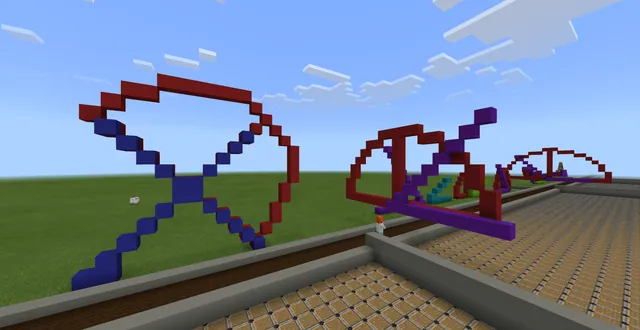
Viewing geometric transformations in a three-dimensional setting adds real-world depth and spatial challenge to fundamental math concepts. As students navigate space, they see firsthand how shapes move, turn, or flip without changing their structural properties.
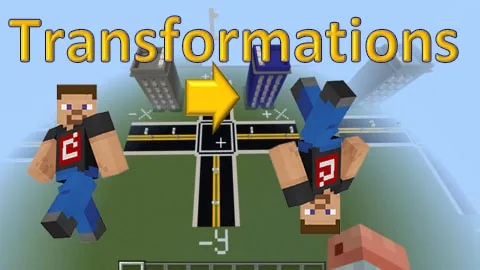
In this lesson, learners enter an observation-only Minecraft world configured to prevent block destruction and item selection. Students travel between thirteen distinct problem stations to identify reflections, rotations, and translations, logging their conclusions onto a paper worksheet.
Learning objectives
By the end of this lesson students will be able to:
- Identify reflections, rotations, and translations across thirteen three-dimensional stations.
- Navigate an observation world using standard directional movement controls.
- Record geometric transformation findings accurately on the accompanying worksheet.
Blocks and items used in this lesson


Key vocabulary
- Reflection
- A transformation that flips a figure across a line or plane to produce a mirror image.
- Rotation
- A transformation that turns a figure around a fixed central point or axis.
- Translation
- A transformation that slides a figure to a new location without rotating or flipping it.
Before class
Lesson sequence
Suggested timing: about 45 minutes in total.
- Introduction and Movement Review10 min
Introduce the three types of transformations: reflections, rotations, and translations. Explain that the Minecraft world is an observation space where building and inventory selection are disabled.
Review basic spatial controls with students to make sure they can confidently navigate forward, backward, left, right, up, and down.
- World Observation and Recording25 min
Have students connect to the hosted world and move through the 13 problem stations at their own pace.
At each station, students examine the 3D structures from multiple perspectives, determine the transformation shown, and write their answers on the worksheet.
- Class Review and Discussion10 min
Bring the class together or utilize global in-game chat to review the answers to the 13 problems.
Discuss how viewing shapes in three dimensions changed the way students verified rotations, reflections, and translations.
Assessment: success criteria
- Correct identification of transformations on the 13-station worksheet.
- Demonstrated ability to move through the 3D space using basic navigation controls.
- Participation in the transformation review and chat discussion.
Differentiation
Pair students who need help with 3D spatial orientation or controls with a partner to navigate the stations together.
Ask early finishers to describe in the global chat the exact direction or degree of movement shown at specific stations.
Knowledge check
5 questions to check understanding after the lesson. Tap an answer to see if it is right; the score appears at the end.
1Which three geometric transformations are the focus of this lesson?
Answer: B. The lesson specifically targets identifying reflections, rotations, and translations.
2How many problem stations are students expected to evaluate in the world?
Answer: A. The teacher prep notes indicate that the world contains 13 problems.
3Why are command blocks set up in this lesson's world?
Answer: C. Command blocks are placed specifically to keep students from selecting items from their inventory.
4Which command is recommended to turn on chat for the lesson?
Answer: D. The prep notes recommend that teachers enable chat by typing /gamerule globalchat true.
5Where do students record their answers for each transformation problem?
Answer: B. Students are instructed to identify and record each transformation on the provided worksheet.
Resources
- Lesson package (.zip)Everything the author attached to this lesson in one download.
- Worksheet to be completed with the assignmentThis is a PDF file, it can be uploaded into Onenote or any other online LMS to be annotated on and turned in.
Frequently Asked Questions
Can students break or place blocks while exploring the stations?
No, this is strictly an observation world where block breaking is disabled and command blocks prevent players from selecting inventory items.
How is student progress assessed in this lesson?
Student understanding is evaluated through the completed assignment worksheet, which tracks their identification of all 13 transformation stations.
Adapted from Transformations: Rotations, Reflections, Translations by Britton Proctor on Minecraft Education, last updated Nov 9, 2023. This classroom version, the timings and the quiz were written by 9Minecraft Education.