- Type
- Lesson plan
- Subject
- MathClimate & Sustainability
- Ages
- Ages 8-13
Why do shared community resources dwindle, and how does human self-interest affect sustainability?
Overview
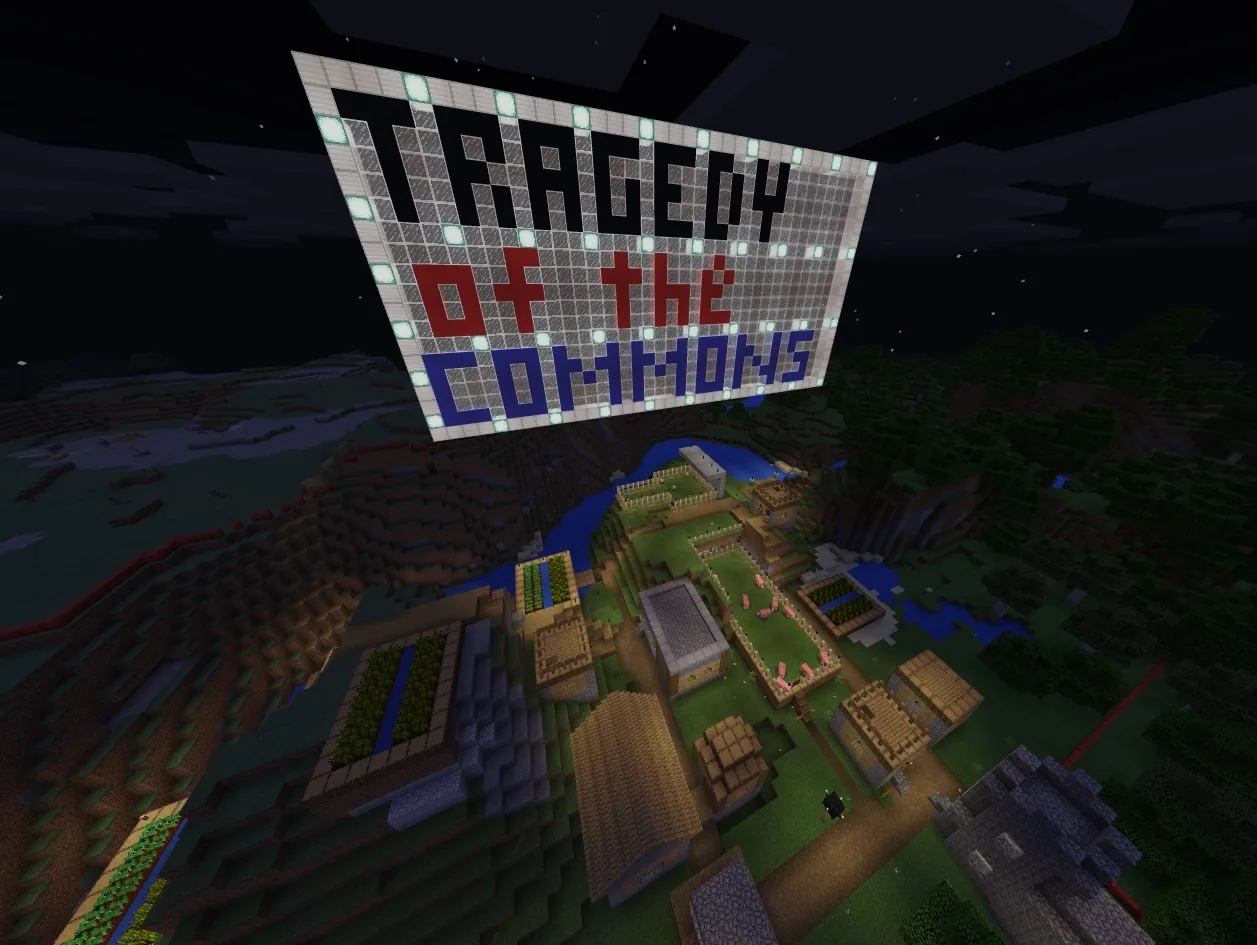
The Tragedy of the Commons examines what occurs when individuals share a limited community resource without central regulation. Although collective resource sharing is mathematically viable, individual self-interest often compels people to take more than their equal allotment, ultimately causing the resource system to collapse.
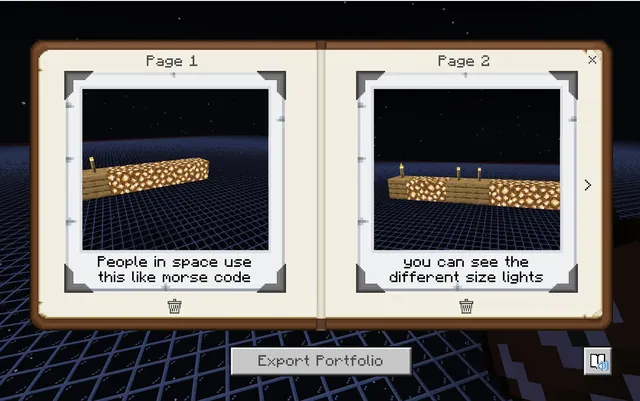
In this Minecraft activity, small student teams enter a town experiencing a mysterious decline in shared livestock. Working collaboratively, learners interview non-player characters, observe environmental conditions, and collect visual evidence using cameras and writable books to analyze the human behaviors driving resource depletion.
Learning objectives
By the end of this lesson students will be able to:
- Investigate the causes behind dwindling livestock numbers in a shared community pasture.
- Gather and record observational data using non-player characters, cameras, and portfolios.
- Synthesize observations in a writable book and export the final report for assessment.
- Explain how human self-interest challenges the sustainability of shared communal systems.
Blocks and items used in this lesson


Key vocabulary
- Tragedy of the Commons
- A situation where individuals acting in self-interest deplete or spoil a shared resource.
- Sustainability
- The ability to maintain or use a resource so that it does not run out over time.
- Self-Interest
- Focusing on personal needs or gains rather than the shared well-being of the group.
- Non-Player Character (NPC)
- An in-game character that provides instructions, clues, and external informational links.
Before class
Lesson sequence
- Introduction and Briefing
Organize students into groups of two to three learners. Present the town mystery: the community livestock in the shared common area is steadily decreasing, and students must determine why.
- NPC Investigation
Students explore the settlement and interact with non-player characters to receive directions and clues. Learners may access the browser links or videos offered by NPCs to deepen their understanding of the problem.
- Evidence Collection
Teams monitor the shared pasture, using the in-game camera and portfolio to record photographic evidence and documenting notes on how resources and livestock are managed.
- Reporting and Exporting
Learners synthesize their observations inside a writable book, explaining how self-interest contributed to the resource decline. Students finalize and export their completed book to submit to the teacher.
Assessment: success criteria
- Student accurately documents observations of the shared pasture using the camera and portfolio.
- Student articulates how human self-interest causes shared resources to deplete in their written report.
- Student successfully finalizes and exports the in-game writable book file for submission.
Differentiation
Pair students needing help with supportive peers to focus on locating NPC clues and navigating the book export process.
Have advanced students use world builder rights (/wb) to test and calculate new livestock or food allocations that could make the shared space sustainable.
Knowledge check
5 questions to check understanding after the lesson. Tap an answer to see if it is right; the score appears at the end.
1What problem are students tasked with solving in the town?
Answer: A. The lesson introduction explains that the town has a shared common area for livestock, but the animal numbers have started to dwindle.
2Why does communal resource sharing frequently fail according to the guiding ideas?
Answer: C. The source notes that although communal sharing works mathematically, humans naturally take more than their share out of self-interest.
3What is the maximum number of student groups that should be on each running map?
Answer: D. The student activities guidelines specify that each running map should have three groups maximum.
4Which set of in-game tools do students use to document and submit their work?
Answer: B. The lesson lists the writable book, portfolio, and camera as the required tools for taking notes and submitting responses.
5Which command gives permissions to modify livestock counts, animal food, and NPC text?
Answer: A. The source notes that elements like livestock count, animal food, and NPC dialogue can be changed with world builder rights using /wb.
Resources
- Lesson package (.zip)Everything the author attached to this lesson in one download.
- Screenshot 1Screenshot of an NPC
- Screenshot 2Overview of the town
- Screenshot 3Example of the book students receive upon entering the Inn.
Frequently Asked Questions
What group sizes work best for this activity?
Students should work in teams of two to three, with a maximum of three groups operating within a single running world map.
Do students require additional applications outside Minecraft?
No external software is required other than a standard web browser if students choose to visit the research links and videos provided by the NPCs.
Can the livestock numbers and difficulty be customized for older or younger classes?
Yes. Teachers can use world builder rights by typing /wb to modify livestock amounts, animal food, NPC dialogue, and instructional links to match their grade level.
Adapted from The Tragedy of the Commons by Jung Koo on Minecraft Education, last updated Jun 14, 2018. This classroom version, the timings and the quiz were written by 9Minecraft Education.