How can engineers design and construct safe, functional artificial islands to meet specific human needs?
Overview
Coastal engineering allows societies to expand living and commercial space into the sea, with Dubai serving as a prominent real-world example of artificial island development. In this project, students explore how land resources can be excavated and repurposed offshore to construct new territory that balances aesthetic form, safety, and usable area.
Working in teams assigned to coastal village locations in Minecraft, students harvest earth from the mainland and engineer custom artificial islands in the adjacent ocean. After establishing their landforms, teams determine a clear function for their development—such as science research, tourism, or housing—and construct purpose-built structures to support it.
Learning objectives
By the end of this lesson students will be able to:
- Investigate real-world artificial island projects, such as those built in Dubai, to inform structural planning.
- Mine and manage land-based materials required to construct stable offshore landforms.
- Engineer an innovative island layout that prioritizes safety, visual design, and efficient land use.
- Construct purposeful facilities on the finished island suited for tourism, scientific research, or residential living.
Blocks and items used in this lesson


Key vocabulary
- Artificial Island
- An island constructed by human engineering rather than formed through natural geological processes.
- Coastal Engineering
- The branch of civil engineering concerned with building structures along shorelines and managing coastal spaces.
- Land Reclamation
- The process of creating new land from ocean, riverbeds, or lake beds.
Before class
Lesson sequence
- Inspiration and Research
Introduce the challenge by having students watch video clips of real-world island projects in Dubai. Discuss the engineering methods, aesthetic patterns, and physical resources required to build stable land in open water.
- Team Assignment and Site Planning
Assign student groups to one of the coastal village sites. Teams sketch their island blueprints, plan how much material must be excavated from the mainland, and decide on a core purpose such as residential housing, scientific research, or tourism resorts.
- Mining and Island Engineering
Students mine earth materials from the designated coastal mainland and transport them into the water. Working cooperatively, they raise the seabed to form their innovative island pattern while ensuring adequate surface area and safety.
- Infrastructure Construction
Once the island base is secure, teams construct thematic buildings that fulfill their chosen community purpose, integrating hotels, research stations, or homes into the island layout.
- Presentation and Reflection
Teams tour each other's coastal villages and artificial islands. Students evaluate how effectively each design maximized land space, maintained structural balance, and served its intended purpose.
Assessment: success criteria
- Student teams successfully excavated required earth from the mainland and deposited it to form offshore islands.
- The completed island demonstrates an intentional, innovative pattern with stable construction.
- The island surface maximizes usable space while addressing visitor or resident safety.
- Built structures directly reflect the team's intended purpose, such as hospitality, science, or housing.
Differentiation
Provide a simple geometric island layout template and assist the team in dividing mining and placing roles among members.
Challenge advanced students to engineer complex multi-island archipelagos with specialized zoning and interconnected transit systems.
Knowledge check
5 questions to check understanding after the lesson. Tap an answer to see if it is right; the score appears at the end.
1Which real-world city is highlighted as the primary inspiration for the artificial islands in this lesson?
Answer: B. The lesson specifically uses Dubai's famous island engineering projects as inspiration for student builds.
2Where do students obtain the materials needed to build their offshore islands?
Answer: A. The lesson plan specifies that students mine earth from the coastal land to build out into the water.
3What should students do before beginning their engineering work in Minecraft?
Answer: C. The activities recommend a quick look at video projects of Dubai to inspire and inform student designs.
4Which trio of design qualities are students asked to focus on when constructing their islands?
Answer: C. The performance expectations state that students should build their design focusing on safety, beauty, and maximizing land space.
5Which of the following is an example of an island purpose suggested in the lesson?
Answer: B. The source suggests tourism hotels or resorts, science research, or residential homes as valid purposes.
Resources
- Lesson package (.zip)Everything the author attached to this lesson in one download.
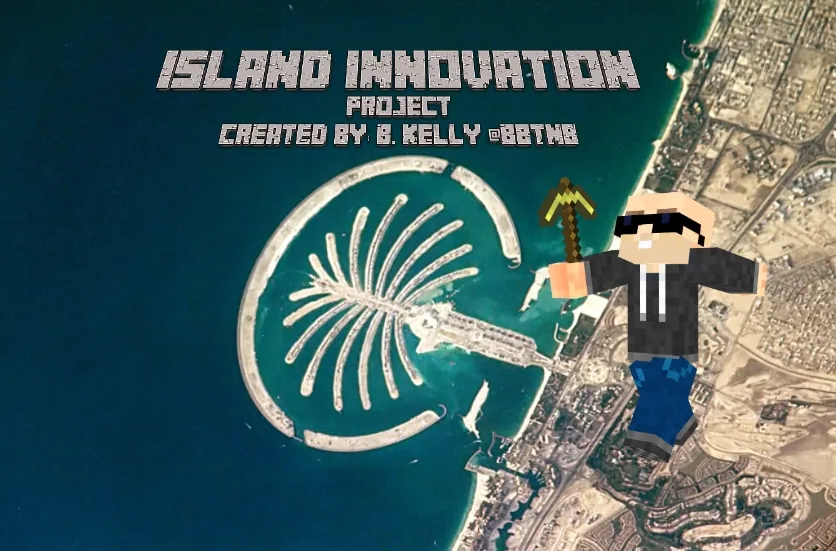
- Island Innovation Title PictureJust the project profile image
- Screen shot 1screen shot of boards
- Screen shot 2 - village 2village 2 across from village 1
- screen shot 3 - village 1village 1 SPAWN location
Frequently Asked Questions
Does this lesson include a pre-built downloadable world template?
No, the lesson does not come with a downloadable world file, so teachers can use any standard Minecraft world that features coastal villages and an open ocean area.
How should teams divide the construction tasks during the build phase?
Teams typically work best when dividing responsibilities between excavating earth from the land, transporting and laying the island foundation in the water, and constructing the surface facilities.
Adapted from The Island Innovation Project by Benjamin Kelly on Minecraft Education, last updated Jun 26, 2021. This classroom version, the timings and the quiz were written by 9Minecraft Education.