- Type
- Lesson plan
- Subject
- Math
- Topics
- Math & Economics
- Grade
- Primary (Grades 3-5)
- Ages
- Ages 8-10
How can measuring area and perimeter help us plan and gather the exact materials needed to build a house?
Overview
This lesson connects foundational geometry concepts to architecture and resource management. Students explore how area and perimeter calculations dictate the physical materials needed to construct roofs, walls, and facades, showing that mathematical planning is essential before starting any real build.
Working first in a prototype world, learners plan their layout, record measurements on an in-game slate, and review blueprints. They then transition to a cooperative survival setting where teams gather specific raw materials, craft building blocks, and assemble their structures together while managing night challenges.
Learning objectives
By the end of this lesson students will be able to:
- Calculate the area and perimeter of two-room floor plans using multiplication and addition.
- Design a home prototype including a roof, facade, and door, documenting the measurements on an in-game slate.
- Explain how wall calculations relate to perimeter multiplied by height.
- Collaborate in survival mode to mine, harvest, and craft the necessary building materials based on blueprint data.
Blocks and items used in this lesson


Key vocabulary
- Perimeter
- The total distance around the outside edge of a flat shape.
- Area
- The amount of flat surface covered by a shape, measured in square units.
- Prototype
- A model or test version of a build created to plan and check ideas before final construction.
- Facade
- The front or exterior face of a building, often decorated with details.
- Scaffolding
- A temporary structure, such as dirt blocks, used to support builders while constructing high areas like roofs.
Before class
Lesson sequence
- Slideshow Brainstorm and Big Idea
Present the slideshow images to prompt student ideas on how math helps build roofs and facades. Connect student observations on the whiteboard to the Big Idea: math is necessary for building construction, and area and perimeter are the tools used to achieve it.
- Blueprint Review and Peer Check
Organize students into groups of four. Have them retrieve their blueprints, verify their numbers, and conduct peer reviews of each other's work before logging into the digital environment.
- Developing the Prototype
Students enter the Home Prototype World to complete four tasks: design their roof, facade, and door, and log their math variables on an in-game slate (roof, facade, area, walls, and total). Conduct a quick debrief asking whether Minecraft changes how they think about math.
- Survival Resource Gathering
Review blueprints to determine material counts. Divide students into three survival gathering groups: Miners (pickaxes for stone, coal, iron), Lumberjacks (axes for wood, flowers in a forest), and Mudders (shovels for sand, gravel, clay along a river). Each student aims to collect at least three stacks for the team.
- Crafting and Survival Building
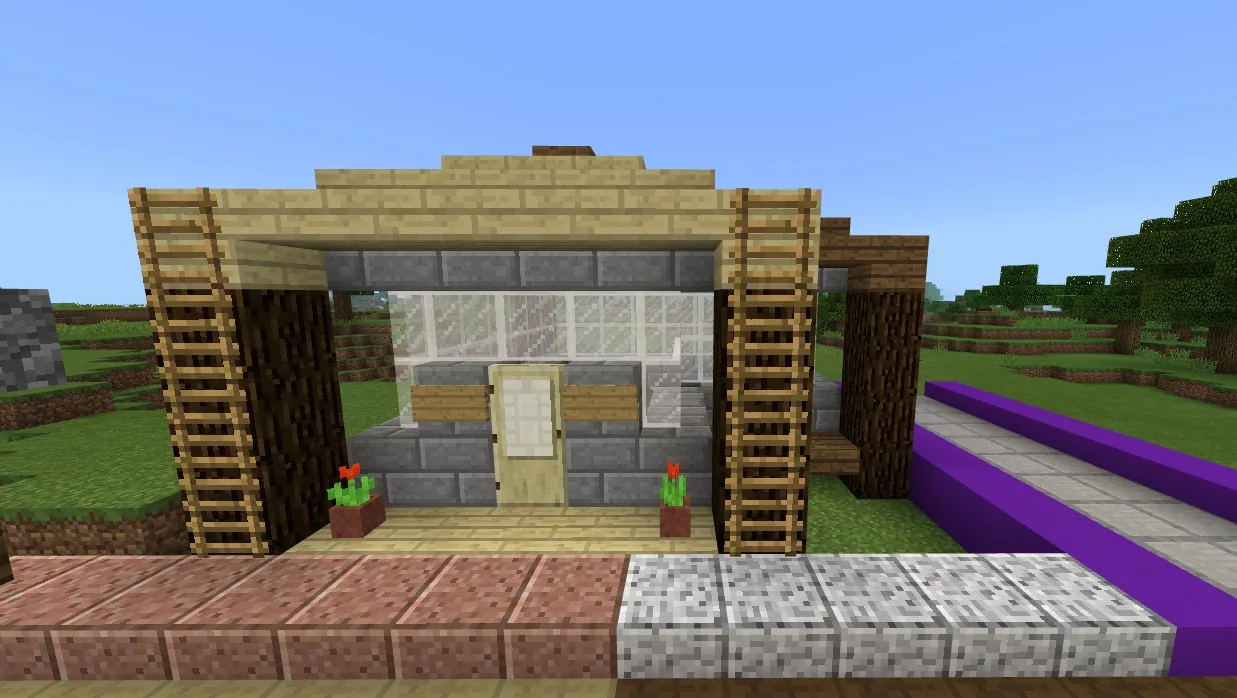
Have students deposit gathered materials into nine chests arranged in three labeled rows (stone, wood, mud/flowers) alongside coal-filled furnaces. Students take needed items to craft components like stone bricks, slabs, or concrete, use dirt scaffolding for roofs, and decorate facades using potted flowers, trapdoors, signs, or ladders.
- Fight the Night and Final Debrief
Challenge students to collect mob loot by setting the game to hard mode and running /gamerule mobgriefing false and /time set night. Conclude by flying up to view the road map, allowing students to present their completed structures and explain their math strategies.
Assessment: success criteria
- The student accurately creates walls by stacking perimeter loops and explains that walls equal perimeter multiplied by height.
- The student records correct calculations for roof, facade, area, walls, and total blocks on the in-game slate.
- The student demonstrates the distributive property, showing how A x (B + C) = (A x B) + (A x C) connects to their floor plan.
- The student successfully gathers materials according to their role and builds their planned rooms in the survival world.
Differentiation
Allow students who struggle with mental multiplication to count unit squares on graph paper and focus on calculating a single rectangular room before adding a second.
Challenge advanced learners to design multi-room floor plans that demonstrate distributive property equations and incorporate advanced decorative facade patterns.
Knowledge check
5 questions to check understanding after the lesson. Tap an answer to see if it is right; the score appears at the end.
1Which formula connects perimeter and height to find the total blocks in a building's walls?
Answer: B. The performance expectations state that students explain how wall blocks equal perimeter multiplied by height.
2What tool and material assignment is given to the Lumberjacks group during resource gathering?
Answer: C. Lumberjacks are equipped with axes and teleported to a forest to collect wood and flowers.
3What temporary material does the lesson recommend using as scaffolding to build roofs?
Answer: C. The lesson advises students to build scaffolding out of dirt to easily reach and construct their roofs.
4Why is the command /gamerule mobgriefing false run before setting the time to night?
Answer: A. The lesson notes that setting mobgriefing to false prevents creepers from destroying student structures.
5Which items must students record on their in-game slate in the prototype phase?
Answer: B. The prototype activity requires documenting math variables on a slate showing roof, facade, area, walls, and total.
Resources
- Lesson package (.zip)Everything the author attached to this lesson in one download.
- Slideshow
- Rubric
- Lesson worldOpens the world page in Minecraft Education (sign-in with a school account may be needed).
Frequently Asked Questions
How are community resources organized before crafting begins?
Place nine chests arranged into three rows labeled stone, wood, and mud/flowers, along with coal-loaded furnaces so students can deposit all harvested items into a central pool.
What items can students use to decorate their building facades?
The lesson suggests using potted flowers, trapdoors, signs, and ladders to add decorative detail to facades.
What mathematical property connects student floor plans to multiplication?
Students model the distributive property by showing how A x (B + C) equals (A x B) + (A x C) across two-room layouts.
Adapted from Survival City Part 3 by Minecraft Education on Minecraft Education, last updated Sep 16, 2023. This classroom version, the timings and the quiz were written by 9Minecraft Education.