- Type
- Lesson plan
- Subject
- Math
- Topics
- Math & Economics
- Grade
- Primary (Grades 3-5)
- Ages
- Ages 8-10
- Duration
- about 1.7 hours (suggested)
How can measuring area, perimeter, and applying the distributive property help us accurately plan and construct buildings?
Overview
In this lesson, students explore how geometry and algebraic thinking connect directly to construction. Using area, perimeter, and the distributive property, learners design a floor plan, partition spaces into functional rooms, and calculate the exact quantity of building materials required to turn their architectural designs into reality.
Students begin by drafting blueprints on paper, prototype their structures in the Home Prototype World, and then transition into the Class Survival World. Working in specialized resource-gathering teams, they mine, harvest lumber, and gather aggregate to stock community chests before constructing their finished homes in survival mode.
Learning objectives
By the end of this lesson students will be able to:
- Calculate the area and perimeter of two-room floor plans using multiplication and addition.
- Model the distributive property by splitting a large room into two separate functional spaces.
- Determine the total block count needed for exterior walls using perimeter and height calculations.
- Collaborate in survival mode to harvest materials, craft components, and construct planned homes.
Blocks and items used in this lesson


Key vocabulary
- Perimeter
- The total distance around the outside edge of a shape or room.
- Area
- The total amount of flat space covered inside the boundaries of a shape.
- Distributive Property
- A mathematical rule showing that multiplying a number by a sum equals the sum of each multiplied part, shown as A x (B + C) = (A x B) + (A x C).
- Prototype
- A practice model or draft built to test an idea before creating the final version.
Before class
Lesson sequence
Suggested timing: about 100 minutes in total.
- Warm-up and Mathematical Brainstorm10 min
Display the slideshow images showing structures and wall layouts. Guide a whole-class brainstorm on the whiteboard discussing how math forms walls, introducing the distributive property and demonstrating that wall blocks can be determined by multiplying perimeter by height.
- Blueprint Drafting and Peer Review15 min
Distribute the Blueprint Worksheet. Students map out their home foundation, establish room boundaries, and plan wall dimensions. Before entering Minecraft, students swap designs with a partner for a brief peer review.
- Prototype Construction and Modeling30 min
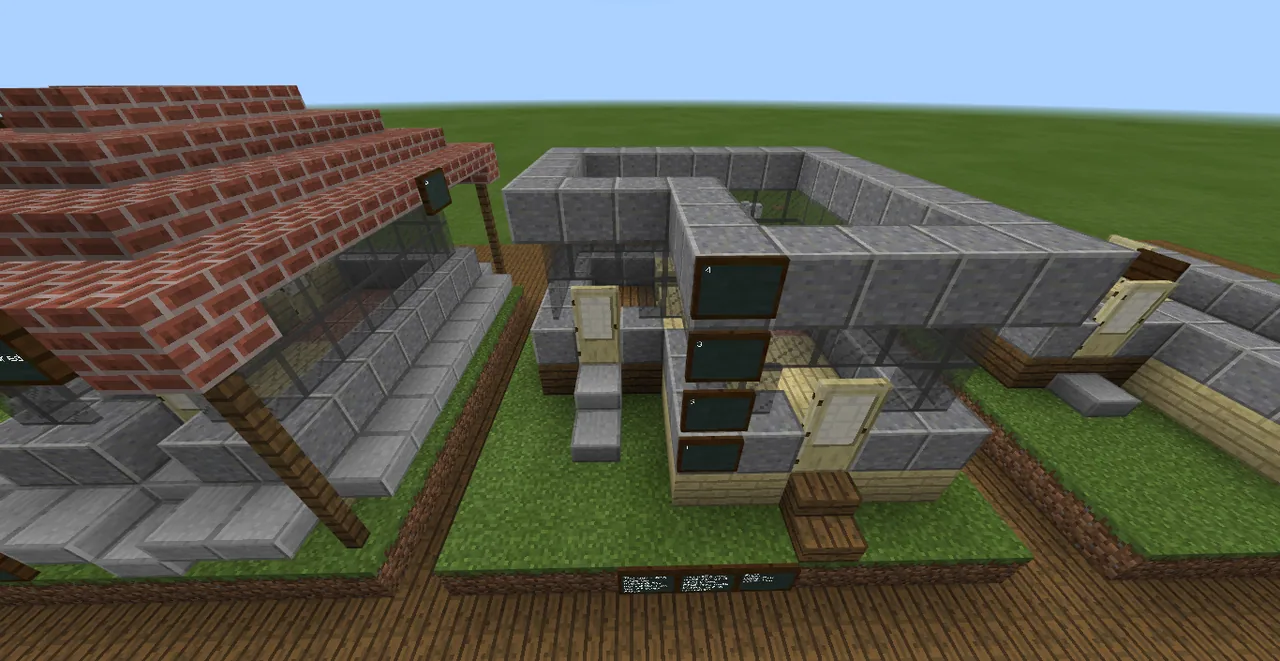
Students join the Home Prototype World to complete designated tasks: build a math model of the distributive property, divide their largest room into a kitchen and living room while calculating each area, build wall frames, and calculate the total blocks required. Fast finishers can begin gathering basic resources in the Class Survival World.
- Resource Harvesting and Crafting30 min
Transition students into Day 4 survival tasks by dividing them into three resource teams: Miners (stone, coal, iron), Lumberjacks (wood, flowers), and Mudders (sand, gravel, clay). Teams deposit gathered items into nine labeled community chests and coal-fueled furnaces, then craft required building materials like stone bricks, slabs, or concrete.
- Survival Build and Reflection15 min
Students use their crafted blocks to construct their home walls and rooms in the survival environment, making sure to carry extra glass in case of breakage. Conclude by viewing the overall layout from above and having selected students present how they calculated and built their rooms.
Assessment: success criteria
- Student can accurately calculate and explain the area and perimeter of a divided two-room floor plan.
- Student demonstrates and explains the distributive property formula A x (B + C) = (A x B) + (A x C) using their room layout.
- Student successfully calculates the total blocks required for walls using the formula perimeter multiplied by height.
- Student constructs the home in survival mode according to the calculated prototype and blueprint.
Differentiation
Allow learners to count individual unit squares on graph paper and provide hands-on perimeter counting support before calculating wall heights.
Knowledge check
5 questions to check understanding after the lesson. Tap an answer to see if it is right; the score appears at the end.
1Which formula connects wall height and perimeter to determine the total blocks in a wall?
Answer: B. The lesson rubric states that walls are constructed by stacking perimeters on top of one another, calculating walls = perimeter x height.
2What algebraic equation are students expected to model when dividing their largest room?
Answer: B. The performance expectation requires students to build and explain models showing how A x (B + C) = (A x B) + (A x C) relates to their floor plan.
3What specific job is assigned to the 'Mudders' group during resource gathering?
Answer: D. The activity instructions specify giving Mudders shovels and teleporting them to a river to gather sand, gravel, and clay.
4Why are students advised to take extra glass blocks when constructing walls in survival mode?
Answer: A. The lesson explicitly notes that students should take extra glass because it breaks if they make an error.
5What should students do with their harvested materials before crafting their building blocks?
Answer: C. Students empty their inventories into nine community chests arranged in three labeled rows before crafting their needed supplies.
Resources
- Lesson package (.zip)Everything the author attached to this lesson in one download.
- Rubric
- Slideshow
- Lesson worldOpens the world page in Minecraft Education (sign-in with a school account may be needed).
Frequently Asked Questions
How does this lesson connect mathematics with economics?
Students connect math with economics by estimating exact material requirements beforehand and working collaboratively to harvest, share, and process raw resources from community chests without wasting blocks.
What should early finishers do during the prototype phase?
Early finishers can enter the Class Survival World ahead of the main survival phase to begin gathering communal materials such as stone, wood, sand, and gravel for the class.
Adapted from Survival City Part 2 by Minecraft Education on Minecraft Education, last updated Sep 16, 2023. This classroom version, the timings and the quiz were written by 9Minecraft Education.