- Type
- Lesson plan
- Subject
- Math
- Topics
- Math & Economics
- Grade
- Primary (Grades 3-5)
- Ages
- Ages 8-10
How can calculating area and perimeter help us plan and construct a building accurately?
Overview
Constructing any building begins with accurate mathematical planning. By understanding how area and perimeter function, builders can determine the exact amount of ground their structures will cover and anticipate the resources needed for construction before starting in a survival environment.
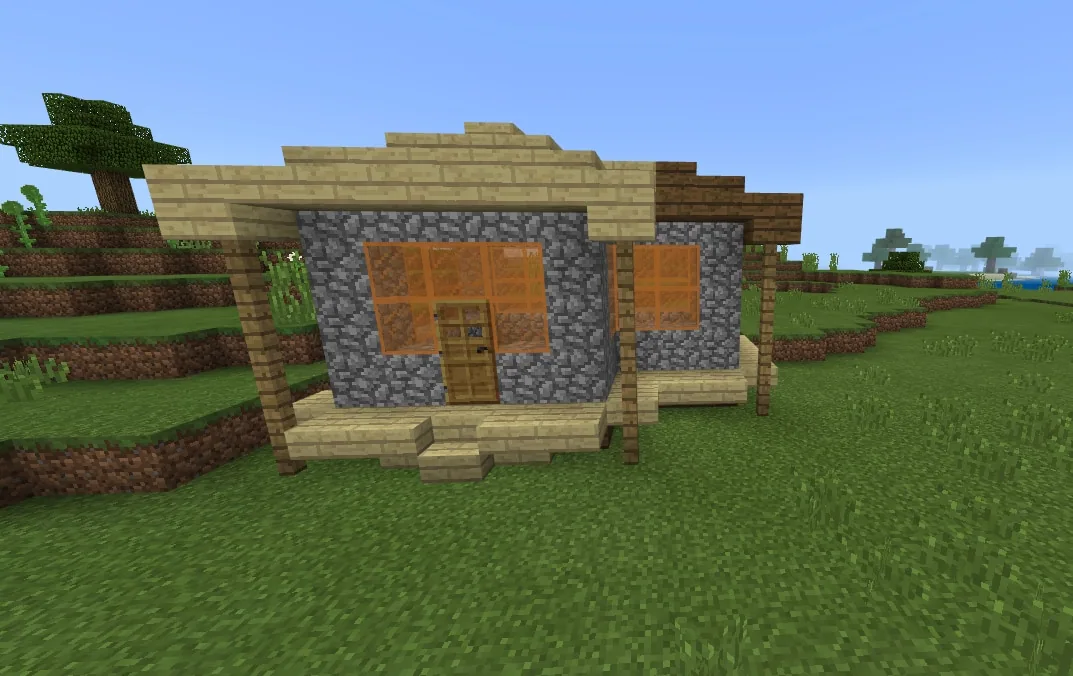
In this lesson, students explore the relationship between multiplication and area, sketch a foundation blueprint on paper, and review each other's designs. They then enter a prototype world to clear a plot of land, build a two-room foundation, measure its boundary, and document their mathematical proof using in-game slates and pictures.
Learning objectives
By the end of this lesson students will be able to:
- Draft a two-room foundation layout on a blueprint worksheet using area and perimeter calculations.
- Clear a 10 meter by 10 meter building plot and determine its total area.
- Construct a foundation made of two rectangles in Minecraft and calculate the area of each room as well as the total combined area.
- Measure and build a perimeter on top of the foundation while recording mathematical work with in-game tools.
Blocks and items used in this lesson


Key vocabulary
- Area
- The total amount of flat space inside a shape, measured in square units.
- Perimeter
- The continuous line or boundary around the outside of a closed shape.
- Unit Square
- A square with sides of one unit, represented by the equation 1 x 1 = 1.
- Prototype
- A preliminary model built to test measurements and layout before final construction.
Before class
Lesson sequence
- Introduction and Brainstorming
Present the slideshow images to the class and invite students to record observations in their math notebooks. Guide a whiteboard discussion connecting multiplication to area until students recognize that math is necessary for building structures. Introduce the guiding idea: Math is needed to construct all buildings and measuring the area and perimeter of shapes are its tools.
- Blueprint Drafting and Peer Review
Distribute the Blueprint Worksheet. Students design their home foundations on paper by drafting specific areas and perimeters within their assigned plot. Once completed, partners swap worksheets to peer review measurements and layout designs before moving into the game.
- Developing the Home Prototype
Students log into the Home Prototype World and complete three sequential tasks based on their worksheets:
- Clear and flatten an area measuring 10 meters by 10 meters, then calculate its total area.
- Build a foundation consisting of two joined rectangles, calculate the area of each separate rectangle, and determine the combined total area.
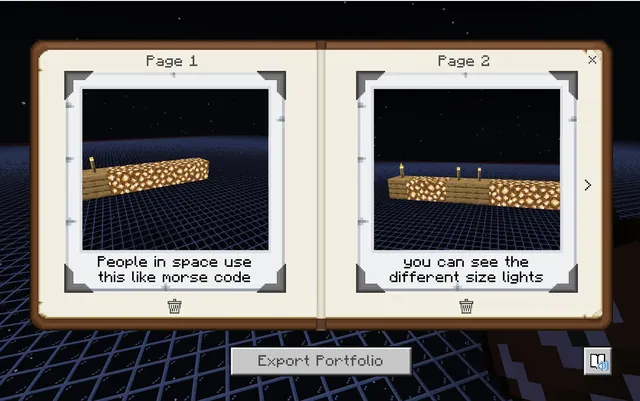
- Construct a perimeter directly on top of the foundation and record work using slates and camera pictures.
- Survival Gathering and Debrief
Students who complete their prototype early join the Class Survival World to harvest construction materials including wood, stone, sand, and gravel. Gather the whole class for a final debrief to discuss three key questions: what a unit square is and how 1x1=1 proves it, how math assists in home construction, and how perimeter differs from area.
Assessment: success criteria
- Student accurately clears a 10 by 10 meter area and identifies the total square units.
- Student designs a two-room layout on the worksheet and reproduces it as a prototype in Minecraft.
- Student calculates and explains the individual and combined areas of both rectangles using length and width.
- Student places slates and pictures to document mathematical measurements and perimeter work in-game.
Differentiation
Have students count individual grid squares one by one on graph paper before applying multiplication equations to find rectangular area.
Ask students to analyze why the total number of placed perimeter blocks is smaller than the measured perimeter in meters due to corner blocks, and have them adjust their equation.
Knowledge check
5 questions to check understanding after the lesson. Tap an answer to see if it is right; the score appears at the end.
1What are the dimensions of the land students must flatten in the prototype world?
Answer: B. The activity instructions state that students must flatten an area measuring 10 meters by 10 meters.
2What shape configuration must students build for their home foundation?
Answer: D. The lesson directs students to build a foundation composed of two rectangles.
3Which equation is used in the debrief to prove what a unit square is?
Answer: A. The debrief section explicitly states that a unit square is proven by the equation 1x1=1.
4What activity is designated for students who complete their prototype tasks early?
Answer: C. Early finishers are directed to enter the Class Survival World to collect raw materials for the class.
5Why can the measured perimeter in meters differ from the actual number of blocks placed along the boundary?
Answer: B. Because corner pieces sit on two edges, measuring perimeter in meters counts them twice compared to counting the individual blocks placed.
Resources
- Lesson package (.zip)Everything the author attached to this lesson in one download.
- Home Blueprint
- Slideshow
- Rubric
Frequently Asked Questions
How do students display their mathematical proof inside the game?
Students document their measurements, room areas, and perimeter calculations directly next to their foundations using in-game slates and camera pictures.
What must students complete before they are allowed into the Minecraft world?
Students must draft their foundation plan on the Blueprint Worksheet and participate in a peer review with a classmate before loading the digital world.
Why is this math activity framed around prototyping?
Prototyping allows students to calculate exact dimensions and surface areas so they know how many blocks and resources they will need to collect before constructing a home in survival mode.
Adapted from Survival City - Making Homes by Minecraft Education on Minecraft Education, last updated Jan 23, 2019. This classroom version, the timings and the quiz were written by 9Minecraft Education.