- Type
- Lesson plan
- Ages
- Ages 11-13
- Includes
- Quiz: 5 questionsLesson files
How can we redesign our school building to conserve energy and water while meeting modern sustainability goals?
Overview
This STEM project challenges students to think critically about resource efficiency by reimagining their existing school as a futuristic, sustainable facility. Grounded in Sustainable Development Goal 7, the lesson guides learners through the engineering design process to address modern environmental issues such as heavy electricity consumption and water management. Students inspect their actual campus, note structural measurements, and identify areas ripe for ecological improvements before planning their build.
Using Minecraft Education in Creative mode, paired students bring their architectural drafts to life to scale. They model eco-friendly features like rainwater harvesting and reduced electricity reliance, while calculating the surface area, perimeter, and financial cost of their construction materials based on a teacher-assigned budget system. Every stage of design, justification, and budgeting is documented directly in the game using the Book and Quill.
Learning objectives
By the end of this lesson students will be able to:
- Design a futuristic, sustainable school model in Minecraft that aligns with SDG 7 clean energy goals.
- Calculate the perimeter, area, and total material cost of the planned structure.
- Identify architectural changes that reduce electricity usage and facilitate rainwater reuse.
- Document the engineering design phases, scale, and material rationale using the Book and Quill.
Blocks and items used in this lesson


Key vocabulary
- SDG 7
- A United Nations Sustainable Development Goal aimed at ensuring access to affordable, reliable, sustainable, and modern energy.
- Engineering Design Process
- A structured method of defining a problem, researching solutions, drafting plans, creating prototypes, and improving the design.
- Scale
- The proportional ratio comparing the dimensions of a model to the dimensions of the real-world building.
- Book and Quill
- An in-game tool used to write text, record project progress, and export written portfolios.
Before class
Lesson sequence
- Campus Observation and Problem Identification
Introduce SDG 7 and discuss practical building improvements, such as lowering electrical use and recycling rainwater for plants or facility needs. Pair students up to tour the school interior and exterior, taking notes, sketching layouts, and estimating perimeter and area dimensions while identifying structural problems to solve.
- Drafting and Mathematical Planning
Working in their pairs, students produce physical drafts of their sustainable school design. They establish a scale ratio, finalize perimeter and area calculations, and outline their green energy strategies prior to opening the game.
- Minecraft Construction
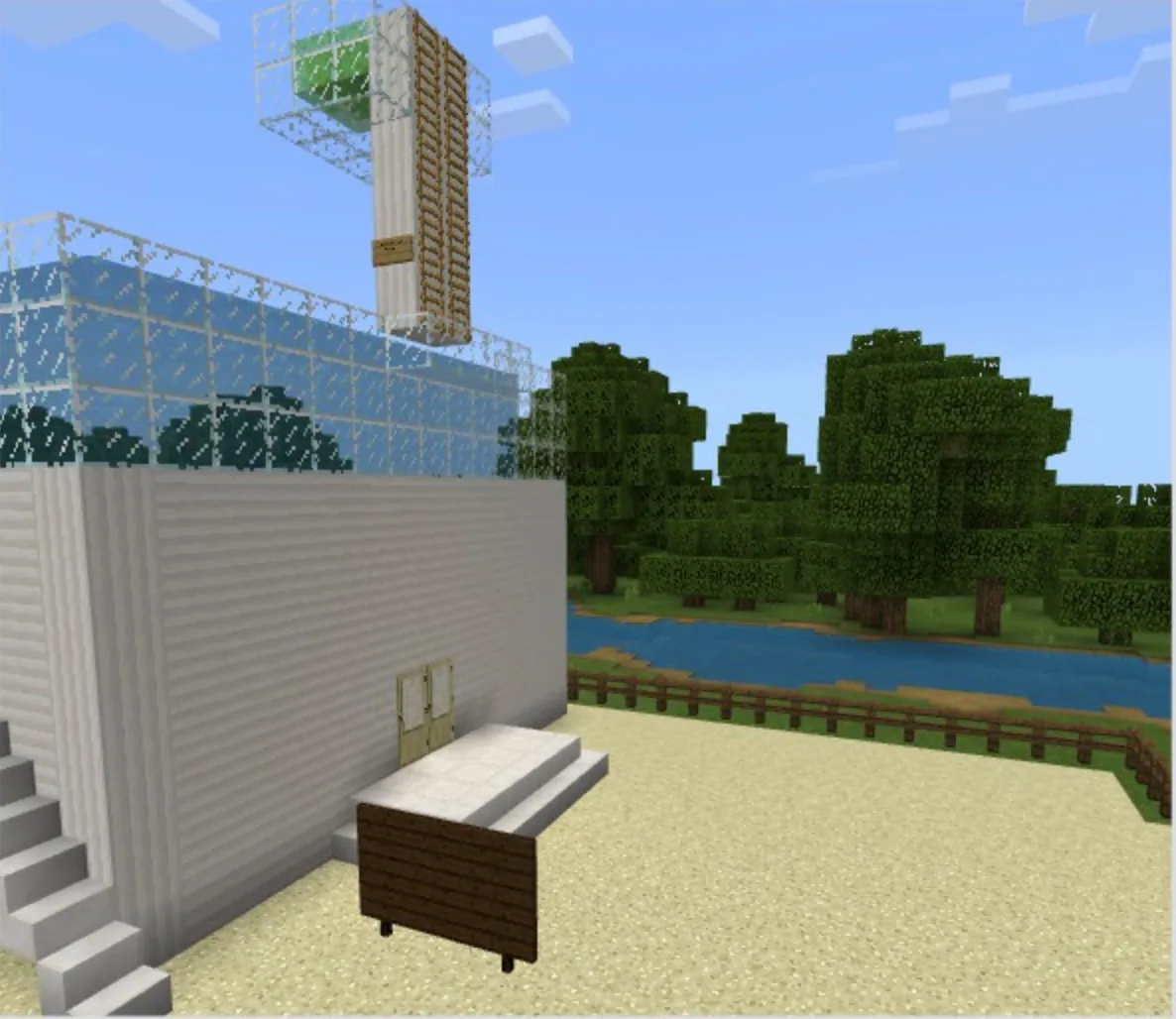
Students launch a Creative mode world to construct their redesigned school based on their drafted scale. They incorporate sustainable features such as natural light to reduce electricity and rainwater collection systems for plant care.
- Documentation and Budgeting
Using the Book and Quill, partners record each phase of construction. They justify their choice of building materials, log the scale and area measurements, and calculate the overall funding needed using the teacher-provided block pricing guide.
Assessment: success criteria
- The redesigned structure incorporates concrete sustainable features related to SDG 7, such as rainwater reuse or passive lighting.
- The student Book and Quill contains written justifications for chosen materials and records the scale used.
- Mathematical calculations for area, perimeter, and total block expenditures are completed and documented.
- The student pair shows evidence of following the engineering design process from sketch to final build.
Differentiation
Provide a simplified grid template with pre-measured perimeter values to assist students with scale and area calculations.
Challenge pairs to design multi-stage rainwater plumbing circuits and calculate simulated long-term utility savings based on their reduced electricity design.
Knowledge check
5 questions to check understanding after the lesson. Tap an answer to see if it is right; the score appears at the end.
1Which United Nations Sustainable Development Goal forms the basis of this redesign project?
Answer: B. The project directly targets SDG 7 and its objective to promote clean energy and energy efficiency.
2What should students complete before building their model in Minecraft?
Answer: A. The engineering design process requires students to tour the building, take notes, and draft plans prior to digital construction.
3Which in-game item is required to record calculations, scale, and design phases?
Answer: C. Students are instructed to document all phases of construction, scale, and material choices in the Book and Quill.
4How do students determine the total funds needed for their school construction?
Answer: B. Students calculate project costs using a unit cost assigned to each block material by the teacher.
5Which two environmental improvements are specifically highlighted for the school building?
Answer: C. The guiding ideas focus on reducing electricity use and collecting rainwater to water plants or supply building facilities.
Resources
Frequently Asked Questions
Which world template should be used for this activity?
Because no downloadable world is provided with the source, teachers can have students start in a standard flat or blank Creative world to construct their school from scratch.
How should the teacher set material prices for the economics objective?
Create a simple one-page price index assigning arbitrary monetary values to common building blocks, which enables students to practice budgeting and multiplication as they tally their build.
Adapted from STEM classroom by sara Abou Afash on Minecraft Education, last updated Sep 25, 2020. This classroom version, the timings and the quiz were written by 9Minecraft Education.