- Type
- Lesson plan
- Ages
- Ages 8-13
- Duration
- 30 min
- Level
- Beginner
- Includes
- Quiz: 5 questions
How does redstone transmit energy to activate different mechanical components?
Overview
Learning redstone fundamentals allows students to discover basic logic, power distribution, and cause-and-effect relationships in an interactive environment. By observing how energy travels through different components, students develop foundational problem-solving skills relevant to computing and physical science.
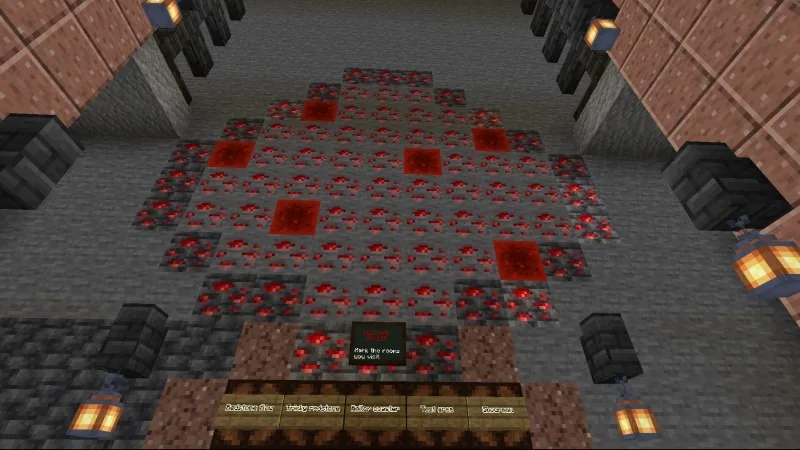
In this lesson, learners navigate the Redstone Museum, tackling sequential challenge rooms that demonstrate energy flow, comparator functions, and rail systems. They record their mechanical observations using portfolio tools and track their completed rooms on a central progress wall.
Learning objectives
By the end of this lesson students will be able to:
- Identify how redstone carries an energy signal along a pathway.
- Repair incomplete redstone lines, power connections, and rail systems.
- Investigate the functional behavior of a redstone comparator.
- Document observations of working mechanisms using an in-game camera and book.
Blocks and items used in this lesson
 Redstone Dust
 Redstone Comparator
 Camera
 Book and Quill
 Powered Rail
 Rail
 Redstone Lamp
Key vocabulary
- Redstone
- A mineral material that carries energy signals to power components and mechanisms.
- Circuit
- A complete, connected route that transmits redstone power from a source to an active device.
- Comparator
- A redstone component used to check, maintain, or measure signal strength.
Before class
Lesson sequence
Suggested timing: about 30 minutes in total.
- Orientation and Setup5 min
Introduce the Redstone Museum layout and explain the suggested room sequence. Ensure each student equips a camera and a book and quill to document how mechanisms function as they explore.
- Core Circuit Challenges15 min
Guide students through the first three stations in order:
- Redstone Flow: Fix an interrupted redstone wire path.
- Tricky Redstone: Experiment with a redstone comparator.
- Light It Up: Connect energy sources to complete lighting circuits.
- Mechanics and Application7 min
Allow students to repair rails in the optional Roller Coaster room, activate devices in the Test Area, or observe complex setups in the Showroom.
- Progress Check and Review3 min
Gather students back at the spawn area to mark off completed rooms on the wall panel and share one mechanical detail they recorded in their notes.
Assessment: success criteria
- Successful repair of the broken redstone line in the Redstone Flow room.
- Completion and marking of visited rooms on the central hall panel.
- Recorded notes and images of observed mechanisms within the book and quill.
Differentiation
Encourage learners to follow the exact room sequence starting with Redstone Flow to master basic wire connections before trying comparators.
Have advanced learners examine the Showroom mechanisms and design their own functional contraption in a separate creative world.
Knowledge check
5 questions to check understanding after the lesson. Tap an answer to see if it is right; the score appears at the end.
1Which room requires students to fix a broken path of redstone dust?
Answer: B. The Redstone flow room challenges students to fix an interrupted redstone path.
2What happens to a student's inventory when they step out of an exhibit room?
Answer: D. The source notes state that a student's inventory is cleared while exiting each room.
3Which specific device do students explore in the 'Tricky redstone' room?
Answer: A. The Tricky redstone challenge focuses specifically on working with a redstone comparator.
4Where do students go to record which museum rooms they have completed?
Answer: C. Students can mark the rooms they have visited using the panel located at the spawn point.
5Which museum challenge is designated as optional for studying rail mechanics?
Answer: B. The Roller coaster room is marked as an optional route to investigate how rails work.
Frequently Asked Questions
Why does the museum clear student inventories between rooms?
Clearing inventory prevents items from one puzzle from being carried into another, ensuring students solve each challenge using only the intended components.
How do students record what they learn during the tour?
Students can carry an in-game camera along with a book and quill to capture images and write observations about how each redstone mechanism operates.
Adapted from Redstone Basics by Leticia Ahumada on Minecraft Education, last updated Mar 7, 2025. This classroom version, the timings and the quiz were written by 9Minecraft Education.