- Type
- Lesson plan
- Ages
- Ages 8-18
- Includes
- Quiz: 5 questionsLesson files
How can we represent medieval Portuguese society, economy, and fourteenth-century crises inside Minecraft?
Overview
During the thirteenth and fourteenth centuries, Portugal developed its economy, society, and municipal governance amid broader European developments. While agriculture anchored daily survival, internal and external trade routes expanded, port towns grew, and social dynamics shifted between the privileged nobility and clergy, the working peasantry, and a rising urban bourgeoisie.
In this project-based lesson, students investigate historical sources using a study guide, translate their findings into written notes, and collaborate in Minecraft. Learners construct models representing medieval Portuguese environments, such as rural manors, trading ports, or town municipalities, while reflecting on the severe fourteenth-century challenges of famine, plague, and conflict.
Learning objectives
By the end of this lesson students will be able to:
- Explain the relationship between natural resources, rudimentary techniques, and medieval agriculture and trade.
- Identify the distinct social groups of medieval Portugal, contrasting the privileges of nobility and clergy with the obligations of peasants.
- Describe the impact of fourteenth-century famine, pestilence, and war on living conditions and social stability.
- Construct a collaborative Minecraft build representing medieval Portuguese life, trade, or architecture.
Blocks and items used in this lesson


Key vocabulary
- Manor
- A rural estate owned by a noble or religious institution and cultivated by peasants.
- Charter
- An official document granting rights and local autonomy to residents of a municipality.
- Cortes
- An assembly where representatives of social groups participated in making key decisions for the kingdom.
- Bourgeoisie
- The growing class of town-dwelling merchants and artisans empowered by commercial expansion.
- Gothic Art
- A style of medieval architecture that emerged alongside earlier Romanesque forms in religious and civic buildings.
Before class
Lesson sequence
- Brainstorm and Initial Inquiries
Introduce the driving question regarding how to portray medieval Portugal. Ask students to share what they know about medieval daily life, farming reliance, and the geographic significance of Portuguese coastlines and ports.
- Guided Research and Synthesis
Using study guides and reference materials, students investigate designated topics: agricultural methods, privileged versus non-privileged social classes, town charters, trade routes, Romanesque and Gothic architecture, or fourteenth-century crises. Students must write their findings in their own words before building.
- Minecraft Construction Phase
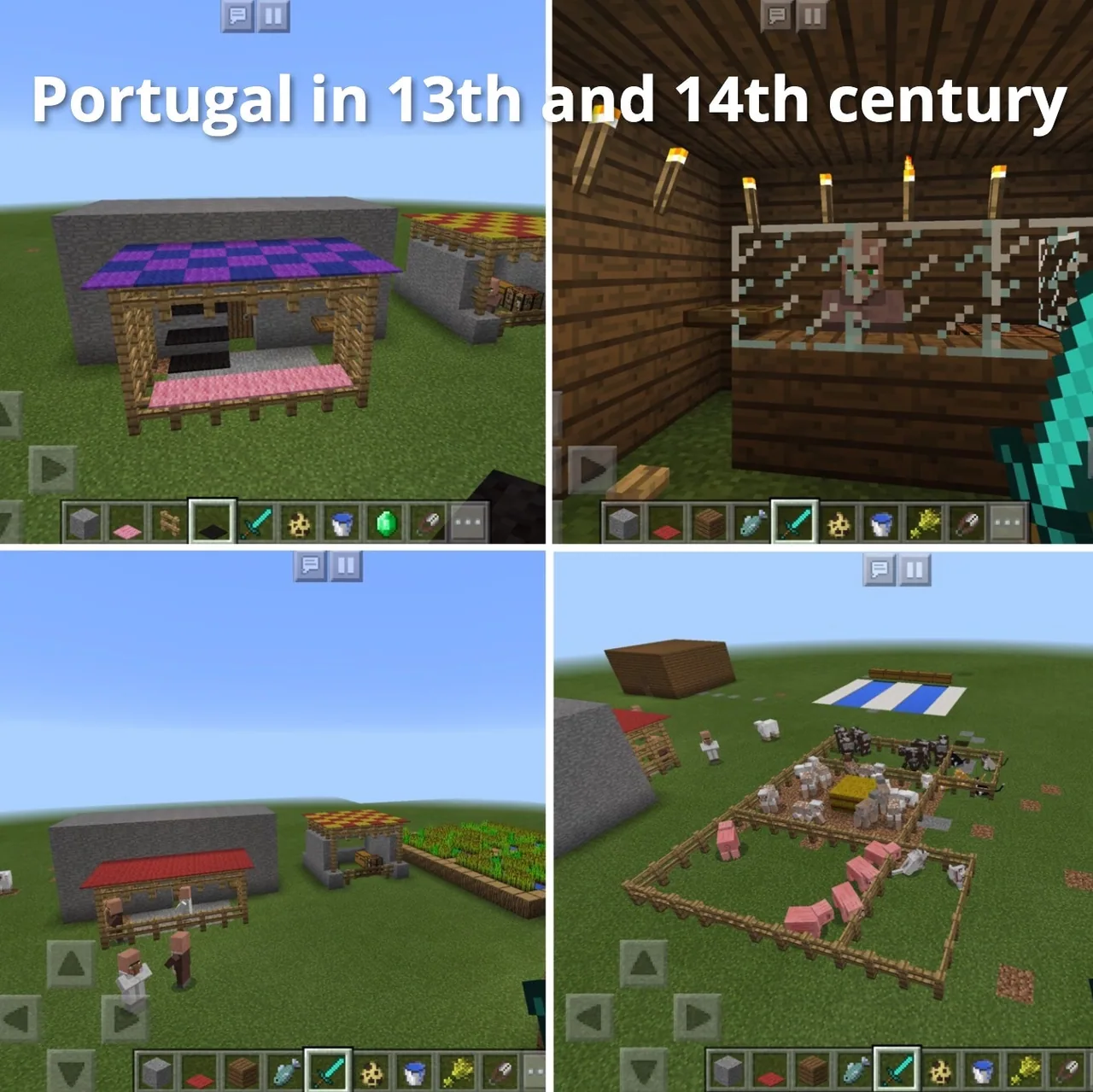
Teams enter Minecraft to construct visual representations based on their research notes. Projects may depict monastic or noble manors, rural farmland, trading ports along external trade routes, or fortified towns showing municipal autonomy.
- Presentation and Historical Walkthrough
Students guide their peers through their Minecraft builds, explaining how specific structures represent historical realities such as social hierarchies, commercial trade growth, or the widespread hardships of famine, plague, and war.
Assessment: success criteria
- Students produce written notes in their own words detailing medieval Portuguese economic activities and social groups.
- Minecraft models accurately reflect historical elements such as rural manors, ports, municipal towns, or architectural styles.
- Presentations explain how 14th-century crises (war, famine, plague) affected populations and triggered popular uprisings.
- Team members demonstrate collaborative planning and execution throughout the project.
Differentiation
Provide graphic organizers focusing on a single topic, such as modeling a peasant farm and explaining their duties to the lord.
Have advanced students incorporate elements of town autonomy, such as a municipal council hall created under a royal charter, or contrast Romanesque and Gothic building styles.
Knowledge check
5 questions to check understanding after the lesson. Tap an answer to see if it is right; the score appears at the end.
1What was the primary economic activity in medieval Portugal during the 13th and 14th centuries?
Answer: B. Agriculture formed the central economic activity for medieval populations, despite the expansion of trade.
2Which documents granted relative autonomy to residents living in medieval municipalities?
Answer: A. Letters of Charter officially granted local self-governance and privileges to municipal inhabitants.
3What were the 'Cortes' in medieval Portuguese governance?
Answer: C. The Cortes allowed different social estates to take part in major decisions concerning the kingdom.
4Which group gained notable strength in urban centers due to economic and commercial growth in the 12th and 13th centuries?
Answer: D. Commercial revival and urban growth directly bolstered the influence of the town-based merchant class, the bourgeoisie.
5The fourteenth century across Europe was predominantly characterized by which set of crises?
Answer: A. Fourteenth-century Europe was defined by severe hardships including widespread famine, plague (pestilence), and warfare.
Resources
Frequently Asked Questions
Does this lesson require a specific downloadable world?
No custom world is required. Students can build in a standard creative world, utilizing coastal areas, rivers, or open plains to represent Portugal's geography.
How can teachers verify historical accuracy before students build?
Follow the source's project plan: require students to write their research findings in their own words and obtain teacher approval before launching their Minecraft build.
Adapted from Portugal: 13th/14th Centuries by Joana De Almeida Simas on Minecraft Education, last updated Apr 17, 2017. This classroom version, the timings and the quiz were written by 9Minecraft Education.