How can engineers design resource pipelines that transport vital energy while protecting local communities and the environment?
Overview
Responsible resource development requires balancing economic needs with environmental safety and community well-being. In this lesson, students explore the logistical and ethical complexities of resource transportation by planning and installing an oil pipeline across diverse terrain.
Using Minecraft, learners collaborate in teams to cap a hazardous open oil well, interview local villagers and technical experts, and route pipeline infrastructure across farmland, rivers, and mountains toward a processing town.
Learning objectives
By the end of this lesson students will be able to:
- Consult with local villagers, workers, and experts to understand community and environmental concerns.
- Cap an open oil well site to prevent environmental hazards.
- Plan a safe, non-intrusive, and cost-effective pipeline route connecting the oil source to the processing settlement.
- Construct reinforced pipeline infrastructure that safely navigates mountains, farmland, and rivers.
- Relate the challenges of responsible resource transportation to domestic and global energy management.
Blocks and items used in this lesson


Key vocabulary
- Pipeline
- A connected line of pipes designed to transport liquids, such as crude oil, over long distances.
- Well capping
- The process of securing and sealing an open wellhead to prevent leaks and control resource flow.
- Resource development
- The extraction, transport, and management of natural materials to support human infrastructure and industry.
Before class
Lesson sequence
- Consultation and Site Exploration
Students locate the oil source and follow the glowstone trail leading toward the processing town. As they travel, they interact with in-world experts, workers, and local villagers to gather input on safety, landscape preservation, and community concerns.
- Well Capping and Route Planning
Working collaboratively, students first cap the open oil well. Teams then evaluate the suggested path, make necessary route modifications, and present an offline or in-game proposal to the teacher for approval before building.
- Pipeline Engineering and Obstacle Navigation
Students build the pipeline as a team, maintaining cost efficiency while respecting the surrounding landscape. They apply critical thinking to construct specialized safety structures when crossing rivers, mountain ranges, and farming areas.
- Inspection and Real-World Connections
The class inspects the completed pipeline route to ensure local lifestyles and ecosystems remain protected. Students finish by discussing how the trade-offs encountered in-game relate to infrastructure projects in their own country and daily lives.
Assessment: success criteria
- Students successfully secure the site by capping the open oil well.
- The built pipeline establishes an unbroken connection from the oil source to the processing town.
- The route incorporates specific engineering adjustments to protect rivers, mountains, and farmland.
- The planned design reflects input and safety advice gathered from villagers and experts.
- Students can articulate how the project's economic and environmental challenges apply to real-world energy systems.
Differentiation
Allow students to build strictly along the pre-marked glowstone trail while focusing primarily on simple structural pipe connections.
Prompt advanced students to design alternative routes that minimize visual disruption and avoid agricultural zones entirely while calculating construction trade-offs.
Knowledge check
5 questions to check understanding after the lesson. Tap an answer to see if it is right; the score appears at the end.
1What initial safety action must students take at the oil site before starting pipeline construction?
Answer: B. The lesson requires students to cap the open well to secure the oil source before laying pipe.
2What visual guide can students follow between the oil well and the destination town?
Answer: C. The student activity tips advise following the glowstone trail to navigate toward the nearby town.
3Who do students consult during the planning phase to gather feedback on the pipeline?
Answer: A. Learners are instructed to speak with technical experts, workers, and local residents to understand their needs and concerns.
4Which set of obstacles requires extra safety considerations during pipeline engineering?
Answer: D. The lesson specifically asks students to apply critical thinking when navigating rivers, mountains, villages, and farmland.
5How can student teams share their proposed pipeline route with the teacher for review?
Answer: C. The source specifies that students may communicate their planned route via an offline or in-game plan.
Resources
- Lesson package (.zip)Everything the author attached to this lesson in one download.
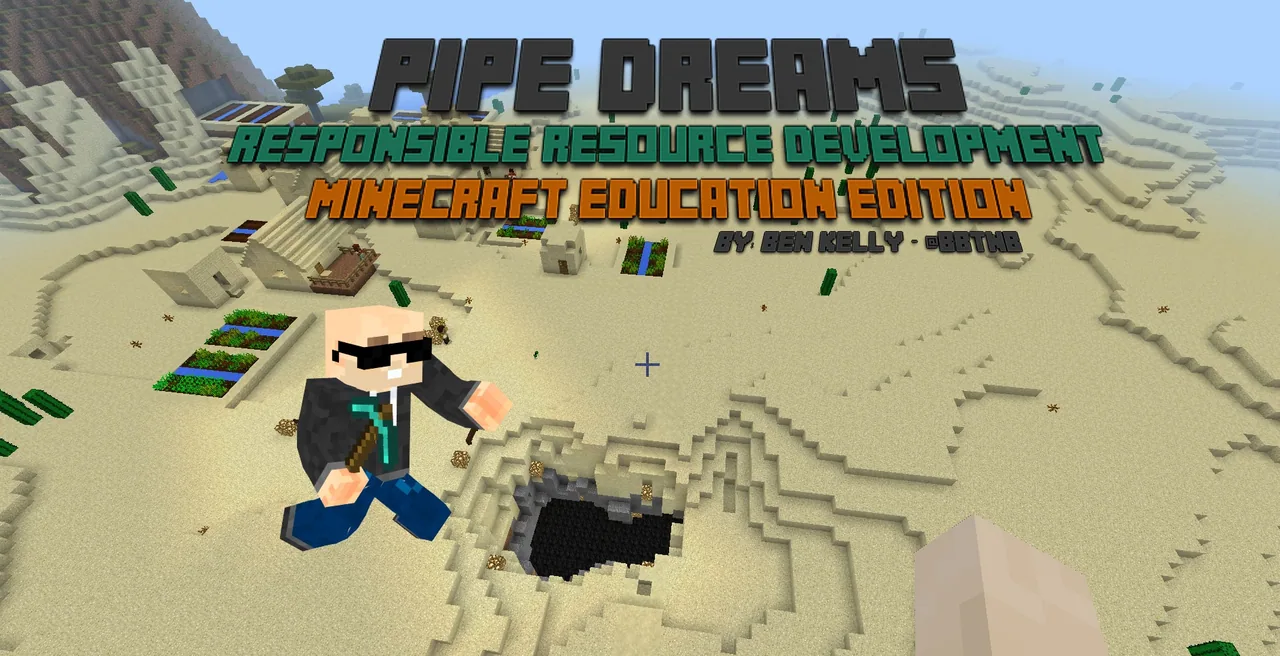
- Pipe Dreams Title CardTitle Card
- spawn coordinatesjust in case world spawn fails
- Screen shot 1ss1
- screen shot 2ss2
- ss3ss3
- ss4ss4
- ss5ss5
Frequently Asked Questions
Does this lesson include a ready-to-use world download?
No, there is no downloadable world file included. Teachers should use the provided spawn coordinates, title card, and screenshots to set up the build area in an existing Minecraft world.
How do students ensure their pipeline accounts for community concerns?
Students interview in-world villagers and experts before construction begins, incorporating their safety warnings and landscape preferences directly into the approved route design.
Adapted from Pipe Dreams by Benjamin Kelly on Minecraft Education, last updated Aug 29, 2019. This classroom version, the timings and the quiz were written by 9Minecraft Education.