- Type
- Lesson plan
- Grade
- Early years (Pre-K to Grade 2)Primary (Grades 3-5)Middle school (Grades 6-8)High school (Grades 9-12)
- Ages
- All ages
- Duration
- 45 min
- Level
- Beginner
How can we design sustainable communities that protect ocean biodiversity and ecosystem health?
Overview
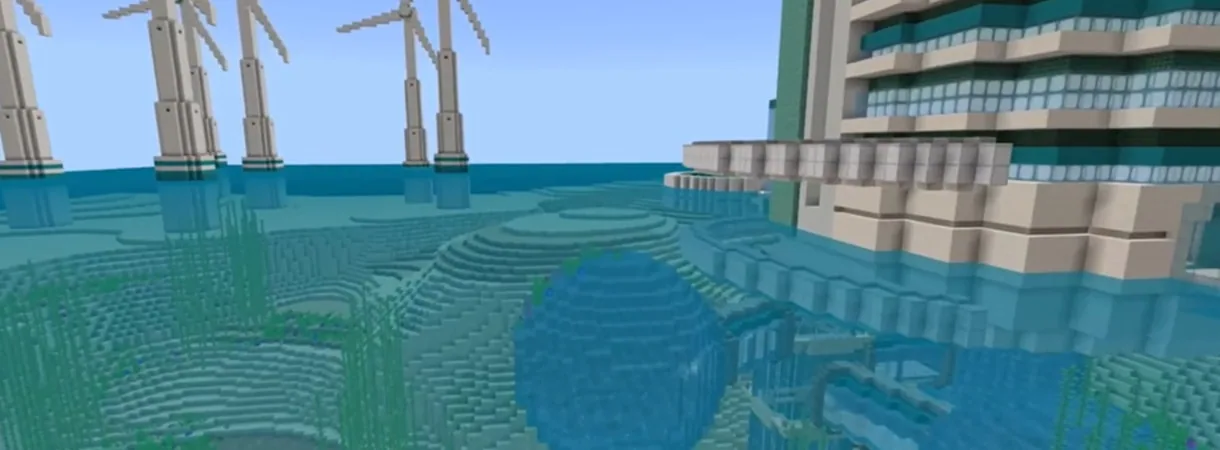
Healthy marine ecosystems depend on robust biodiversity, representing the variety of life across the planet's waters. When aquatic environments face degradation, understanding the balance of species and ecosystem services becomes critical to proposing effective conservation and urban design solutions. In this Minecraft Education lesson, students collaborate alongside a team of scientists to clean polluted water and construct a sustainable ocean settlement. Through hands-on problem-solving, learners examine how species richness reflects environmental health and weigh different design interventions to protect marine life.Learning objectives
By the end of this lesson students will be able to:
- Define biodiversity as the variety of species found across terrestrial and oceanic ecosystems.
- Explain how the completeness of an ecosystem's biodiversity serves as an indicator of its health.
- Evaluate competing design solutions aimed at maintaining biodiversity and ecosystem services.
- Construct sustainable city features that help clean ocean waters and protect marine habitats.
Blocks and items used in this lesson


Key vocabulary
- Biodiversity
- The variety of different plant and animal species living within an ecosystem.
- Ecosystem Services
- The natural benefits and resources that healthy ecosystems provide to support living things.
- Ecosystem Health
- A measure of how well an ecosystem functions and maintains its species balance.
- Sustainability
- The practice of using resources in ways that do not harm natural environments for the future.
Before class
Lesson sequence
Suggested timing: about 45 minutes in total.
- Introduction to Ocean Biodiversity10 min
Introduce the concept of biodiversity as the variety of life across land and ocean ecosystems. Discuss how scientists assess the health of an ecosystem by measuring the completeness and integrity of its species.
- World Exploration and Water Cleanup15 min
Load students into the Minecraft world to meet the in-game scientist team. Instruct students to investigate the aquatic environment and complete water cleanup tasks to support degraded marine habitats.
- Building a Sustainable Ocean City15 min
Students plan and construct features of a sustainable ocean city. Encourage learners to evaluate design choices based on how well they balance human settlement needs with the preservation of marine biodiversity.
- Design Review and Reflection5 min
Convene as a whole group to compare different building approaches. Have students explain how their structures maintain ecosystem services and help preserve local marine life.
Assessment: success criteria
- Student accurately defines biodiversity and identifies it in ocean contexts.
- Student articulates how species completeness reflects the overall health of an ecosystem.
- Student evaluates design choices based on their impact on biodiversity and ecosystem services.
Differentiation
Provide sentence starters and a reference sheet defining biodiversity and ecosystem health during the planning phase.
Have students write a brief impact analysis comparing two competing design approaches and identifying which better preserves ecosystem services.
Knowledge check
5 questions to check understanding after the lesson. Tap an answer to see if it is right; the score appears at the end.
1What does the term biodiversity describe?
Answer: C. Biodiversity refers to the variety of plant and animal species found across land and water ecosystems.
2How do scientists use the completeness of an ecosystem's biodiversity?
Answer: A. The completeness or integrity of biodiversity is a key indicator of an ecosystem's health.
3What task do students undertake with scientists in the lesson world?
Answer: D. The lesson challenges students to join scientists in cleaning the water and constructing a sustainable ocean city.
4Why is it important to evaluate competing design solutions for ecosystems?
Answer: B. Evaluating competing designs ensures that human developments protect ecosystem services and species variety.
5Which core skill is emphasized alongside critical thinking in this challenge?
Answer: B. The lesson source identifies character, citizenship, and critical thinking as primary target skills.
Resources
- Ocean Climate Impact Challenge Teaching GuideUse this guide in conjunction with the Ocean Climate Impact Challenge world in Minecraft.
- Lesson worldOpens the world page in Minecraft Education (sign-in with a school account may be needed).
Frequently Asked Questions
What grade level are the learning objectives designed for?
The core science objectives around evaluating design solutions and understanding biodiversity are targeted at a 6th to 8th grade level, though the source notes the challenge can be adapted across age groups.
Do students need advanced Minecraft building skills to participate?
No, the lesson is classified as beginner experience level, making it accessible to students who are relatively new to Minecraft Education.
Adapted from Ocean Climate Impact Challenge by K12 Inc. on Minecraft Education, last updated Jul 21, 2025. This classroom version, the timings and the quiz were written by 9Minecraft Education.