- Type
- Lesson plan
- Subject
- Math
- Topics
- Math & Economics
- Grade
- Primary (Grades 3-5)
- Ages
- Ages 8-10
- Duration
- about 75 min (suggested)
How does understanding the family relationship between multiplication and division help us solve equations and build strategically?
Overview
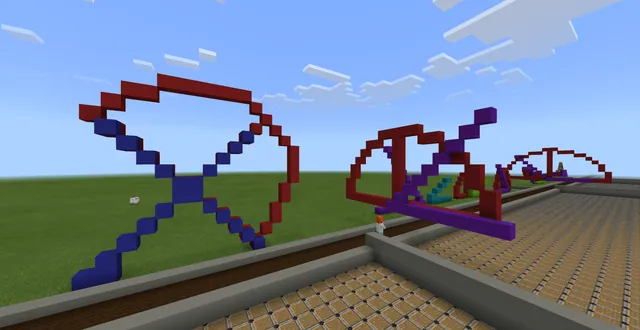
Multiplication and division share an inverse relationship and belong to the same fact families. By connecting visual groupings to written equations, students discover how knowing a multiplication fact helps them solve corresponding division problems and recognize properties such as the commutative and distributive rules.
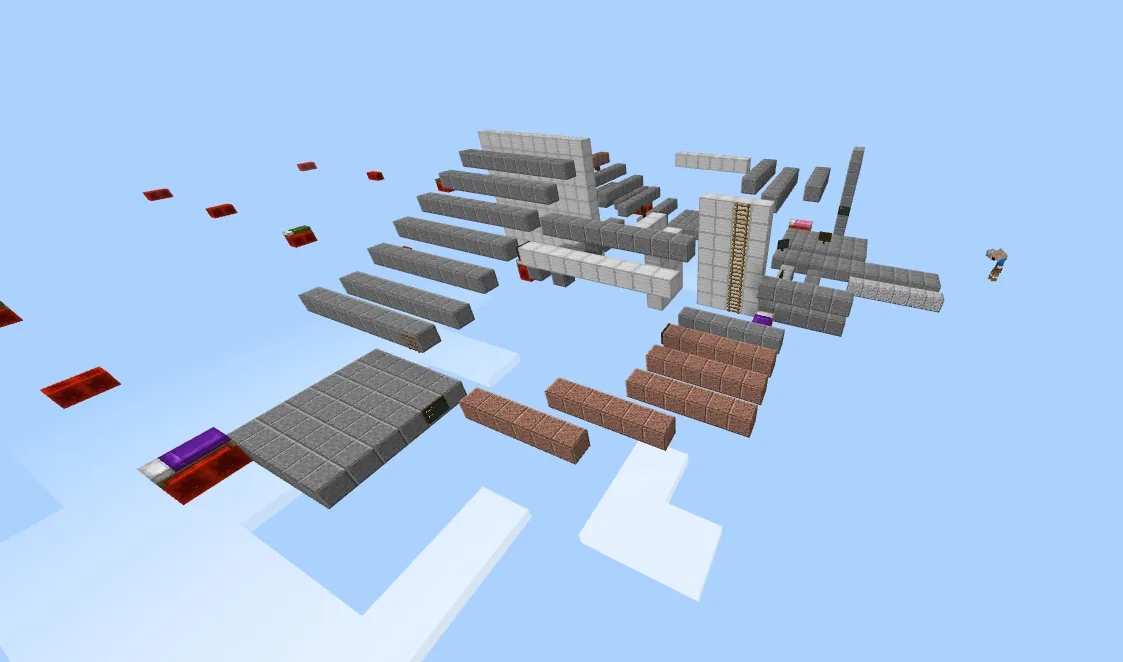
In Minecraft, students construct 3D models representing these operations across a sky arena while playing in Creative mode. These physical structures not only reinforce mathematical reasoning through slates and color coding, but also serve as walkways, tactical platforms, and trap locations for a mini-game.
Learning objectives
By the end of this lesson students will be able to:
- Explain the inverse relationship between multiplication and division using visual models and number families.
- Build at least six labeled Minecraft math models representing three multiplication and three division facts.
- Peer review classmates' models by recording observed equations and resolving mathematical discrepancies.
- Use math models strategically within an interactive sky-based game arena.
Blocks and items used in this lesson


Key vocabulary
- Inverse Relationship
- An opposite mathematical operation that undoes another, such as division undoing multiplication.
- Number Family
- A collection of related numbers that work together in multiplication and division equations.
- Commutative Property
- A rule stating that numbers can be multiplied in any order without changing the final product.
- Distributive Property
- A rule showing that multiplying a sum by a number gives the same result as multiplying each addend separately and adding the products.
Before class
Lesson sequence
Suggested timing: about 75 minutes in total.
- Opening Discussion and Notebook Setup15 min
Present the opening slideshow displaying the two Minecraft math models. Guide class discussion on how the models are linked, which one represents multiplication, which one represents division, and why one group in the division model is highlighted in a separate color to display the quotient.
Have students record the four discussion answers, sketch and label each model with its equation, and note the related number families before revealing the central theme that multiplication and division belong to the same family.
- Sky Map Construction25 min
Students log into the Minecraft sky map in Creative mode at night and claim a bed by sleeping in it. Remind students that encasing a bed completely in blocks is prohibited; beds must always have at least one clear entrance and exit.
Each student constructs at least six math models (three multiplication and three division) displaying inverse relationships, labeling each with slate items showing the equation and creator's name.
- Peer Review15 min
Learners fly around the sky map to inspect classmates' structures. Reviewers place a slate on each inspected model noting their own name and the equation they interpret from the blocks.
If the reviewer's equation differs from the creator's slate, both students discuss the build to resolve the difference before game play begins.
- Bed Wars Mini-Game and Debrief20 min
Facilitate the Math Bed Wars mini-game using the peer-reviewed sky arena following the mini-game guidelines from the supporting files.
Gather the class to debrief with questions exploring how students placed models strategically, how multiplication and division structures helped them navigate, and how operations function together as a family.
Assessment: success criteria
- Student constructs at least six accurate math models displaying inverse pairs of multiplication and division.
- All built structures are correctly labeled with student names and mathematical equations on slates.
- Peer review slates reflect accurate evaluations and any identified discrepancies are discussed and corrected.
- Student explains during discussion or debrief how multiplication and division models belong to the same family.
Differentiation
Provide graph paper templates so students can draft their equal groups and color-coded quotients before building them in the game.
Fast finishers can construct additional inverse models to extend the sky map walking paths and integrate functional redstone traps into their structures.
Knowledge check
5 questions to check understanding after the lesson. Tap an answer to see if it is right; the score appears at the end.
1Why does one group in the introductory division model use a different color?
Answer: B. The division model highlights one specific group in a separate color to visually demonstrate the answer to the problem.
2What rule must students follow when setting up their beds in the sky map?
Answer: C. Enclosing beds completely is not allowed, ensuring an opponent can access the bed and the owner can leave.
3How many total math models must each student construct at minimum?
Answer: A. The assignment requires building at least six models, split evenly between three multiplication and three division representations.
4What should a peer reviewer do after examining a classmate's model?
Answer: C. Reviewers fly to peer builds and label each model with their own name and the equation they see to check accuracy.
5What is the primary big idea revealed during the introductory lesson?
Answer: D. The introductory discussion leads to the unveiling of the core concept that multiplication and division are in the same number family.
Resources
- Lesson package (.zip)Everything the author attached to this lesson in one download.
- Opening Slideshow
- Rubric
- How to Play Math Bed WarsInstructions for how to play the Minecraft mini-game Bed Wars
- Lesson worldOpens the world page in Minecraft Education (sign-in with a school account may be needed).
Frequently Asked Questions
How do students label their builds inside Minecraft?
Students use in-game slate items placed directly on or beside their structures to write their names and the matching equations for both initial construction and peer review.
What can early finishers do once they build their initial six models?
Students who finish early may continue constructing extra inverse math models to create more pathways across the sky map and can wire redstone traps into their builds.
Adapted from Multiplication and Division by Minecraft Education on Minecraft Education, last updated Sep 15, 2023. This classroom version, the timings and the quiz were written by 9Minecraft Education.