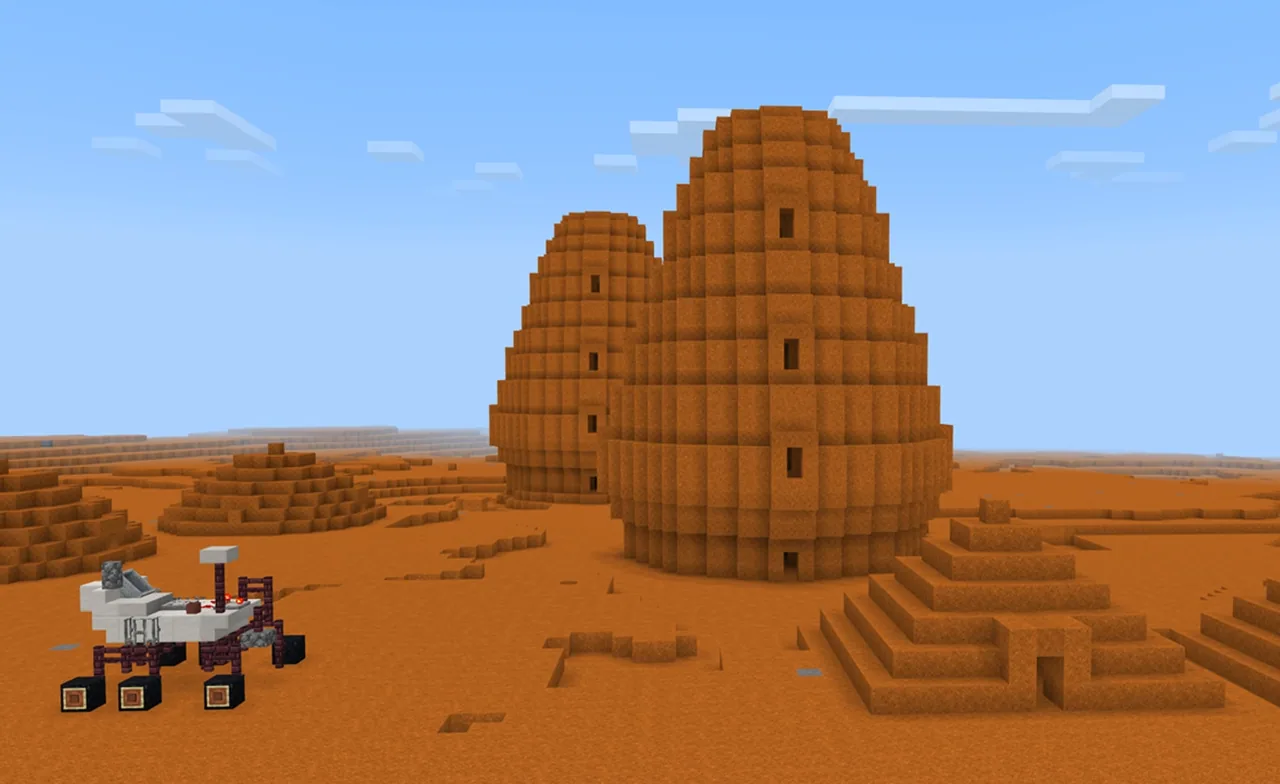
How can autonomous robotics and native planetary materials be utilized to build pressurized human habitats on Mars?
Overview
Establishing a human presence on other planets requires overcoming hostile environments and severe logistical hurdles. Transporting conventional construction supplies across space is impractical, making automated robotics and the use of native planetary regolith essential for developing sustainable, pressurized living facilities.
In this lesson, learners investigate swarm robotics and in-situ 3D printing using the Mission to Mars world file. Working with Code Connections in Minecraft, student teams write algorithms for their Agent to gather surface sand and engineer sealed habitats capable of supporting life on Mars.
Learning objectives
By the end of this lesson students will be able to:
- Identify key environmental and practical challenges involved in colonizing other worlds.
- Explain how swarm robotics and 3D printing can turn surface regolith into functional structures.
- Program an Agent using block-based code to gather raw materials from the Martian terrain.
- Construct simple and complex 3D pressurized shelters through automated coding commands.
Blocks and items used in this lesson


Key vocabulary
- Swarm Robotics
- A collective approach where multiple coordinated robots collaborate to perform complex tasks like mining or building.
- Regolith
- The layer of loose dust, soil, and broken rock resting on the bedrock of a planet.
- Agent
- The programmable robotic helper in Minecraft that carries out mining and building instructions.
- 3D Printing
- A manufacturing method that builds three-dimensional physical structures layer by layer from digital models.
- Pressurized Environment
- An enclosed, airtight shelter engineered to sustain safe internal air pressure for human occupants.
Before class
Lesson sequence
Suggested timing: about 50 minutes in total.
- Starter Coding Practice10 min
Instruct students to open Minecraft Education and launch the Hour of Code (AI for good) lesson from the main menu. This quick warmup provides hands-on practice with block-based coding fundamentals and Agent movement before tackling planetary construction.
- Mars Habitation Challenge30 min
Deliver the Mission to Mars presentation to introduce swarm robotics and the process of 3D printing structures using regolith. Next, divide students into small groups, distribute the Mission to Mars Worksheet, and direct them to launch the Mission to Mars world file.
Groups must program their robotic Agent to harvest sand blocks from the surface and run coded algorithms to build functional, pressurized habitats.
- Plenary and Review10 min
Have a representative from each group present their finished habitat to the class. Facilitate a reflective discussion focusing on the coding roadblocks groups faced and how swarm robotics and 3D printing address the real-world obstacles of space colonization.
Assessment: success criteria
- Student successfully wrote an algorithm that guided the Agent to harvest materials and construct a structure.
- Student clearly explained the logic and operational steps of their written code.
- Student described the benefits and limitations of using swarm robotics and 3D printing for off-world habitation.
Differentiation
Provide the help guide and assist learners in writing simple, linear code sequences to lay down a basic structure.
Challenge advanced students to code complex, multi-layered pressurized shelters with distinct interior living zones.
Knowledge check
5 questions to check understanding after the lesson. Tap an answer to see if it is right; the score appears at the end.
1What approach to robotics is introduced in the lesson to accomplish collaborative planetary building tasks?
Answer: A. The lesson specifically introduces swarm robotics to demonstrate how multiple robots can collaborate on gathering resources and building.
2Which specific resource do students program the Agent to harvest from the Martian landscape?
Answer: B. The worksheet challenges students to instruct their Agent to harvest blocks of sand from the Martian regolith.
3Which tool within Minecraft connects external code instructions to the in-game Agent?
Answer: B. The lesson directs students to use the Code Connections tool to program their Agent.
4What manufacturing technique do students investigate to convert mined regolith into habitats?
Answer: C. The presentation and challenge focus on 3D printing structures out of materials extracted from the planetary surface.
5Which introductory activity is used during the starter to teach block-based coding?
Answer: D. The starter activity instructs students to load the Hour of Code (AI for good) lesson from the start menu to learn block coding.
Resources
- Lesson package (.zip)Everything the author attached to this lesson in one download.
- Lesson PlanLesson plan
- PresentationSets the scene and introduces students to Swarm Robotics and coding in Minecraft
- Help guideStudent help guide with code samples
- Mission to Mars World FileMission to Mars World File
Frequently Asked Questions
Do students need advanced coding skills before beginning this lesson?
No prior coding experience is required because the lesson begins with a ten-minute Hour of Code starter that teaches students how to code the Agent using accessible block-based commands.
What supporting materials are needed to deliver this lesson?
Teachers should use the provided lesson plan, presentation slides, student help guide, Mission to Mars Worksheet, and the downloadable Mission to Mars world file.
How do students work together during the building challenge?
Students collaborate in small groups to problem-solve, plan their structural designs, and write algorithms for their Agents to harvest resources and build pressurized habitats.
Adapted from Mission to Mars by Simon Johnson on Minecraft Education, last updated Jul 14, 2022. This classroom version, the timings and the quiz were written by 9Minecraft Education.