- Type
- Lesson plan
- Subject
- Math
- Topics
- Math & Economics
- Grade
- Primary (Grades 3-5)
- Ages
- Ages 8-10
How can area, perimeter, and the distributive property help us design and construct rooms in a house?
Overview
Mathematics serves as the foundational framework for building design and structural construction. In this lesson, students explore how geometric measurement tools, specifically area and perimeter, guide real-world architecture. They also examine how the distributive property allows designers to subdivide large floor plans into distinct, functional living spaces.
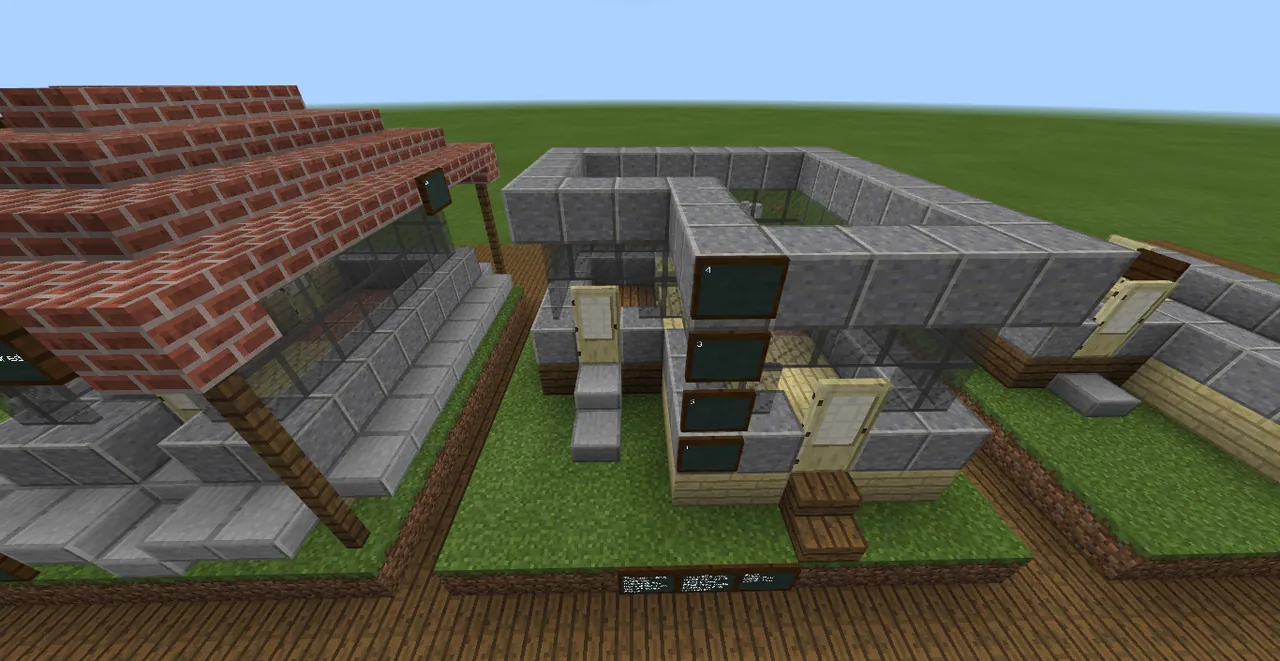
Using Minecraft as a prototyping environment, learners take the foundation from their previous build and partition their largest room into a kitchen and living room. By stacking perimeter loops upward, students calculate total wall volume and visualize how algebraic properties directly govern physical structures.
Learning objectives
By the end of this lesson students will be able to:
- Apply the distributive property to divide a large room into two functional spaces.
- Calculate the area and perimeter of a two-room floor plan.
- Determine total wall materials by multiplying room perimeter by wall height.
- Construct and decorate a home prototype based on a drafted blueprint.
Blocks and items used in this lesson


Key vocabulary
- Area
- The total amount of flat surface space inside a shape, found by multiplying length by width.
- Perimeter
- The continuous line or measurement forming the outer boundary of a closed geometric figure.
- Distributive Property
- A mathematical rule showing that multiplying a sum by a number equals multiplying each addend separately: A × (B + C) = (A × B) + (A × C).
- Prototype
- A preliminary model or mock-up created to test and refine a design concept.
Before class
Lesson sequence
- Introduction & Brainstorming
Display the slideshow images and guide students to observe how mathematics can be used to construct walls. Introduce the distributive property and reveal the big idea: math is essential to all construction, utilizing area and perimeter as its primary tools.
- Blueprint Drafting & Peer Review
Distribute the Blueprint Worksheet. Guide students as they sketch their wall layouts on paper, dividing their largest room into a kitchen and a living room. Once completed, have students conduct peer reviews of each other's designs before opening the game.
- In-Game Prototype Construction
Students open their Lesson 1 world or the Home Prototype World to execute their blueprint tasks:
- Build a physical math model representing the distributive property.
- Subdivide their largest room into a kitchen and living room, calculating the area of each.
- Construct the exterior walls by stacking perimeter loops, calculating the total block count needed.
- Furnish and decorate the finished rooms.
- Aerial Review & Class Debrief
Instruct students to fly above their builds to view their layouts from above. Conclude with a class debrief discussing what the distributive property is, how it helps organize rooms, and how perimeter assists in calculating wall blocks, allowing volunteers to present their work.
Assessment: success criteria
- Student accurately builds and explains a model showing how A × (B + C) = (A × B) + (A × C) relates to their floor plan.
- Student correctly calculates and explains the area and perimeter of both rooms in their subdivided floor plan.
- Student demonstrates and explains that total wall blocks equal perimeter multiplied by wall height.
- Student accounts for the mathematical difference between measured perimeter and the actual block count required at wall corners.
Differentiation
Provide grid paper with pre-outlined room boundaries so students can physically count square units before writing out multiplication equations.
Challenge students to adjust their equations to account for corner overlaps in block counts or translate their prototypes into a Survival World build.
Knowledge check
5 questions to check understanding after the lesson. Tap an answer to see if it is right; the score appears at the end.
1Which mathematical equation represents the distributive property modeled in this lesson?
Answer: A. The lesson specifically focuses on modeling the distributive property using the equation A × (B + C) = (A × B) + (A × C).
2How can students calculate the total number of blocks needed to construct their walls?
Answer: B. Walls are constructed by stacking loops of perimeters, meaning the wall block count equals perimeter multiplied by height.
3Into which two functional spaces are students asked to divide their largest room?
Answer: C. The activity instructions direct students to turn their biggest room into a living room and kitchen.
4What should students do immediately after completing their Blueprint Worksheet?
Answer: D. The student activities specify that students complete a peer review of their blueprint worksheet before entering the Minecraft world.
5Why are students asked to fly up above their homes during the debrief?
Answer: A. The debrief instructs students to fly up, look at their home layout from an aerial perspective, and share how they built it.
Resources
- Lesson package (.zip)Everything the author attached to this lesson in one download.
- Slideshow
- Blueprint Worksheet
- Lesson worldOpens the world page in Minecraft Education (sign-in with a school account may be needed).
Frequently Asked Questions
Which Minecraft world file should students load for this lesson?
Students should load their saved world file from Making Homes - Lesson 1 or use the downloadable Home Prototype World provided with the lesson materials.
How does this lesson connect perimeter to three-dimensional walls?
Students view walls as repeated perimeter loops stacked vertically, which leads to the formula that total wall blocks equal perimeter multiplied by wall height.
How does dividing a room teach the distributive property?
By splitting a single room sharing one common side length into two separate areas (a living room and kitchen), students visually and physically model A × (B + C) = (A × B) + (A × C).
Adapted from MAKING HOMES, PART 2 by Minecraft Education on Minecraft Education, last updated Dec 19, 2022. This classroom version, the timings and the quiz were written by 9Minecraft Education.