- Type
- Lesson plan
- Subject
- Math
- Topics
- Math & Economics
- Grade
- Primary (Grades 3-5)
- Ages
- Ages 8-10
How do area and perimeter help us plan and construct real-world buildings?
Overview
Mathematics plays an essential role in architecture and construction. Through the foundational concepts of unit measurements, area, and perimeter, builders are able to accurately plan, budget, and assemble real-world structures.
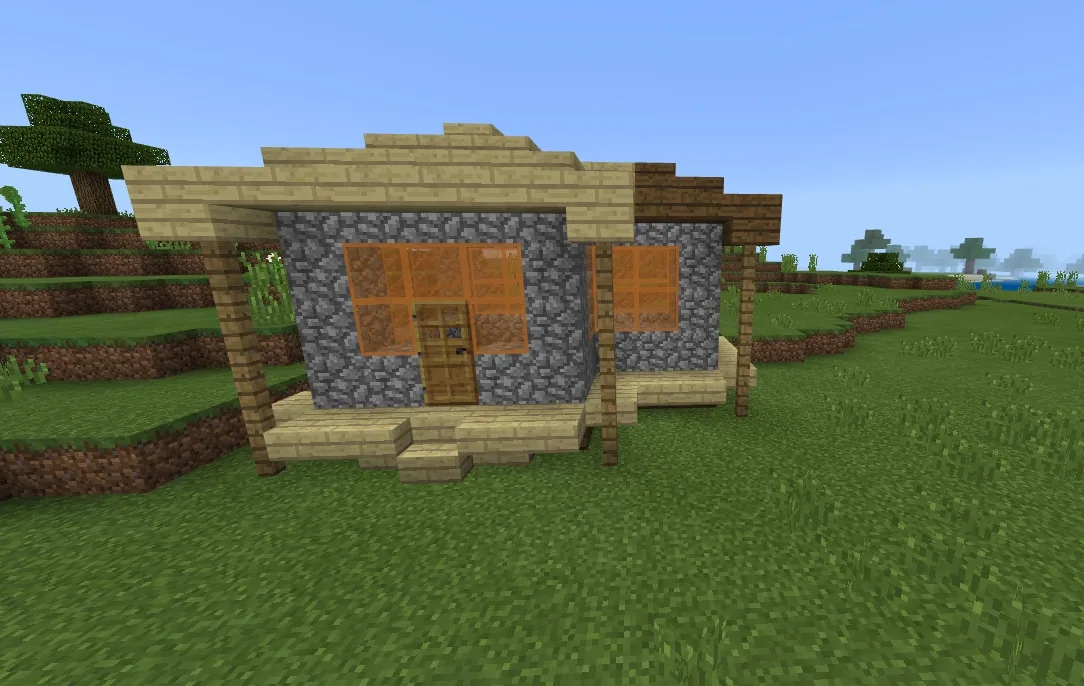
In this lesson, students explore the connection between multiplication and area using visual slides and draft their layout on a paper blueprint. They then load a dedicated prototype world to calculate plot size, construct a foundation composed of two rectangles, document measurements with in-game tools, and install a perimeter wall.
Learning objectives
By the end of this lesson students will be able to:
- Calculate the total area of a 10-meter by 10-meter building plot.
- Build a foundation composed of two rectangles and determine its combined area.
- Construct and measure the perimeter boundary around the foundation.
- Document mathematical calculations in Minecraft using slates and the camera.
Blocks and items used in this lesson


Key vocabulary
- Area
- The total amount of two-dimensional surface space inside a shape, measured in square units.
- Perimeter
- The total distance around the outside edge or boundary of a shape.
- Foundation
- The solid base structure constructed to support a building.
- Unit Square
- A square with side lengths equal to one unit, having an area calculated as 1 times 1 equals 1.
Before class
Lesson sequence
- Warm-up and Introduction
Show the slideshow images to facilitate a class discussion connecting multiplication to area. Guide students toward the core concept that mathematics, area, and perimeter are required tools for building construction.
- Blueprint Drafting and Peer Review
Distribute the Blueprint Worksheet. Guide students as they sketch their home foundations by planning area and perimeter layouts on their plot grid. Have students peer-review each other's blueprint math before launching the game.
- Minecraft Prototype Construction
- Determine the area of the 10-meter by 10-meter plot in the Making Homes world.
- Build a foundation made from two rectangles, calculate the area of each rectangle, and find the combined sum.
- Record calculations on in-game slates and capture photos of the structure with the camera.
- Build a perimeter wall directly on top of the foundation edge and calculate its boundary measurement.
- Debrief and Reflection
Gather the class to review core concepts. Ask students how to mathematically prove a unit square (1x1=1), how math assists in building homes, and how area differs from perimeter.
Assessment: success criteria
- Student accurately determines that the 10 by 10 meter building plot has an area of 100 square meters.
- Student constructs a foundation made of two distinct rectangles and calculates the individual and total area.
- Student builds the perimeter along the foundation boundary and measures its length.
- Student records their mathematical work on in-game slates and documents their build with the camera.
Differentiation
Refer students to the visual foundation examples on the slideshow to help break down their foundation into two separate rectangles before finding the total area.
Ask advanced learners to explain why counting physical perimeter blocks differs from adding side lengths in meters, prompting them to adjust their formula for shared corner blocks.
Knowledge check
5 questions to check understanding after the lesson. Tap an answer to see if it is right; the score appears at the end.
1What is the area of a building plot that measures 10 meters by 10 meters?
Answer: C. Multiplying length by width (10 meters times 10 meters) gives an area of 100 square meters.
2Which equation proves the area of a single unit square?
Answer: A. A unit square with sides of length 1 has an area calculated as 1 times 1 equals 1.
3What tool are students instructed to use to show their math measurements inside Minecraft?
Answer: B. Students show their measurement work using slates and capture visual evidence with the in-game camera.
4How must the prototype foundation be structured in the Minecraft building activity?
Answer: B. The activity instructions require students to build a foundation composed of two rectangles and find their individual and combined areas.
5Why might the number of physical blocks in a perimeter wall be smaller than the calculated perimeter value?
Answer: C. Corner blocks sit on two adjacent edges, meaning their positions are counted twice in linear measurement calculations.
Resources
- Lesson package (.zip)Everything the author attached to this lesson in one download.
- Slideshow
- Worksheet
- Lesson worldOpens the world page in Minecraft Education (sign-in with a school account may be needed).
Frequently Asked Questions
What prep work must students finish before entering the Minecraft world?
Students should finish drafting their foundation plans on the Blueprint Worksheet and participate in a peer review with a classmate prior to opening the game.
Why does the corner block perimeter discrepancy occur in Minecraft?
Because corner blocks share two exposed outer edges, adding boundary measurements in meters counts the corners twice, whereas physically counting the placed blocks counts each corner unit only once.
Adapted from MAKING HOMES, PART 1 by Minecraft Education on Minecraft Education, last updated Sep 16, 2023. This classroom version, the timings and the quiz were written by 9Minecraft Education.