- Type
- Lesson plan
- Subject
- History & Social Studies
- Ages
- Ages 11-13
How can archeological evidence and historical texts be integrated into Minecraft to reconstruct ancient sacred sites and evaluate religious reforms?
Overview
This lesson guides students through an investigation of ancient Georgian history, pagan religion, and state formation. Learners examine historical texts, toponymy, and archeological findings concerning the Armazi idol in Mtskheta, analyzing religious reforms under King Farnavaz and comparing historical conditions between the reigns of Farnavaz and Mirian.
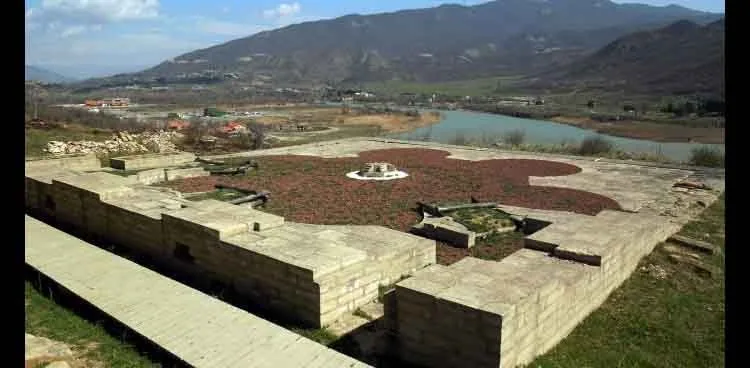
Using Minecraft as a collaborative reconstruction tool, student teams design and build the Armazi six-arch temple and the idol itself. They apply archeological data to ensure architectural accuracy while utilizing appropriate materials such as gold and silver to reflect the historical resources of the era.
Learning objectives
By the end of this lesson students will be able to:
- Analyze Georgian and foreign historical records alongside archeological research to verify the presence of the Armazi idol in Mtskheta.
- Debate the benefits and drawbacks of King Farnavaz's religious reforms and the role of the Armazi idol in political consolidation.
- Construct an archeologically accurate model of the Armazi six-arch temple and idol in Minecraft using authentic materials like gold and silver.
- Deliver an oral presentation and write a 200-250 word post-project essay detailing shifts in historical understanding.
Blocks and items used in this lesson


Key vocabulary
- Armazi Idol
- A major pagan deity and statue in ancient Georgia associated with King Farnavaz's religious policies.
- Toponymy
- The study of place names and how geographical naming provides historical evidence.
- Consolidation
- The act of uniting disparate groups, territories, or beliefs under a single authority or system.
- Gentile Religion
- Pagan or polytheistic religious belief systems pre-dating monotheistic state conversions.
Before class
Lesson sequence
- Historical Research and Source Comparison
Introduce historical and foreign written accounts regarding the Armazi idol and place toponymy in Mtskheta. Have students compare these texts with archeological reports about the temple ruins to trace when the idol was raised and destroyed.
- Debate on Religious Reform
Organize a classroom discussion where students evaluate King Farnavaz's religious reforms as an effort toward Georgian consolidation. Direct learners to compare the religious landscape during Farnavaz's era with that of King Mirian.
- Minecraft Temple and Idol Reconstruction
Students work in collaborative groups to plan and construct Armazi's six-arch temple and idol. Groups must focus on architectural and archeological accuracy, selecting period-appropriate resources such as gold and silver blocks.
- Oral Presentations and Written Reflection
Teams present their completed Minecraft builds by word of mouth, explaining their design choices and historical links. Afterward, each student independently writes a 200-250 word essay reflecting on their research, building experience, and how their historical perspective changed.
Assessment: success criteria
- Preliminary project design shows archeological and architectural planning (worth 20 points).
- Completed Minecraft build demonstrates factual accuracy in the six-arch temple and idol construction (worth 40 points).
- Group members deliver a clear, fact-based oral presentation explaining their reconstruction (worth 20 points).
- Post-project essay contains 200-250 words evaluating source work, Minecraft modeling, and learning growth (worth 20 points).
Differentiation
Offer graphic organizers outlining the structural layout of the six-arch temple and focused reading prompts about King Farnavaz.
Ask advanced learners to integrate detailed chronological arguments about the exact dates of the idol's raising and overthrow using conflicting source texts.
Knowledge check
5 questions to check understanding after the lesson. Tap an answer to see if it is right; the score appears at the end.
1Which distinct architectural feature must students recreate for the Armazi temple?
Answer: B. The lesson guidelines specifically direct students to build a six-arch temple based on archeological research.
2Which materials are highlighted in historical accounts for modeling the Armazi idol in Minecraft?
Answer: C. The student activity explicitly emphasizes using authentic resources such as gold and silver based on ancient accounts.
3What political and spiritual process is connected to King Farnavaz in the lesson?
Answer: A. Guiding ideas focus on King Farnavaz's religious reforms and the Armazi idol as an instrument of Georgian consolidation.
4What is the required word count for the individual post-project essay?
Answer: D. The assignment specifies a reflective essay between 200 and 250 words.
5How many total points is the finished Minecraft project worth in the grading rubric?
Answer: B. According to the assessment breakdown, the finished project component accounts for 40 points.
Resources
- Lesson package (.zip)Everything the author attached to this lesson in one download.
- The ruins of the Temple
- Armazi idol
Frequently Asked Questions
Is a custom Minecraft world file needed to teach this lesson?
No custom world download is required. Students build their six-arch temple and idol in any standard creative world using reference materials from archeological and historical records.
How should teachers structure the 100-point grading system?
Assess students across four components: project design (20 points), the completed Minecraft build (40 points), an oral presentation (20 points), and the post-project reflective essay (20 points).
Adapted from How we Learn History by Lela Kakashvili on Minecraft Education, last updated Jun 21, 2018. This classroom version, the timings and the quiz were written by 9Minecraft Education.