How can reconstructing damaged cultural monuments in Minecraft help us understand and protect world heritage?
Overview
Across the globe, irreplaceable cultural landmarks face destruction from armed conflict, neglect, and natural disasters. This project invites students to step into the role of cultural preservationists by researching UNESCO world heritage sites, examining their original architecture, and understanding their historical significance to global communities.
Using Minecraft as a collaborative workspace, students analyze real-world proportions and geometric shapes to reconstruct lost or damaged monuments. Through guided walkthroughs, in-game documentation, and class discussion, learners build global empathy and explore how digital tools can help preserve human history for future generations.
Learning objectives
By the end of this lesson students will be able to:
- Analyze the geometric forms, architectural proportions, and history of selected UNESCO heritage sites.
- Reconstruct damaged or destroyed heritage monuments collaboratively inside Minecraft using photo references.
- Document architectural features using in-game cameras and note-taking tools during site walkthroughs.
- Discuss the importance of preserving historical heritage and showing empathy toward diverse global cultures.
Blocks and items used in this lesson


Key vocabulary
- Heritage Site
- A landmark or location recognized for its outstanding historical, cultural, or physical value.
- Proportion
- The comparative relationship between the size, scale, and dimensions of different parts of a structure.
- Ruins
- The remains of a building or monument that has decayed or been destroyed over time.
Before class
Lesson sequence
- Research and Analysis
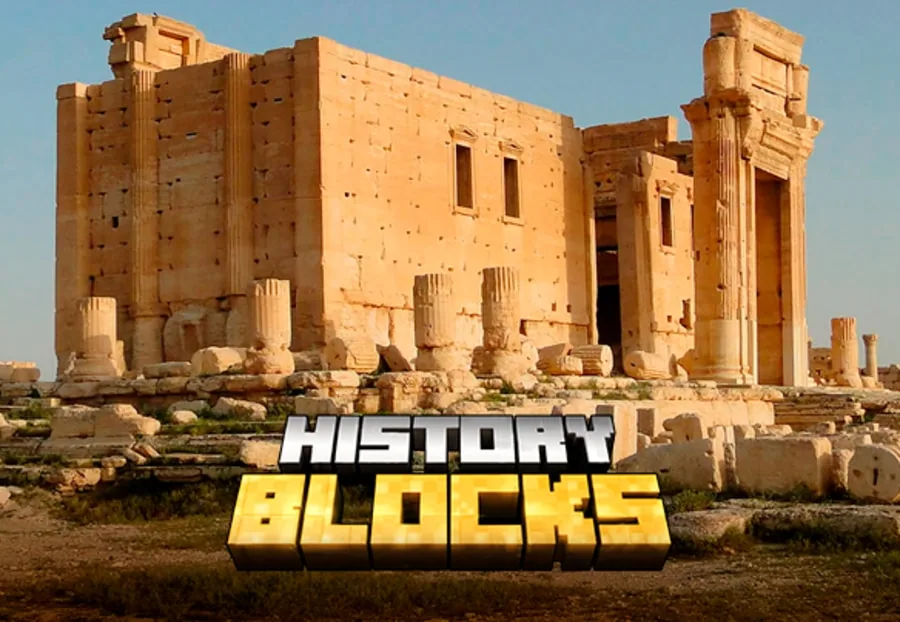
Introduce the project and assign or let teams select heritage landmarks, such as the Al Noori Mosque, Bel Temple, Monastery of Sant Elian, Bamiyan Buddha, or the ancient city entrance of Aleppo. Guide students to research photographic references, examine geometric forms, and analyze real-life proportions before placing any blocks.
- Class Walkthrough and Observation
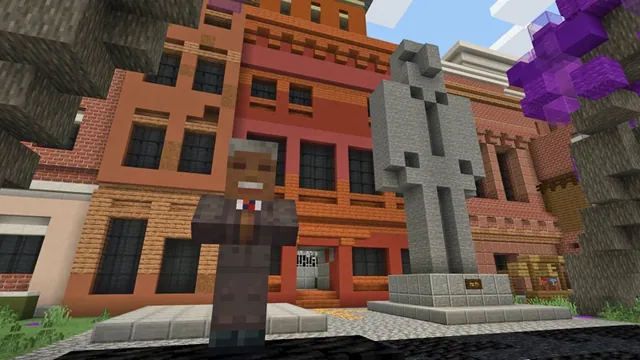
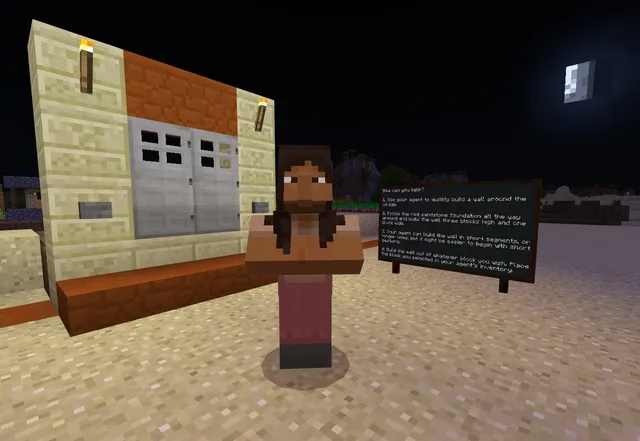
Display a model world on a central screen or allow students to enter a pre-existing student-built world. Have learners walk through the structures to observe spatial design, take in-game photos, and write notes according to your prepared guiding questions.
- Collaborative Reconstruction
Teams work in Minecraft to rebuild their chosen monuments, referencing their original designs, historical destruction, and surviving ruins. Act as a facilitator by asking probing questions about scale, structure, and problem-solving rather than providing direct instructions.
- Debrief and Community Reflection
Convene as a whole group to reflect on the build process. Have students share what they discovered about the sites and discuss the ethical responsibility of preserving historical heritage impacted by neglect, disasters, or conflict.
Assessment: success criteria
- Student builds reflect careful study of geometric shapes, reference photos, and realistic proportions.
- Teams collaborate effectively by distributing roles, functions, and building tasks.
- In-game notes and photos demonstrate thoughtful observation and engagement with the monument's historical context.
- Students actively participate in discussions regarding cultural preservation and global empathy.
Differentiation
Provide simplified photo sets focusing on basic exterior outlines so learners can focus on primary geometric shapes before adding interior details.
Challenge students to reconstruct both the intact structure and its current ruined state, documenting the causes and timeline of its destruction.
Knowledge check
5 questions to check understanding after the lesson. Tap an answer to see if it is right; the score appears at the end.
1What should students investigate before building a heritage site in Minecraft?
Answer: B. The source notes that before building, students should study the geometric forms and analyze real-life proportions of the monuments.
2What is the recommended role for the teacher during this project?
Answer: B. The lesson suggests the teacher act as a mediator by asking questions that empower students to find their own solutions.
3Which tool or technique can students use during a walkthrough of a heritage world?
Answer: B. During the walkthrough, students walk through buildings, take photos with in-game tools, and make notes according to teacher prompts.
4Which of the following sites is mentioned in the lesson source as an example world?
Answer: C. The Bamiyan Buddha in Afghanistan is listed in the source under World 2.
5What is a central purpose of rebuilding destroyed heritage sites in this project?
Answer: A. The source emphasizes raising awareness, understanding diverse cultures, showing global empathy, and preserving heritage for future generations.
Resources
- Lesson package (.zip)Everything the author attached to this lesson in one download.
- World 1: Al Noori Mosque (Iraq) and Bel Temple (Syria)
- World 2: the Monastery of Sant Elian (Syria) and the Bamiyan Buddha (Afghanistan)
- World 3: Mausoleum Imam Awn al-Din (Syria), and entrance to the ancient city of Aleppo (Syria)
Frequently Asked Questions
What if my students know more about Minecraft building tools than I do?
That is completely fine and expected. The teacher acts as a mediator of research, historical context, and classroom dynamics, while students use their digital skills to solve building challenges.
Can this project be completed if our class cannot download external world files?
Yes. Teachers and student groups have the freedom to start in a fresh world and rebuild monuments from scratch using photo references and research findings.
Adapted from History Blocks by Francisco Tupy on Minecraft Education, last updated Sep 16, 2019. This classroom version, the timings and the quiz were written by 9Minecraft Education.