- Type
- Lesson plan
- Ages
- Ages 6-13
- Duration
- about 60 min (suggested)
How can ordered pairs in Quadrant I be used to plan and build digital artwork?
Overview
Understanding coordinate systems is a fundamental mathematical skill that bridges numerical data with spatial representation. Working within the first quadrant introduces learners to perpendicular axes, the origin, and the convention of reading and plotting ordered pairs.
In this lesson, students translate coordinate mathematics into visual art. By mapping points on paper and transferring them to a digital grid, learners see firsthand how horizontal and vertical numerical values correspond directly to physical placement.
Learning objectives
By the end of this lesson students will be able to:
- Plot ordered pairs accurately within Quadrant I of a coordinate plane.
- Design original digital artwork using horizontal and vertical grid axes.
- Interpret coordinate values to describe locations on a grid.
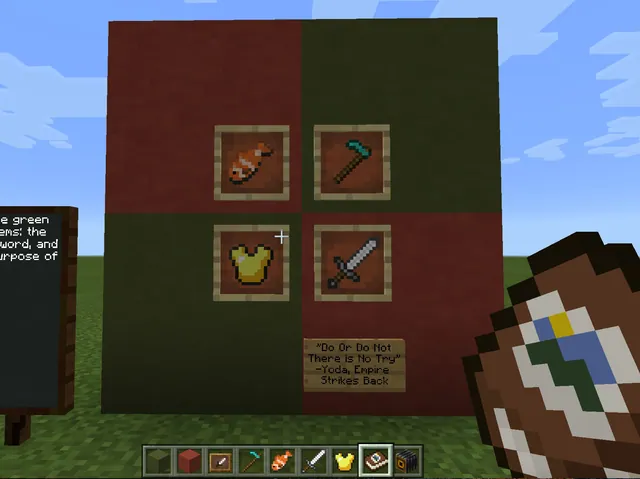
Blocks and items used in this lesson


Key vocabulary
- Origin
- The point (0, 0) where the perpendicular horizontal and vertical axes meet.
- X-axis
- The horizontal number line on a coordinate grid.
- Y-axis
- The vertical number line on a coordinate grid.
- Ordered Pair
- A pair of numbers, written as (x, y), indicating a specific location on a coordinate plane.
- Quadrant I
- The section of a coordinate plane where both x and y coordinates have positive values.
Before class
Lesson sequence
Suggested timing: about 60 minutes in total.
- Coordinate Introduction10 min
Review the components of the first quadrant, identifying the origin at (0, 0) and the perpendicular x- and y-axes. Demonstrate how an ordered pair dictates moving horizontally first and vertically second.
- Paper Planning15 min
Provide graphing paper and ask students to draft a simple pixel-style art design. Have students write down the ordered pairs that define the key blocks or outlines of their creation.
- Grid Construction20 min
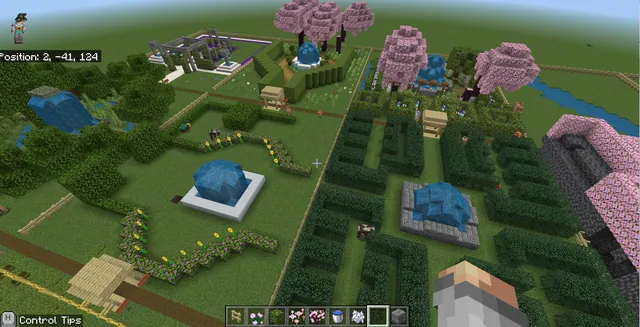
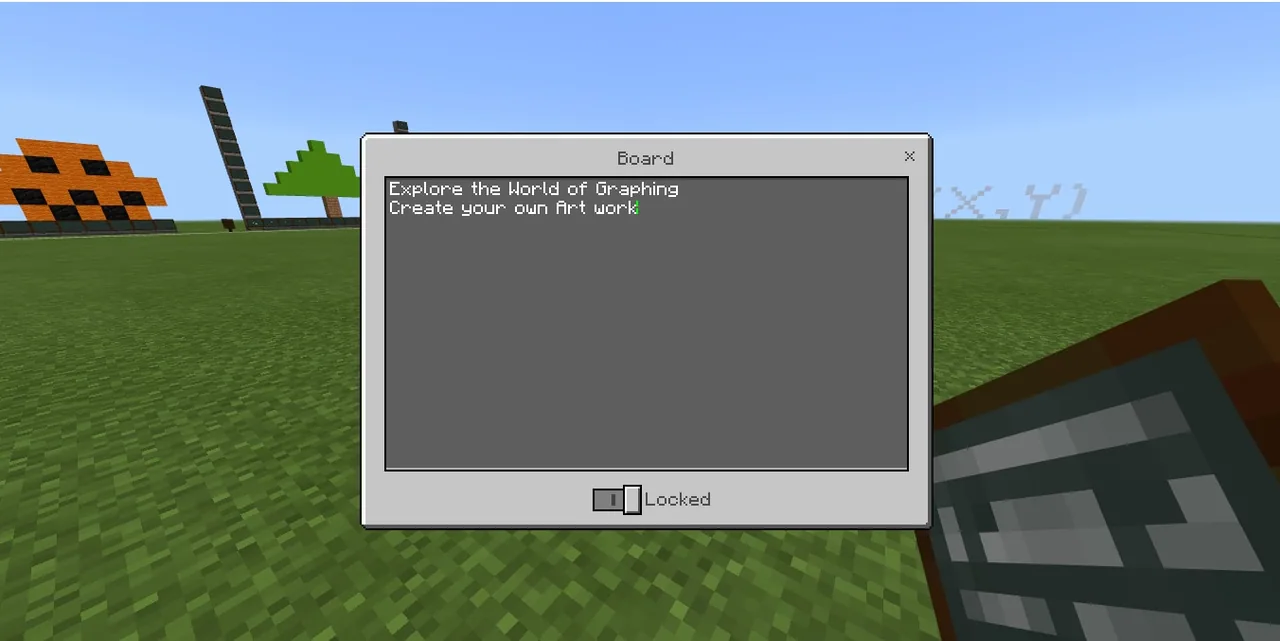
Students log in and build their artwork on the in-game grid, placing blocks at the exact coordinates corresponding to their written ordered pairs.
- Coordinate Exchange and Review15 min
Partners trade coordinate sheets and read the ordered pairs to verify that the digital blocks match the intended mathematical positions, discussing any misplaced points.
Assessment: success criteria
- Accurately identifies and writes ordered pairs from plotted points.
- Correctly plots points on Quadrant I using horizontal and vertical movements.
- Builds a digital artwork that aligns with the prepared coordinate list.
Differentiation
Provide a pre-labeled grid with color-coded axes to help students keep track of x and y directions.
Have students expand their designs to cover a broader coordinate range with more complex patterns.
Knowledge check
5 questions to check understanding after the lesson. Tap an answer to see if it is right; the score appears at the end.
1What term describes the point (0, 0) where the axes intersect?
Answer: B. The origin is the intersection of the perpendicular axes where coordinates start at zero.
2In the ordered pair (5, 8), which number shows the distance along the horizontal axis?
Answer: D. The first number in an ordered pair represents the x-coordinate along the horizontal axis.
3Which quadrant contains points where both coordinates are positive?
Answer: A. Quadrant I is the region where both the x and y values are positive numbers.
4When graphing a point from the origin, which movement is made first?
Answer: C. Coordinate convention requires traveling in the direction of the horizontal x-axis before the vertical y-axis.
5What is the primary role of using graphing paper before building in the game?
Answer: B. Graphing paper allows students to plan their artwork and identify the exact ordered pairs they will build.
Resources
- Lesson package (.zip)Everything the author attached to this lesson in one download.
- Graphing WorldDownload graphing World
- Graphing PaperStudents can design their art work with this document.
Frequently Asked Questions
What materials are necessary to run this lesson?
Teachers need standard graphing paper for drafting and devices with Minecraft Education installed for the digital plotting phase.
Can this lesson be used across multiple age groups?
Yes, the lesson scales well across primary and middle grades by adjusting the size of the grid and the complexity of the art designs.
Adapted from Graphing World by Bobby Brian Lewis on Minecraft Education, last updated Jan 25, 2019. This classroom version, the timings and the quiz were written by 9Minecraft Education.